Episode Transcript
[00:00:00]
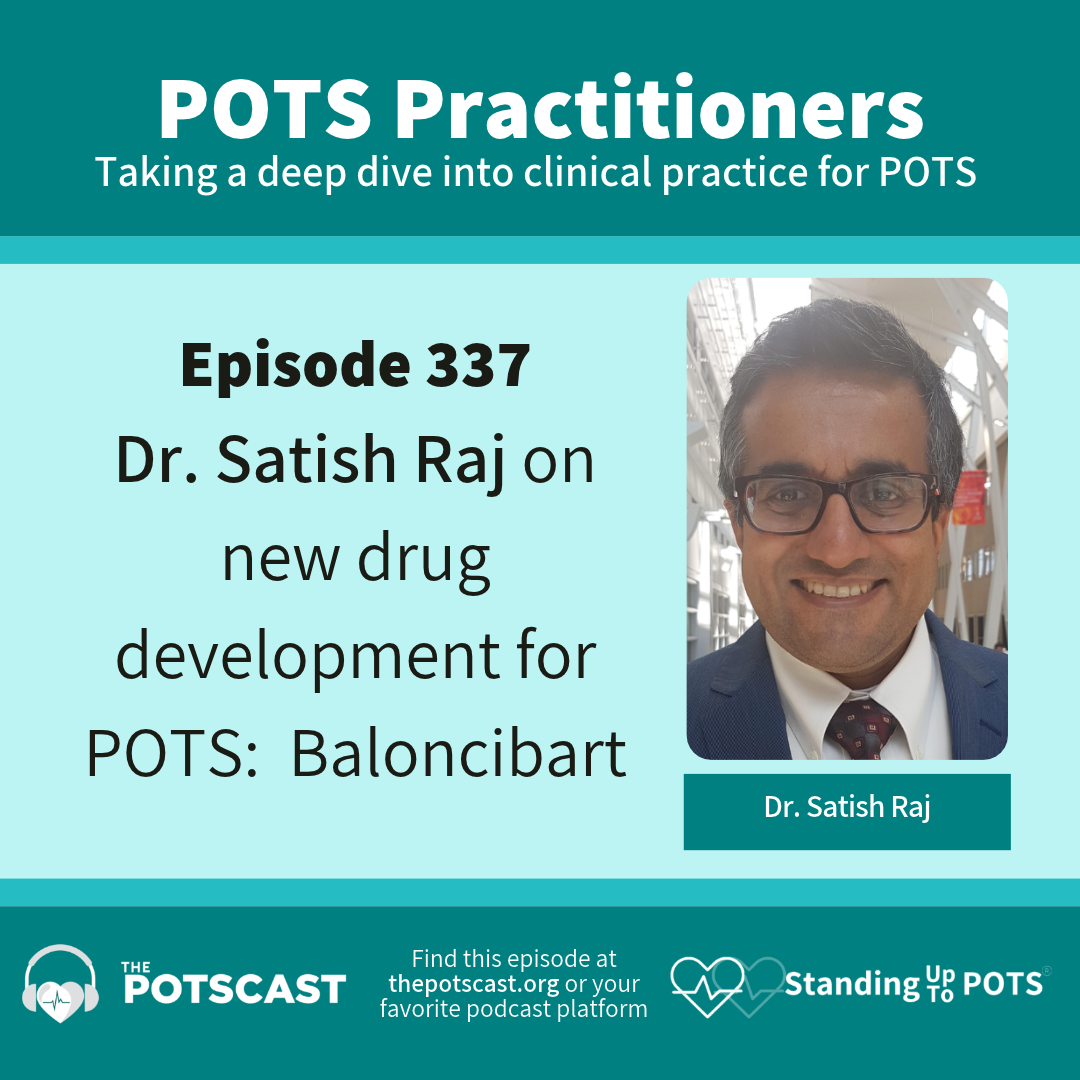
Jill Brook: Hello, fellow POTS patients and lovely people who care about POTS patients. I'm Jill Brook, your horizontal host, and today I am delighted to welcome Dr. Satish Raj, one of the very most influential researchers and physicians in the world of POTS and autonomic disorders. Dr. Raj probably doesn't need an introduction in this community, but for anybody who may be new here, he is professor of cardiac sciences at the University of Calgary, chief of the Cardiac Arrhythmia Clinic, and founder and medical director of the Calgary Autonomic Investigation and Management Clinic.
His pioneering research has helped shape our understanding of POTS, including his landmark work on the renin-aldosterone paradox, demonstrating that patients with POTS can have abnormally low blood volume without the expected hormonal response to conserve salt and water. He also led influential clinical trials showing that lower doses of propranolol can actually improve [00:01:00] POTS symptoms more than higher doses.
And these are just two of many, many examples of how his work has been instrumental in advancing both our understanding and our treatment of POTS. Dr. Raj is also a past president of the American Autonomic Society. He serves as medical advisor to several POTS groups, including POTS UK and Dysautonomia International, where he was named 2014's Physician of the Year.
He helped create the expert consensus statements on POTS, and I could go on all day about his contributions, but suffice it to say that for all of us who have POTS, our lives are impacted and better for the work that Dr. Raj has done. Dr. Raj, welcome, and thank you so much for being here today.
Dr. Satish Raj: Jill, thanks for having me and, and for the excessively kind introduction.
Jill Brook: Well, I don't know. I don't think so. I mean, even last week at the American Autonomic Society's annual meeting, you and your colleagues had some research findings to reveal about [00:02:00] something called, I think, Baloncibart? What is that?
Dr. Satish Raj: Yeah. So this is a, a new it's a new drug. It's actually a, a peptide, an antibody that's been produced by Regeneron, a company that does a lot of genomics antibody work. And it is what I'll say is it's the first drug that I know of that's actually been developed and going through the drug development process to get approval targeting POTS, right?
There may be other things that they want to look at, but right now that's actually, you know, the lead, the lead disorder, if you will. And that's, in my mind, the first time this has happened. Usually, when we've done drug studies, it's taking drugs that have been around 40 or 50 years for other things and trying to repurpose it and see if it can work.
So, so I think it is a big, it's, it, you know, it's a big advance that we've, we've finally hit the radar of, of the pharmaceutical industry and companies that have, have the resources to maybe move the needle forward, right? To move the needle in the right direction. Resources, not [00:03:00] just in terms of money, but in terms of scientists, smart people, people that know how to get a drug through to approval, right?
All of these are, are skills that you know, are, are beyond sort of any one individual. So I think it, it was quite exciting.
Jill Brook: Yeah. Yeah, and this is kind of a big deal company too, right? They made the monoclonal antibodies during COVID.
Dr. Satish Raj: They, they, they do lots of antibody stuff, but President Trump, I remember, you know, early on, there was a, I think for the first wave is my understanding, they had an antibody that was very effective. I know COVID's gone on for a while, and we've sometimes forgotten, but this is the wave that was landing people in the ICU and had a high early mortality rate.
And they had an antibody that was apparently pretty effective if you got it. And when President Trump got sick in his first term you know, he actually did receive it. I don't know if they're still selling that. My understanding is that as COVID has mutated and evolved that antibody is less effective.
But, but they have lots of things on the go. It's not a, it's not a little startup, right? It's, it's a company that is a going concern.[00:04:00]
Jill Brook: So I think some of us when we think of monoclonal antibodies, we think of like treating a virus or an infection or something. But is that how this Baloncibart is intended to work, or how, how would this help with POTS?
Dr. Satish Raj: So I guess, you know, let's take a step back and, and, and you, you alluded to the fact that some of the work we did you know, years ago at Vanderbilt was, you know, trying to understand blood volume regulation in POTS. A high percentage of POTS patients, when you formally assess the blood volume, were found to have low blood volume, right?
Lower than what you'd expect. And I don't wanna make it sound like, you know, it's like fifty percent lower. We're talking about, you know, maybe ten, twelve percent. In one early study, it was, I think, twelve or thirteen percent. It may be a little less. You know, if you wanna convert that to, you know, absolute volumes, we're talking about two hundred or two hundred and fifty milliliters.
So less than a can of Coke, right? But the key is not the volume in a can of Coke. The key is getting that in the right space, in the blood space. And that's a lot trickier to do, right? It's easy to drink a [00:05:00] can of Coke, but most of that fluid doesn't go into the blood space. And so, you know, years ago, we did some work with renin-angiotensin regulation, but there are other systems that help regulate that.
And one of the systems is, is a natriuresis system. So natriuresis is the getting rid of sodium and the, like, the kidney getting rid of sodium. And you know, the reason we tell POTS patients to eat a lot of salt is because in the kidneys, the water follows the sodium, right? So when we're trying to pickle you, if you will, by taking a lot of salt and water, we're trying to get you to get the salt in and then use that sodium in the salt to help the kidney hold onto the water you're drinking to retain the fluid, right?
To get the blood volume up. So there's a, you know, a series of hormones in the body that are natriuretic peptides, right? And, and you know, despite the names I'm gonna tell you, they're actually all cardiac related, right? So there's one called ANP or atrial natriuretic peptide that, you know, early science showed that if you actually stretch the atrium or you cause a, an SVT, a supraventricular tachycardia, [00:06:00] your levels go up as the atrial wall is stretched, and that causes you to pee.
In some patients, when they have SVTs, they actually have told me they, they wanna pee, and this is actually the mechanism of it. The reality is that's not measured as much clinically day-to-day in cardiology, but its brother brain natriuretic peptide or BNP, and even though it says brain, it's actually cardiac.
It responds to, you know, more ventricular wall stress. So in patients with heart failure, for example, who are fluid overloaded and stressing the, the, you know, the walls of the heart and stretching it out, that causes the body to release BNP or brain natriuretic peptide. And what that peptide does is that it goes and finds its receptor, and when it finds a receptor, it's saying, "Hey, you need to get rid of some of the sodium that we have and pee out more of the sodium, and then the water will follow to lower, lower volume."
BNP itself is used as a marker every day in millions of people in, on cardiology wards in the emergency room. It's a very [00:07:00] standard biomarker these days. So its role is, is, is fairly clear. So what Baloncibart is, is a peptide that blocks the receptor that ANP and BNP would normally go and bind to to say, "Hey, we need to pee out the sodium, and we need to lower our volume."
Right? So it's blocking the receptor, natriuretic peptide receptor one or NPR-1, blocking the receptor that would receive these hormones that we all have saying, "Pee more sodium." And so the end result, you would think, if it works the way we think it does, is that you would pee less sodium, and you would potentially expand the blood volume, right, which is something we try to do, we've been trying to do for years with other means in terms of taking more salt and water and things like that. It also may have some direct vascular effects where it causes a bit of vascular squish, right? So it's not probably just a volume effect. It probably does a bit of a squish effect as well.
But that's still being probed a little more. But, but its mechanism of action is to block this one [00:08:00] receptor. So it's an injectable drug. In the phase two study that was presented last week, it was, you know, a single active dose drug and patients were followed basically for a month, but the primary endpoint was a week later.
And you know, the results as you've heard, have been fairly positive, and we can talk more about that. But the, the consequence of that is that the next phase of study, a phase three study, which is a larger study, and one that'll go on for six months. So it'll involve multiple doses, like one dose a month, but for six months.
And if that's positive, then, then that's the data that the company will take to the FDA and, you know, hopefully Health Canada and the European Medicine Agency to try and get approval to make this available to the public.
Jill Brook: Wow, that is so exciting. So can we dig in a little bit more into what they did find in those phase two results? I think that you measured a number of different things, and do you wanna, you wanna share sort of exactly what you found?
Dr. Satish Raj: Yeah. So I mean, the primary endpoint [00:09:00] was a reduction in orthostatic tachycardia. So the, a reduction in the increase in heart rate from lying to standing at one week, right? So they say day eight, but day one was the injection day, so one week after the injection.
And then they also looked at other things. They looked at blood pressure. They looked at outcomes out to 28 days, right? And this was at a time when patients were discouraged, and by discouraged, forbidden from taking other heart rate affecting or blood volume affecting drugs, right? So that was sort of a clean period of time.
And, you know, they, so they found the heart rate was reduced. That was, you know, good. Worth noting that we don't think that Baloncibart is primarily a heart rate-reducing drug, right? The presumed mechanism of action is similar to when we did our dietary salt study, you know, a few years ago at Vanderbilt.
You know, we gave salt and then we looked at the heart rate. But, there are actually a few steps in between, right, that was how the salt worked, right? So taking in the high salt [00:10:00] diet versus the low salt diet actually increased, in that study, the liquid part of blood, the plasma volume, right?
And then that decreased evidence of sympathetic nervous system activation, and that was measured biochemically using upright norepinephrine levels or standing norepinephrine levels. And then that, we think, lowered the standing heart rate. So the blood volume caused the sympathetic nervous system, the increase in blood volume normalized it a bit, right?
So the stress that caused an increase in sympathetic tone, you didn't need as much, so that lowered, right? And then, then that didn't drive as much of a high heart rate on standing up, so that lowered. So that was what we did with the salt. And basically we think there's a similar mechanism here. And I say we think because the blood volume wasn't formally measured but they did look at some indirect markers that were consistent with that.
So for example, if you look at hematocrit, so the, you know, you get a column of blood, and you see, well, what percentage of it is red cells. And in blood, you know, there are lots of important things in blood. We talk about [00:11:00] white blood cells and cytokines and things like that.
It turns out they don't take up a lot of space, right? So if you, if you look at a tube of blood and you're just saying, "Okay, from a volume point of view, what makes up blood?" It's red cells and liquid stuff, right? And the liquid stuff's the plasma, right? And, and so salt would work on that. And so the idea is if you increase the plasma and if you prevent the peeing out of, you know, water and sodium, you know, that's the part you'd expect to increase quickly.
And so what they saw was that they didn't directly measure it, that involves more complicated tests. There are plans to do that in the next study, but didn't do that. But they looked at hematocrit. So you take a bit of blood, and you spin it, and you see, well, what percentage of it is red cells?
Well, if you increase the plasma and your, your red cell volume doesn't change, then the percentage would go down of red cells. And that's what they saw, right? About, I think it was eight to 10%, I think was the number that I recall, drop in hematocrit, right? Obviously, the other way you could drop hematocrit is by, you know, destroying red [00:12:00] cells, but there's no evidence of that, right?
So we think that's actually a sign that the plasma volume increased. The other thing they looked at was actually, remember I mentioned that the brain natriuretic peptide or BNP is a clinically available test in basically every hospital. And so they looked at a metabolite of that that's a bit more stable.
The problem is it's, it's available, but it's, it's the, the BNP gets destroyed fairly quickly, and so it's hard to measure. But there's something called NT-proBNP, a metabolite of it that's lasts a little longer, so you can track it. They looked at that, and those levels went up, right? So again, in heart failure, when patients get fluid overload, those levels go up.
The levels didn't go up to ridiculously high dangerous levels, but the, you know, they went from ridiculously low to, you know, high normal, even a little bit high, right? So again, that's consistent with a blood volume expansion, right? So not proven that the plasma volume or the blood volume increased, but findings that we did look at, that were looked at in the study, were consistent with that.
And then they did look at the norepinephrine levels on standing, and those [00:13:00] went down, right? So similar to what we did with the dietary salt, the findings are concordant that with a strategy of trying to increase the blood volume, that downstream we lowered sympathetic tone, and then that lowered the heart rate on day eight at the one-week time point.
Right, so that's, that's the physiology bit, right? And that's, you know, I'm a human physiologist at heart, and that's, you know, gratifying that it did all those things. You know, patients care a little bit about the heart rate changes 'cause they can measure that, right? I mean, these other things are theoretical, right?
I mean, they're not measuring their blood volume. These things are theoretical to them. What most patients I've met really care about is, well, am I gonna feel better? Am I gonna function better? Am I gonna be able to do more? And so one of the challenges that we've had in the POTS space is how do you measure that, right?
We have tools, some of which we stole from the autonomic failure group of patients with orthostatic hypotension that developed for that. But in some more recent, the COMPASS-31, for example, and there's the Malmo scale, which Artur Fedoroski's group [00:14:00] when he was in Malmo, not surprisingly from the name, you know, developed a few years ago.
But these aren't, you know, perfectly validated tools, right? Tool validation is a complex thing. So one of the things Regeneron did, you know, is that they went to the FDA and said, "Okay, well, what do you wanna see in a POTS tool that, that would convince you that it's robust and real and our findings are real?"
And so they worked with them and created a new tool called the Living with POTS questionnaire. And so that was used in the study and there are different domains, but, like, the, the, the first domain is they looked at you know, orthostatic intolerance symptoms. And, you know, the patients that received the active drug, you know, their symptoms decreased.
Interestingly, the peak drop was actually at fifteen days. So two weeks out, not one week out. It was on a little bit of a lag. And that could have more complicated explanation or a simple explanation. The simplest explanation is the question said, "In the last seven days, rate these [00:15:00] things." Like, how did you feel, right?
And so it may take, you know, the first seven days are starting from when you got the drug and, like, the minute after you got the drug. So there's a bit of a lag in terms of the way we ask the questions. But, but, you know, at fifteen days, there was a significant decrease in orthostatic intolerance symptoms, which are obviously the symptoms that are critical to the diagnosis of POTS.
But then they also looked at issues around you know, function and activities of daily living and, you know, so what you can do, not just the you know, one is the symptoms, then there's the how you feel more globally, and then there's the are you able to do more. And, and each of these, they showed significant improvement.
So everything, you know, sort of fell in line the way you'd want it to in the sense that the physiology responded, the heart rate went down. But, but it's not just the heart rate went down. They're able to show the patients actually felt better if they got active drug as opposed to placebo.
Jill Brook: Wow. And this was in 82 patients, is that right? Something like that?
Dr. Satish Raj: Something like that, 81, 82 [00:16:00] patients, right? So there were three groups, right? So it was a two-to-one randomization, so two different drug doses. There was a lower dose, a higher dose, and then a placebo dose. And you know, what they found is that for some of the findings, the higher dose effect seemed to last out to 28 days, while the lower dose, you know, you got the effect in a week, but by time you got out to 28 days, the effect was, was gone or going away heavily.
And the vision is that this would be a monthly injection. So they're sort of tweaking the dose and trying to figure out the optimal way to do that, right? Obviously, what you want is, you know, a dose that's going to, you know, block, block the receptor, you know, evenly but not, you know, you give too much of anything, you, you increase your risk of side effects without the increased potential benefits.
You wanna sort of find that middle zone where there's enough that you're blocking the receptors you need to block without getting off-target effects.
Jill Brook: Wow. So this is amazing. And so were there any crazy side effects?
Dr. Satish Raj: Well, I'm not sure [00:17:00] about crazy, right? There were, there were a lot of side effects reported, right? But that's, you know, I think expected for this patient population because it's a very symptomatic patient population. Most were mild. There were no severe side effects, right?
So it turns out in, in drug development, the word severe and serious have two very different meanings, right? So severe is, you know, in terms of how bad that effect was, but serious, serious adverse events or treatment-related adverse events have implications about, you know, obviously dying is a serious one, but ending up in hospital, staying in emerge for longer than a certain amount of time, things like that.
So there were two serious adverse events. One was actually, when they looked back, was a vasovagal syncope episode, right? So that probably relates to underlying stuff. But in terms of the testing, they were in emerge long enough that it triggered into the serious category, but it was deemed to be moderate severity, right?
So remember, severity and serious are different things. And the other was a headache, you know. And obviously many [00:18:00] of our patients are prone to headaches and migraines, and so not surprisingly, there were headaches seen in the group. But that may be real. That's part of why you need the larger phase three studies is to see, you know, is the trade-off here that patients will get more headaches or not.
I think it's unlikely that patients will get more syncope. So when we looked at syncope, for example, in the highest dose in the, in the placebo group and the lower dose group, there was a reasonable rate of syncope that was-- I'm trying to think if it was, if it was significantly lower or if it was absent in the highest dose group, right?
So which sort of makes sense that if you're expanding the volume more, that you may have less vasovagal syncope. But conversely, in the active drug groups, I think there was more headache than in the placebo group. So that, that could be real as well. And then there was a hodgepodge of, you know, POTS patients feel unwell, and it's always difficult to say if that's the POTS or if that's the drug.
But most of those other things were pretty evenly spread across the placebo versus the two dose groups.
Jill Brook: Wow. So this sounds really [00:19:00] promising so far. I mean, how many phases are there? So this was phase two.
Dr. Satish Raj: Right. So phase three is, is the phase where people go, assuming the study works well in phase three, where you go to the regulators. And so that's, you know, if the drug, if the drug does well in the phase three study, the plan, presumably we would go to the FDA and try and get approval.
There are phase four studies, but those are post-market studies, right? So sometimes drugs are on the market, right? But the, you know, obviously each phase gets bigger, right? So this phase had 82 people. There's several hundred people planned in the phase three study. But even that's small compared to the US population or even the US population with POTS, right?
So once you get on the market, then you're exposing your drug to thousands and thousands of people, just any drug. And so sometimes there'll be post-release or post-market surveillance studies and things to learn more about the drug, learn about side effects, learn about specific subgroups, things like that.
But phase three is the important one because that's what you need to, that's what you [00:20:00] need to go to the FDA.
Jill Brook: Okay. And is there any idea, like, what sort of a timeline people could expect on that kind of thing?
Dr. Satish Raj: The hope is to start the phase three study sort of in the first half of 2027, so next year. I think they're tweaking the protocol right now. They've already identified a lot of investigative sites around the world, right? Obviously, many will be in the US, but there'll be some in Canada, some in Europe, some in Asia, Australia.
They are really trying to enroll a lot of patients, and they wanna do it quickly. I don't know when they'll go to the FDA. Obviously, that depends on getting the study done. And you have to start before you can finish. But I, but I know that there's a, a sense of both excitement and urgency, right?
If this drug is working, I think from the patient community, I think you want it out there sooner rather than later. And I think the company, you know, based on what they've seen, would like to be able to be done sooner rather than later.
Jill Brook: So we always hear about how POTS is a heterogeneous disorder and there's different kinds or different causes. Is [00:21:00] there any idea yet whether this might help, like only a subset of patients, or would you expect it to help most or any particular ones?
Dr. Satish Raj: Yeah. So I'm not a, you know, a huge fan of subtyping in terms of the labels, but, but certainly, you know, clinical features can matter in terms of some presentations and the such, right? But I mean, in this study, that question can't be answered, right? I mean, the, the criteria involved meeting accepted criteria for POTS and having the heart rate increase at the time of the screening visit and being able to be off other drugs that may affect heart rate. So that, that may limit things to some extent. You know, in a larger study, there may be opportunities to look at features to see if some are responding or not, right? Anytime you start looking at subgroups, obviously your statistical power goes down. So in a larger study, you may have enough power than a subgroup, you can still get a good signal.
But if, you know, we had like, you know, twenty-seven or twenty-eight patients in each group here, right? If you start looking at subgroups, you're looking at, you know, five, six [00:22:00] patients. It's hard to, hard to discern.
Jill Brook: Yeah, yeah. Now I know you used to work for a long time in the US. I don't know how it works in Canada, but what would it mean to have an FDA approved drug for POTS?
Dr. Satish Raj: I think it's huge, right? I think it's huge that, that people are even thinking about it first, right? That's, that's a change. Like 10 years ago, when I give talks, I, you know, you declare conflicts. And one of the things that I point out is that 10 years ago, I had no conflicts because no one in industry cared, right?
I mean, that's, you know, we would do our own little thing and find the drugs, you know, that have been around forty, fifty years that were generic that, you know, we could relatively cheap that we could sort of sit and repurpose and sort of see, right? But no one really cared. And that's, that's really what's remarkable and different here, right?
This is the lead, right? I think after this study, there's, you know, other things the company may be interested in looking at this for, see if this drug could help other things. But, but POTS is, is, is this is the lead study. This is the study [00:23:00] that, that I don't think there are other studies further along, you know, looking at anything else with this, with Baloncibart, right?
So the first thing is the, the interest. But one of the challenges, and, and I hear, I hear this even like in the last week I've heard this, that there's nothing that helps with POTS. And that's based purely, and I think that's wrong by the way, but it's based purely on the argument that there's no FDA-approved drug for POTS, right?
And sometimes that's taken to the next stage of nothing can be done, right? And I think that's sometimes an argument used by physicians to dismiss the patients and is an argument for why these patients don't need to be seen or seen by them, right? Because there's nothing to do. And, you know, what's the proof? There's no FDA-approved drugs. So, you know, obviously it's, it's huge to be able to change that. That doesn't mean that we're gonna get rid of the other drugs for which maybe they're off-label altogether, right? But we know that even with the drugs that we have, the drugs that we have available, they all have limitations, right?
I mean, not everyone you know, [00:24:00] certainly not everyone can tolerate all the drugs. I think very few people tolerate all the drugs, right? But, but, you know, some people find drugs that work for them. Others find drugs that work, but at the cost of side effects they'd rather not have. But they sort of put up with it, and others sort of say, "Listen, I can't take these drugs at all."
And you're sort of left going, throwing up your hands going, "Well, we don't have any other choices." So we really need treatments. We need more treatments. We need effective treatments. We need more options for our patients. And so that this is sort of, I think, at least pointing in the direction of all of those things.
Jill Brook: Yeah. And I just have to laugh because I know that, like, in the bio world of investors and such, this has already made huge news, and I've seen tons of press releases. So I feel like it's already doing lots of POTS awareness raising just in the world of people who invest in pharma companies.
Dr. Satish Raj: And I know you know, this is related not to Regeneron, but you know, Regeneron, as, as mentioned, is a company with means, right? There have been other companies that have been interested in POTS, but they're typically startups, right, where they [00:25:00] have a cool idea and maybe a cool molecule that may be able to be applied, but no, no cool money, right?
And that's the thing about startups. They have to go find money, and that means going to venture capitalists and, and other folks that have money and selling them on it. And, and I know that some companies have had a challenge raising money to study, to develop a drug or, or study it in POTS because there's a sense that, you know, both ways, there's a sense that, you know, well, nothing can be done. There's a sense that people just magically get better. They outgrow it, and they just get better. There's a sense that there are all these drugs out there, and basically everyone is well treated. You know, all of which I think are untrue statements, right?
And I think this changes the paradigm a bit.
Jill Brook: Wow. Well, Dr. Raj, I know you need to run, but thank you so much for your time and for helping us understand this news research and for your many years of dedication to improving the lives of people with POTS and, and for being involved with this [00:26:00] project. We can't wait to follow it and see what happens next.
Dr. Satish Raj: Wonderful. Thank you for having me, Jill.
Jill Brook: Okay, listeners, that's all for today.
We'll be back next week, but until then, thank you for listening, remember you're not alone, and please join us again soon.