Episode Transcript
[00:00:00]
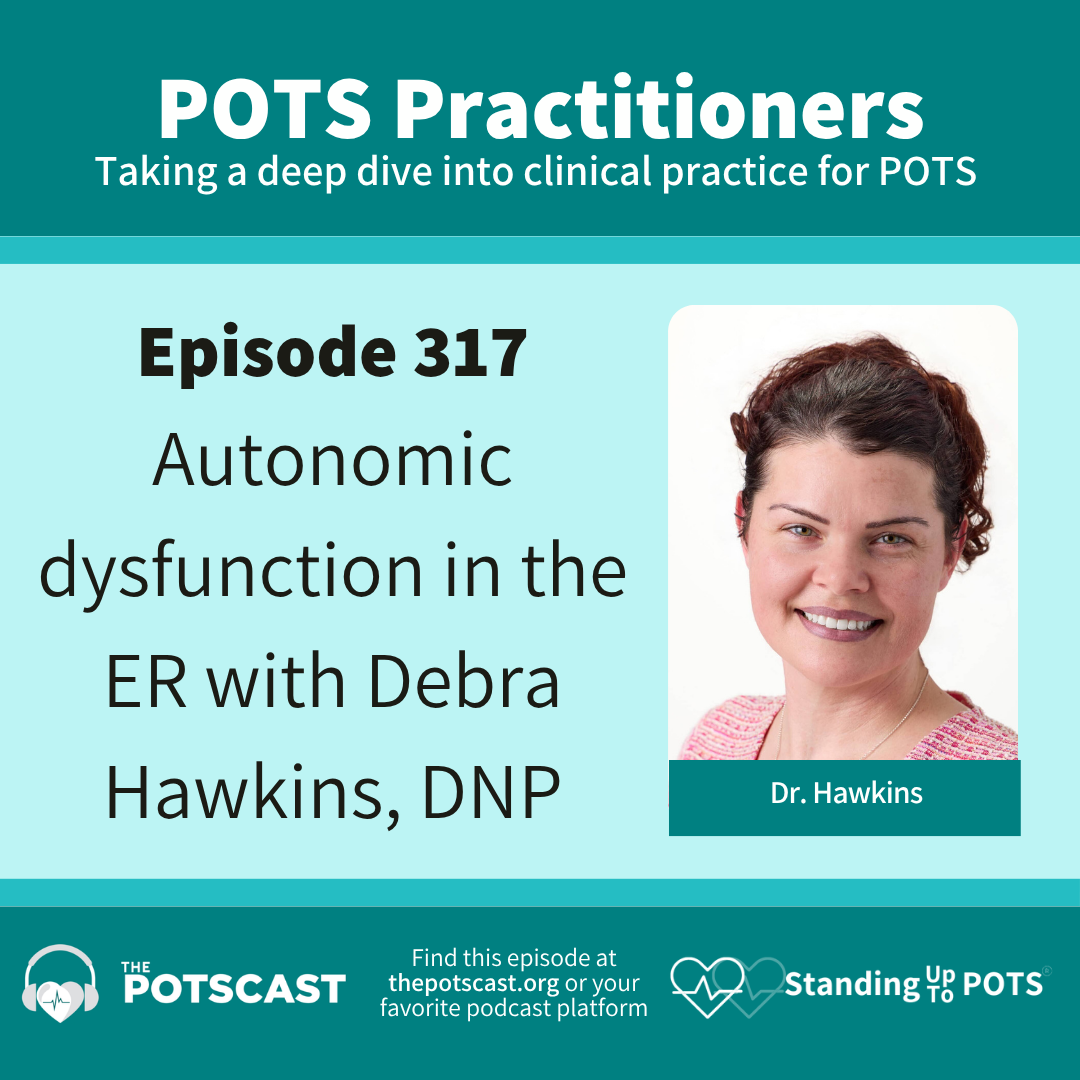
Jill Brook: Hello, fellow POTS patients, and beautiful people who care about POTS patients. I'm Jill Brook, your horizontal host, and today we're learning from a specialist in autonomic dysfunction and emergency medicine who did not always recognize POTS and related conditions in the ER. She's going to share her journey and practical advice with us, so I'm honored to have today's guest, Debra Hawkins, a doctor of nursing practice and cardiology provider at Cardiovascular Health Clinics in Oklahoma. With over a decade of experience in emergency and acute care, including time in the ER, Dr. Hawkins now focuses on cardiovascular and autonomic conditions and helps advocate for patients. Dr. Hawkins, thank you so much for being here today.
Debra Hawkins, DNP: I really appreciate you inviting me, and I'm looking very much forward to talking to our patients.
Jill Brook: Yeah, me too. Maybe you could start by just telling us a little bit more about your background, what [00:01:00] got you into medicine?
Debra Hawkins, DNP: So I always knew I wanted to be in medicine. Even as a little girl, I always played doctor. So I kind of already knew what I wanted to do. Emergency medicine kind of just came throughout my career. I was an RN first, of course, before I became a nurse practitioner. And so I ended up as an ER nurse and I absolutely loved it. I loved the fast pace and just the population that you would meet. So I went ahead and started out as an ER provider before switching over to cardiology. I've been in the medical field now for almost 13 years. Most of it has been in rural Oklahoma.
So I think it's a really interesting environment because you get a lot more advanced conditions and more complexity because people just, they don't go to the doctor as often as they probably should. By the time you see people, you know, you're not just dealing with one issue, you're often dealing with a handful of issues, which is why autonomia kind of fell into my comfort zone, because of the complexity.
Jill Brook: Oh, okay. And I have to laugh because [00:02:00] your logo for your cardiovascular clinics is a little heart and a little brain, and they both have boxing gloves on and they're boxing against each other. So as soon as I saw that, I was like, oh wait, these people really get it. Can I just ask like, how that came about?
Debra Hawkins, DNP: So, my overseeing provider is Dr. Marcus Smith, and he originally was the one who started having patients that were seeing him for POTS, very young patients. And so then he took an interest and now he is the guy to go to in our region of the United States. So of course the doc started getting so many patients.
We have over 2,500 POTS patients. So he was like, well, I really need to bring in someone that I can train to help me with this, this many patients. So, when I first got hired on, I was just cardiovascular and, you know, I was just doing all the heart stuff and then I'd occasionally see POTS patients. And then he kept getting feedback, he was like, you know, the POTS patients you say, say you understand 'em and you listen. And then he just got the idea of, you know what, I think you could be really good with this [00:03:00] population. And so we started to specialize and I started doing a lot of research going to dysautonomia national conferences. And then next thing I know, I have a new specialty.
Jill Brook: Wait, can you say how many POTS patients you said are there again?
Debra Hawkins, DNP: We have 2,500. Probably our farthest state that we have a patient that comes down to see us is we have one that's from one of the Dakotas, I think it's North Dakota, who comes all the way down to see us. It's a little disheartening when you think about that because quite a few of our patients are not local.
They just could not find care or people that would really listen to 'em in their area. So they started to Google and next thing you know, they found this doctor in Oklahoma and they could get into us a little bit faster than some of the other places. So they drive lots and lots of hours and miles to come down and see us.
And it's always such a surprise because they just can't find that kind of care in their, their own states, which is sad, but also surprising. So it gives us the opportunity to meet a lot [00:04:00] of new, interesting people.
Jill Brook: Yeah, I was gonna say 'cause 'cause you hear about sort of like these meccas, but they tend to be on the west coast or the east coast or maybe near Phoenix. And so yeah, so you are the Oklahoma mecca for all of those states in that area.
Debra Hawkins, DNP: It definitely seems that way. Yes, we get, we get quite a few referrals. I wish we could say that we see everybody. Sometimes when we get a few too many, we do have to push people out quite a ways. I think right now we're scheduling till June of, of 2027, and that's with a full-time dedicated clinic. 'Cause that's all I do is autonomia. So my full schedule is autonomia now. And then Dr. Smith still tries to see some of the overflow with new patients, but and so, you know, scheduling all the way out to 2027 when you have a, a full-time dedicated clinic just shows the need.
Jill Brook: Yeah. Wow. Okay, so, so we have a snapshot of where you are now, but the interesting thing was you had mentioned that you started out in the ER and [00:05:00] you hadn't really been trained about this, right? Like can you take us back to when you worked in the ER and what was your awareness of POTS or dysautonomia then and what did, what did that look like?
Debra Hawkins, DNP: Oh, absolutely. And you know, I think the important thing to start is that with all of my education, I became an LPN, first RN, got my BSN, then got my doctorate. Never once was the mention of autonomia or POTS. It could have been in the book somewhere, but never was it an assigned thing to learn about.
And I think it's something that now as providers, like we talk about as in, you know, we never even knew that this existed or we don't even think that they're even talking about this in schools right now. So I definitely think awareness is important. So in the ER, I remember the very first time I had a patient come in and she said that she had POTS, I didn't even know what she was talking about. I just, it was just a scribble on my notepad and we just kept going. One of the other ER providers I asked, I said, she said something about POTS and she was like, oh, that's just a condition where their heart races sometimes. You don't have to worry about this. It has nothing to do with what she's here for. And she [00:06:00] was there for chest pain. And so I remember we just worked her up for, you know, a quick cardiac workup. Oh, you're not having a heart attack, and sent her on her way. You know, never once did we ask questions more about the POTS or you know, really dive into it or even take it for consideration.
It was just something, oh, that's on your diagnosis list. And I think what we started to see was we would have a few more come in with the same type of diagnosis and you know, another fellow provider would be like, oh, just, they just need fluids. Just give 'em fluids and send 'em on their way.
So, you know, you didn't really take the time 'cause you're in the ER, your thought process is, I just have to rule out the emergencies. Anything that's not emergent just needs to go. And I understand more now that that is where all the dismissiveness comes from when it comes to autonomia patients going into the ER. Because they do feel dismissed, and a lot of them don't get the workups that they should because one of these days that chest pain or that shortness of breath could truly be something more than just their autonomia. But there's just so much [00:07:00] dismissal. As soon as that word POTS is said to a provider that knows what they think they know about it, they're like, oh, this is just a POTS flare. Give 'em some fluid, send 'em on their way. And they do, they get, they get very dismissive because, you know, in the next room you might have somebody having a stroke or you're fixing a bone in the next room. And so you're not stopping and even giving kind of the basic bedside care that we should give to patients who are scared.
You know, no chest pain, the first thing we think is our heart. We don't stop and actually explain what's going on, what's causing your chest pain, why this is not an emergency, what your EKG said. And then we're discharging them, just saying, nope, nothing's wrong, and with no education or explanation.
Jill Brook: So that's interesting because yeah, I can see how if you are trained to just only deal with the really hardcore emergencies, I can see that that how many cases of POTS would feel like it was not your problem, but I also see how as soon as that [00:08:00] turns into telling the patient that they're fine and they should go home, that that can cause a lot of pain and suffering going forward.
I mean, so if you worked in the ER nowadays, what do you think would be the ideal way to deal with some of these patients?
Debra Hawkins, DNP: So I think now having more education about what's actually going on for them, education is absolutely the most important thing. I know when I actually break it down to my patients now and explain to them why they're having chest pain, why they're so short of breath, that stabbing sensation, what is actually occurring when they actually have the education to understand now this is when you should go to the emergency room.
This is when it's not normal. These are the steps you can take to see if you can get it to stop. Having that power is huge empowerment when you're able to have the true education and the confidence of somebody telling you, yes, these are really happening. I know you're actually having chest pain.
I know this is very real for you and it's scary and this is why it's happening [00:09:00] and this is why it's not going to kill you. But also while I'm acknowledging that this is what you need to know, to know when it could actually be dangerous.
Jill Brook: Ooh. Can you just say that? I don't even know that. Nobody's ever told me that. When, when do you worry? When do you not, and yeah, why, why is there a stabbing pain? I don't know any of this. I'm excited to hear it.
Debra Hawkins, DNP: So chest pain is very common with autonomias. And of course there's several different types of autonomias, of course. Some of them it's a little bit simpler when you have the hyperadrenergic autonomia and it's a blood pressure related. I always tell people, okay, your first thing is you just need to set down.
Breathe, take your blood pressure, see what your blood pressure's doing. So that is a little bit more of a simpler explanation of what could be going on with that type of population with autonomia. So when we have low blood pressure autonomias, anytime our blood pressure bottoms out, our brain, all of our brains are narcissists. They only care about themselves when it comes to oxygen. So they're gonna make sure that they get all of the oxygen to themselves first, [00:10:00] and then they'll start dispensing it to the organs that they consider vital. And it will be the organs. So a lot of times we see the discolored hands, the discolored feet, the numbness, the tingling.
Our muscles in general are just not getting the oxygenation they should because we are trying to keep us alive. We're trying to centralize that oxygen. So we do, we get some muscle spasms. We get, we get those tremors, twitching, a lot of discomforts especially in the chest area where it really doesn't take much of poor oxygen in the chest muscles.
The cramping there is very uncomfortable and it does kind of feels like a stabbing sensation. I kind of describe it as patients as just like most of us have experienced a Charlie horse in your calf, imagine getting a Charlie horse in your chest. And that is how I picture patients when they tell me I have excruciating pain with my autonomia.
So I talk with them about, we need to make sure what is your blood pressure doing? Is your heart racing too fast? If your heart's racing too fast it is not getting to fill with oxygenated blood. It might be beating 160 times, but it is [00:11:00] not slowing down enough to fill with oxygen and get oxygen around your body.
So a lot of it is poor oxygenation. So we just have to recognize is it from high blood pressure, low blood pressure, or racing pulse? And then do appropriate steps to slow that down. Sometimes it can be as simple as chugging a 16 ounce bottle of water. And it has to be chugged so that we can stimulate the vagus nerve.
And so I tell that to patients too that wanna just kind of have a salt packet. They're like, oh, I just take a salt packet when my, when I feel uncomfortable. But salt actually takes a good 30 minutes to get in your system and have a benefit. But just chugging a bottle of water is one of the first things I tell 'em to do.
When you get that discomfort, sit down, check your blood pressure, check your pulse, chug a glass of water. Then I want you to just wait five minutes and see if you're still having that discomfort. See if your blood pressure's responding. If the chest pain occurs, especially during activity, if you are going up a hill, going upstairs or even maybe trying to do some gentle exercising, and then the chest [00:12:00] pain hit out of nowhere.
Your blood pressure's fine. Your pulse is not extremely elevated, over 110, and the chest pain lasts for over 10 minutes, that's an ER visit. What I, I hear a lot is that people will say, well, I got the chest pain, but by the time I got in the car and everything, it was over, but I still went to the ER. And that's the difficult part.
That's a little bit more of a cue for you that when it's such a short-lived chest pain, when you've had the full cardiac workup and you know that you don't have any underlining cardiac disease, muscular pain can feel very much like a heart attack. So, hydration, resting, and then checking your vital signs is gonna be the key to actually see when this is different from your normal chest discomfort.
Jill Brook: Oh, that's so good to know. And, and that's interesting also, I think you said it kind of fast, so I just wanna highlight it, that chugging, did you say that, that that stimulates the vagus nerve and that's one thing that it does?
Debra Hawkins, DNP: So chugging your water. And it has to be [00:13:00] chugging. Yes, it does help stimulate the vagus nerve, just like as if we were, sometimes when we're trying to stimulate the vagus nerve, sometimes we cause people to gag, but we're not gagging. Just the chugging sensation and the fast water drinking.
And what we find sometimes, especially with neuropathic autonomia is sometimes the vagus nerve is the problem in the first place. You know, of course there's many types of autonomia, so, you know, not everybody will fall into that category. But nerve stimulation can be very helpful with kind of resetting us, you know, kind of reminding our automatic nervous system a big kick in the backside saying, okay, we've got to start working properly.
Let's, let's get back in gear.
Jill Brook: Do you have any other ways that you like to try to help stimulate that? Like do you ever, like recommend people use the the ear clip vagus nerve stimulators, or do you think doing things like chugging is enough?
Debra Hawkins, DNP: So ice packs is a really big one that I think, when I first heard about the ice packs, that was actually from other patients that would tell me, oh, I carry around ice packs and when I first heard about that, then of course I thought, okay, well that makes sense because the [00:14:00] same way when we're trying to slow down SVT or, or fast heart rate we tell people to splash cold water on your face or put ice on them.
And that's the same concept. So putting those ice packs kind of on on their necks, around their carotids, on the back of their neck is even fine. And kind of giving your body a chance to kind of reset can also be very beneficial. And so I do, I have a lot of patients who tell me I carry around ice packs when I'm going somewhere that I'm not gonna, you know, that I know I might have a flare.
And that really does seem to work for them. You know, they'll even come in the office carrying a little cooler with their ice packs. But you know, it works for them. And I think it's great that they have all those tools. I'm always telling patients that this is all about tools in your toolbox to help you live a more productive and normal life.
You have a chronic condition, but that should never set you back from doing anything that you wanna do. So as long as we give you enough tools and you learn how to use them to your full capacity, you should be able to live a completely normal life, even with autonomia.
Jill Brook: Do you have any [00:15:00] other favorite tools or tools that you think are underrated that more people should be trying or what other tools in the toolbox do your, do your patients seem to really like?
Debra Hawkins, DNP: So, of course medications are one of the tools that we do end up using a lot. I do use the CHOP protocol with my patients for exercising. And a lot of my patients when they first come to me are, you know, they're like, if I'm not here, I'm in my bed. I'm not able to do anything. And that's completely understandable.
So it really is difficult to even start any kind of an exercise program. So kind of one of the first things is I tell 'em, I said, well, you know, it has to be little lifestyle changes. So if it means when I go for a walk, even if I can only go halfway around the block I'm gonna go halfway around the block every single day until I can make the full block. For cardiovascular health, I tell them, you know, I don't want you to do stairs. I don't want you to have that episode on stairs. So I talked to him about, you know, on a good cool day, especially in the morning, finding a park with a hill or an area where [00:16:00] just have a, a very slight incline and start doing that because even those of us that don't have autonomia taking an incline, sometimes you realize, oh my gosh, I'm getting a little out of breath just from this small incline.
So that's a great way to get some cardiovascular slowly going. And you know, even if it's something that they can only do for two minutes a day, it just has to be. It's all about still doing that every single day. Pushing yourself just a little bit more. If you get symptomatic, stop doing it.
You're done for the day. Then tomorrow, do it the same amount of time and see did I get symptomatic with this five minute workout? No, I'm not. I'm gonna go ahead and go another 30 seconds or another minute and see how I do. When you keep pushing yourself past symptom initiation, that's when we cause days worth of recovery need.
So as soon as you, you start to notice, okay, I am starting to feel a little funny, I'm starting to get a little dizzy. My heart feels it's racing more than what feels comfortable for me. Stop, you're done. You already did what you needed to do for the day to kind of kick yourself into gear. So, I'm really big on the [00:17:00] exercise, which I think is one of the biggest conversations that I have with patients. And they do seem to get a very discouraged. I know a lot of provi, other providers and other specialties have probably told them, well, you need to exercise more.
Or you know, lose weight. Or, you know, you're just being lazy. And I've actually had patients tell me they have had specialists tell them you're lazy. And it, it's shocking when you hear those things 'cause you just can't imagine people being told that they're overweight or that they're lazy and just completely dismissing 'em.
Or I think the biggest thing we hear about is it's anxiety. Every single person I see comes to me with an anxiety diagnosis. Now, do they have anxiety? Well, I would have anxiety too if I was getting chest pain, if I felt like I was gonna faint all the time. So I'm sure there is some underlying anxiety, but anxiety is not causing all their symptoms.
It's not causing them to faint. So, there's just so much of a culture of dismissal, and lack of trust with our providers, because some people just are not kind. And it's sad to say that in this profession to, to acknowledge that a lot of people are [00:18:00] being dismissed to a level where you, they come in defeated into my office, and the moment I simply listen, they start crying. And, you know, and it's heartbreaking. They just simply needed someone to acknowledge that what they're feeling is real, you know, that they're not crazy. I, I could, I probably have a handful of patients that have literally told me that they were suggested to see a psychiatrist because they were so dismissed. You know, and so it's, you know, I'm getting emotional just talking about it because, you know, when you have a patient break down and just tells you, and they're thanking you just for listening.
As a provider, you're thinking this is the bare minimum that every provider should be doing, listening to you, acknowledging you, and believing you. So I think in that aspect you know, telling hard truths, like, hey, we gotta exercise, we really do, even if it's little bits. Sometimes we do have to say, you know, I know you want to be in bed all day, but we, sometimes we, even if it's just for a few minutes, we gotta get up, we gotta walk around the house, we gotta do what little bit we can, even if it's just a little bit. Because [00:19:00] ultimately we we're gonna get back into your, the old you, the normal you, the way you felt before these symptoms really started to take over your life.
Jill Brook: Yeah. Do you have any advice for patients who are trying to communicate better with their doctors, or do you think it's more a matter of if a doctor dismisses you, you should just try to find a different doctor? Or like what do you recommend to patients who are struggling to find that, you know, version of you?
Debra Hawkins, DNP: Yes. So, I think one of the important things with some of my patients is I try to explain to them that when you're speaking to another specialist, 'cause I often do refer out so that we can find the underlying cause of autonomia, is I tell them, do not start your visits with symptom overload.
If you come into a room with a new provider and they ask you, what are you seeing me for today, especially as cardiology, my first thing that I wanna hear about is cardiac symptoms. So when you spend 20 minutes, which is probably all [00:20:00] that provider planned to have spent with you in the first place, talking about symptoms that has nothing to do with their specialty, they immediately kind of get in more of a defensive role of, well, why are they here to see me?
So I think it's important to kind of acknowledge what kind of specialist you're seeing, what you're seeing them for, and start out with those things that, okay, I'm seeing a neurologist, I wanna talk to 'em about these migraines I'm getting. I wanna talk to 'em about the numbness and the tingling, the vision changes. You know, and, and kind of start with that.
And then it's important that a provider leads some of that. And so this is not just on the patient. The provider needs to have the opportunity to ask you about certain symptoms. When I have a new patient come in, a lot of times I will say, I've already read your records, I'm gonna go ahead and I'm gonna ask you some questions.
So that's reassuring them that I know your history. I know what your complaints are. So I'm gonna start with making sure that they don't have any red flags. But how that's allowed to me is by giving the specialists the opportunity to look for [00:21:00] their specialty red flags. So when a patient first comes in, I know that we wanna hurry up and race and tell them everything that's going on, but we really have to slow down for a moment, pick the main things that are bothering us. Is it my fast heart rate? Is the fact that I'm fainting? If you're going to see somebody for MCAS, are you having hive rashes?
Start with that. So look at where you're going and what they would be most interested in. Once you get their attention, once you've got 'em hooked in to actually thinking, you know what, we do need to do some further testing, then you can kind of share with them as you're building that relationship with your provider, some of the other symptoms that you're like, you know, this isn't one of my main concerns, but this also occurs sometimes. Not everything has to be discussed on that first visit.
Just focus on your top three issues that is bothering you.
Jill Brook: Okay. That's great advice. Thank you. So you had mentioned that you refer people out to other specialties to look for underlying conditions. Can you, can you talk about that? Like how important is it for [00:22:00] somebody to know about underlying issues and what are the most common ones that you see?
Debra Hawkins, DNP: So I absolutely think that anybody that has a POTS diagnosis or believes that they have POTS, POTS is a symptom of another condition. You know, I think a lot of people think of it as the condition, but if we improve whatever the underlying condition is, often POTS symptoms reduce, or even in some cases resolve.
There are reversible causes of autonomia, especially vascular causes. Patients that only have MALS, that only have pelvic congestion syndrome, sometimes when we put a stent in those patients, their symptoms may resolve completely. And so I, I really think it's so important that we actually look for one reversible causes.
So if I'm having a patient that's telling me that they're having, right sided, left sided swelling, so unilateral swelling on one leg, if they're having abdominal pain and that's kind of their normal. And I, you know, the discoloration in the feet and they start triggering all these things, I think,
okay, vascular. If I have somebody come in [00:23:00] and I ask them, so when you take showers, is it just that you get dizzy, a lightheaded? Do you ever get a hive rash? So I ask about hive rashes and then I look at them. If I have a patient walk in my room and they are flushed, I'm either looking for a butterfly rash for lupus, or are they flushed because they possibly have MCAS. So, sometimes you can just. Ask the patient, have you ever been screened for that? If they have, okay, you can check that off your list. But if they say, oh no, I've, I've always broken into hives with water or with certain fabrics touch my skin, I break out. Or I'm always flushed, okay, I know I need to get them over to an allergist. Now when it comes to EDS, a lot of connected tissue disorders, they're already aware of that by the time that they come to me as cardiology. I do think it's very important that you get the genetic testing if you have a family history that could point more towards the vascular EDS.
Vascular EDS is not very common, but it is very dangerous in the fact that that is the type of EDS where you have to worry about the aortic aneurysms. So if a patient tells me, I've been diagnosed with EDS but I [00:24:00] don't know what type, then you look at family history. Do you have aneurysms that run in your family?
When you hear those red flags, you automatically go, okay, you do need to go see a geneticist. If they have young children, you know, if I get 40-year-old moms and they have a 15-year-old, sometimes I'll suggest to them, you know, for financial reasons, have your child tested on their EDS first.
Because if they have hypermobility, you know, you have hypermobility and insurance usually will cover genetic testing for children easier financially than it does for adults sometimes. Sometimes we have to convince them that there's a problem that we need genetic testing for. So that can always be a financial burden.
So, it's all about those red flags and actually looking at your patient. I do not do that on the first visit. And that's what I tell people. I say on the first visit, we're gonna rule out cardiac causes and I'm gonna do the dreaded tilt table test. And then when I have all my information, we're gonna come back together and we're gonna talk about what I found.
And then I'm gonna dive into your symptoms that are not cardiac related. So my first visit is always I need to rule out those people who are gonna need a pacemaker, [00:25:00] who are actually having pauses in their heart, who have AFib. Arrhythmias can mimic POTS symptoms and sometimes it's only an arrhythmia.
So I need to catch those people first. And there's, on a few occasions, we actually catch heart defects that were not diagnosed at birth, congenital issues. So when we do the echoes, we find those. Aortic insufficiency or aortic stenosis, when it's severe, that can also mimic POTS. We don't see that in our younger population much, but we do kind of catch that sometimes in people in their forties and fifties that just suddenly started having symptoms.
And it actually turned out this was a valve disorder and a lot of the symptoms mimic autonomia. So these are all reversible things. But yeah, first visit, you always just start with, this is my specialty. I need to rule out the dangerous things of my specialty. So the second visit is, okay, now we know we've, we've confirmed autonomia.
This is your type of autonomia. Now let's look into what caused it.
Jill Brook: So this is why people travel from other states to come get this thorough workout. That's great. Do [00:26:00] you think that awareness is growing? Like do you think the ERs around you are becoming more aware of dysautonomia?
Debra Hawkins, DNP: So what I have noticed is that a lot of the bigger hospitals, of course in our area, we're looking at OSU, OU, Mercy, things like that. So our big hospital organizations have started to have providers that specialize in autonomia more so in pediatrics. So, all of our major networks now in Oklahoma that I know of most of them, I'm sure there's some smaller ones that I've just, I'm not sure about.
But they all now have pediatric providers who diagnose POTS and treat POTS. Now, here's the deficit. Once these patients age out, then they have to find somewhere to go. So, yeah, so in awareness in our pediatric population, I think that that has gotten so much better. There's a lot more providers talking about it.
I know that we had at a cardiology conference I went to a couple years ago, there was a provider there that was talking about dysautonomia, which I thought was great. Same with sometimes you get neurologists in that are talking about [00:27:00] dysautonomia, and these are conferences that are not geared towards dysautonomia.
So they're being allowed to come and speak about these things and try to put more awareness out there. Now I know we just hired a new PA and I asked her, were you ever taught about POTS? And of course her answer was no. So I was like, well, she just graduated. So we still haven't quite gotten to the school section yet, but when we do, we do filter in a lot of students, nurse practitioner students, medical students through our office.
And so now our office has gotten in the habit of they spend a day with me in the POTS clinic. Because we wanna make sure that when they leave us, even though they may just have a month rotation for cardiology, that they at least had a day of exposure to, this is what autonomia is, these are what the patients are gonna describe on their first visits, and these are the red flags that you need to make sure you caught during maybe your ER rotation or whatever type of rotation they may be in, that should be signaling POTS. And I think with that, with us having a port now here in Oklahoma City, we have also built a referring network. So the [00:28:00] providers that send to us, they're now getting more familiar with what to look for.
We have specialists now that we converse with, that we refer to, that our listeners. They're compassionate, and they have gotten much better at actually recognizing, hey, this patient that I've been seeing for 10 years for lupus or for RA, you know what, a lot of their symptoms that I can't seem to improve really do sound like POTS.
And so then they start referring more and recognizing more and then training their colleagues on it. So, I think that there is some definite improvement in the acknowledgement of dysautonomia and POTS. I think that it has kind of a slow growing, very similar to other conditions, like fibromyalgia took a very long time for medical people to recognize it. But it's, it's very divided. In half the medical community, there's still a lot of people that say that POTS is a symptom and should not be getting the attention that it should as a condition. And you can't really convince someone otherwise if they're not open to being, to being convinced. So with that [00:29:00] said, I think moving forward the important thing from a provider standpoint is fighting to make sure that we start getting dysautonomia taught in schools. That that becomes something that they can have a, as a rotation. And so that's kind of really been the big focus I know with us is trying to encourage that more.
Myself and another one of the providers at our office, we teach college classes on the side. And so, we've kind of find ways to kind of throw that in there when we can, you know.
Jill Brook: Wonderful.
Debra Hawkins, DNP: We can kind of gear towards, oh, and it could be a autonomia. You know, unfortunately not just yet do we have POTS dedicated classes, but we make sure that when we're going through things you know, usually it's cardiology type classes, that we throw in, and it could be dysautonomia, and this is what dysautonomia is. So, you know, you have to, as any provider, I think it's a responsibility to start being an advocate for your population in what we can do. We have most of the advocates for dysautonomia are patients themselves or family. You know, so when each provider that [00:30:00] specializes in dysautonomia should take the time to make sure that their colleagues are aware of dysautonomia to when they refer over to another specialty, to touch base with that specialty. Every single provider that I refer my autonomia patients with, I have met personally or spoken to.
I've asked them their preferences, what they know about dysautonomia, and I've made sure that they are open to those type of patients because they're very complex. And I just think that that should be basic care. Making sure that you're giving good, strong referrals and being a good, strong referral yourself.
Jill Brook: Oh, that's fantastic. So you've kind of mentioned a couple of the challenges of doing what you do. One is that the patients are very complex and not all the other providers are necessarily open to this and maybe don't even believe that it should get the attention that it does, and that patients sometimes come in able to talk for 20 minutes just for, you know, all their different symptoms.
So, it seems like you, you are, are a wonderful advocate and you enjoy what you're doing. Can I, can I just ask, [00:31:00] what do you find rewarding about working in this space? And I'm asking because I'm hoping that other people out there are listening and maybe thinking of becoming, you know, providers and you know, what, what does this space have to offer besides some of these maybe frustrating pieces.
Debra Hawkins, DNP: So I think you know, and, and just talking from purely a provider standpoint because I know that this is a, a difficult chronic condition and so I don't wanna hurt anybody's feelings with making it simply from like a science perspective. These patients, they're beautiful zebras.
What is causing their autonomia? Everyone is a puzzle. I think that that really brings curiosity. It gives you the opportunity to do more research. You come in with all, with a vast amount of symptoms, and sometimes you find these absolutely interesting causes of their autonomia. So there's that little bit of aspect just from a provider where you're just kind of like, ooh, okay, a new puzzle. And then so, so, you know, so that right there kind of keeps, keeps you interested, especially when a provider, if they're interested in [00:32:00] complex things. I know I did my doctorate thesis over sepsis because I love sepsis. Sepsis is just so interesting and complex and so this kind of fell right into that, you know, these complex patients.
So what I do think is important is, even though it's complex from like just a personal level, I don't think I could ever meet a population of people who will be more thankful and appreciative of the most basic care and compassion from a provider. You know, I mean, it's hard when you have patients cry, but when you have them come back after you've gotten them on a, a good medication regimen, or they've been able to get to do some of the physical therapies and things like that, and they came to you upset because they feel like they're a horrible parent.
They can't get up, they can't cook dinner. And they're just, they're, you know, they're, they're broken. They're very broken. And you work together as a team and you build them up and you remind them that every failure on this is just the opportunity for us to get better, for us to learn more about your type of autonomia.
That [00:33:00] there is no setbacks here. Everything is moving forward. And when they come back to you and they say, hey, I took my kid to the park the other day, or, you know, I went shopping and I didn't even get dizzy once. You know, and those are little victories that you get to share with them. So there's not a lot of specialties where you get to see things all the way through from diagnosis all the way through to them actually getting better and having life changing improvement.
So I think in that aspect, it's like a continuous adrenaline high of rewards that what you're doing is literally impacting people's lives in a positive way.
Jill Brook: Oh, that's wonderful. So I'm sure there's listeners out there who are wondering a little bit more about how your clinic works. I know you mentioned that it might have up to a year wait list right now. Does it take insurance? Like how, how does it work? Do people need to come in person every time? How often do you need them to show up? How does it work with you guys?
Debra Hawkins, DNP: So, we do take insurance, 'cause ultimately we are a cardiology cardiovascular office. So half of our office is vascular, the other half is [00:34:00] cardiac. I am the only dedicated autonomia provider, but of course my overseeing provider, dr. Smith, he does also do autonomia. In fact, some of my little bit more complex cases, like my hyperadrenergic POTS with the very high blood pressure, if I cannot get their blood pressure at a acceptable level in a couple of visits, I send 'em over to Dr. Smith so that we could both kind of be working on reducing that aspect. We accept all insurances. I think in a lot of ways because we are technically an outpatient facility that does surgical procedures and different things like that, sometimes it's actually cheaper to pay the cash price because we have it very affordable. We make sure that people from all kinds of backgrounds can afford to get the interventions they need for cardiac or vascular.
So, even some of our cash pay patients, we've made sure to make it to where they can make payments or they can come in and, and kind of get things that they need done. I do not always push a tilt table test. Sometimes if a patient comes in and they're, I don't have to have a test tell me that they have it, this is a diagnosis often by exclusion, but [00:35:00] also has measurable symptoms.
So if we need to not do certain tests because of financial reasons or just fear of the tilt table test, we do that. But so ultimately we are cardiovascular, so most of our patients will come to us for that. And then even though I have a long waiting list, I know we're, we just started doing where we had the autonomia clinic, so we have been kind of running through those patients a little bit faster now that I've, they've kind of pulled me away from most of my cardiac patients and kind of just reassign me to all autonomia all the time, which I love. I do do some televisits with some of my patients.
Not on the first visit. It absolutely has got to be in-person. I think that's very important. And a lot of that too is I need to be able to see things, like, do you have the rashes and things like that. Actually looking at a physical patient is very important. I'm cardiac, so I've got to take a listen to the heart, you know?
I do have my patients sit and then stand so I can actually live action kind of hear. And you, you don't always hear a big response with that, but sometimes you do. So usually I just do my televisits on established patients when [00:36:00] I'm checking with how is your medications doing or checking in on them.
Because ultimately once we get you on a stable medication regimen, once we get you feeling better, once you have your tools in your toolbox, then really you only need to check in maybe once a year. And if you stay stable your primary care can take over prescribing your medications and you can just check in with me to let me know how you're doing. Or well, if you get a little bit older and actually need to start seeing us for cardiac. So that's the goal. That ultimately is the goal. And I all my patients that I say my goal is that you're gonna wake up one day and not need to come back and see me because you're gonna be doing really well and you're gonna have everything you need to keep progressing and keep getting better and feeling better.
So that ultimately is the goal, to get all my patients to an as-needed visit. So, so that's kinda how the clinic works.
Jill Brook: So earlier you had mentioned when we stent someone. Now, now I just am putting two and two together. Now, you mentioned you're a cardio clinic and a vascular clinic. Does the vascular [00:37:00] side of the clinic, are they able to look for things like venous outflow obstructions, or pelvic venous disease?
Debra Hawkins, DNP: Yes. So we have, we have an interventional, interventional radiologist, Dr. Parsons. So he actually does a lot of the diagnosis vascular wise, and then he will separate it out to our surgeons that actually take care of MALS and things like that. Dr. Sheila Warren is our MALS specialist that we have, and people come from all over the place to see her.
She's amazing. And she has patients, I think starting at age 15 and up that she sees specifically for MALS. She can also treat pelvic congestion, but so does Dr. Parsons, the interventional radiologist. So they'll actually do the surgical procedures needed. In that aspect, if it's a vascular issue, it's a one stop shop.
I just simply send 'em to the other side of the building, and they're able to get the screening. There is some of the ultrasounds and things like that that if I'm kind of on the fence where I'm like, well, this, you know, may just be blood pooling, I don't actually think this is a vascular issue. I will go ahead and order those [00:38:00] ultrasounds myself, just so I don't kind of waste their time with having to wait to get into another specialty and those type of things. And that's something that any specialist can order the basics and they should. They should do that for you if, if they're not sure if they should refer you out, they should at least order the basics so that they can make that determination for sure.
So, but yeah, so yeah, we have, half of our building is all vascular. We have a surgical wing on the very bottom where we do quite a few procedures. We even have an EP doc who does a heart ablations and things like that. If it turns out that our patient has an arrhythmia. And, you know, you can have an arrhythmia and it may not be what's actually causing your POTS symptoms. So I try to explain to patients that we still need to do your monitor, the seven day monitor, because I need to see is this just tachycardia, the incline of your pulse, or are you going from 80 above 150 back down to 80, which is SVT. You know, or am I gonna find a rhythm in there that is an electrical issue and has absolutely nothing to do with your dysautonomia?
And I think some people, that catches 'em off guard a little bit that they're like, oh, that, that doesn't have anything to do with each other. And it absolutely doesn't. [00:39:00] You know, autonomia is ultimately not a cardiac condition, but sometimes we find cardiac causes. Same with neurology when they diagnose. Most of the time it's not a true neurological issue.
You often have neurological issues with it. But the dysautonomia itself is just a side effect of other conditions. So, you know, the important thing on my end being cardio is that I make sure that you do not have one of those underlining cardiac conditions and that we dismiss it as, oh, that's just your POTS. Your heart's racing because of your POTS, and we miss the fact that no, your heart jumps up to 150 unprovoked, which is extremely dangerous. So I think it's important that we're, we're doing that. But yes, our facility, the way it's set up is, is really great for our autonomia patients where they can come and kind of see multiple types of specialties at once.
Jill Brook: Yeah. And I mean, thank you so much for all this information. It's been wonderful. And I know I've kept you longer than anticipated 'cause it's just been, it's been so great. We'll put it in the show notes, but what. Is the website for anybody who wants to check out your [00:40:00] clinic.
Debra Hawkins, DNP: So the website is cv, so like cardiovascular, but just the initials, healthclinic.com.
Jill Brook: Cvhealthclinic.com. And Dr. Hawkins, do you have any final words for people? Any closing thoughts you wanna share?
Debra Hawkins, DNP: So I think the main thing that I hope that people get from this is just realizing that you know, this is not a condition that shouldn't get the attention it deserves. You absolutely have something wrong with you. This is not in your head. These symptoms are often random, but they, we know what causes them.
We know it's your autonomic nervous system. So just know that you're not alone. There are providers that care, and this is a team issue that we can work out together. And like I said, every little step is a win. There's no setbacks. There's no real setbacks because everything that we do gets us a little bit closer to making you better.
So you just have to remind yourself that the goal is to feel better. The goal is to get [00:41:00] better, and that even when we fail, when are still trying to get to our goal. And we will get to our goal. Absolutely. We will get there.
Jill Brook: Wonderful. Well, Dr. Hawkins, it's been so nice meeting you, and I'm just so happy to have your expertise and your compassion and your energy on Team Dysautonomia. It's, it's just so, so great. Thank you for everything you do, and thank you for being here today.
Debra Hawkins, DNP: All right. Thank you. Bye bye.
Jill Brook: Okay, listeners, that's all for today, but we'll be back again next week. Until then, thank you for listening. Remember, you're not alone, and please join us again soon.