Episode Transcript
[00:00:00]
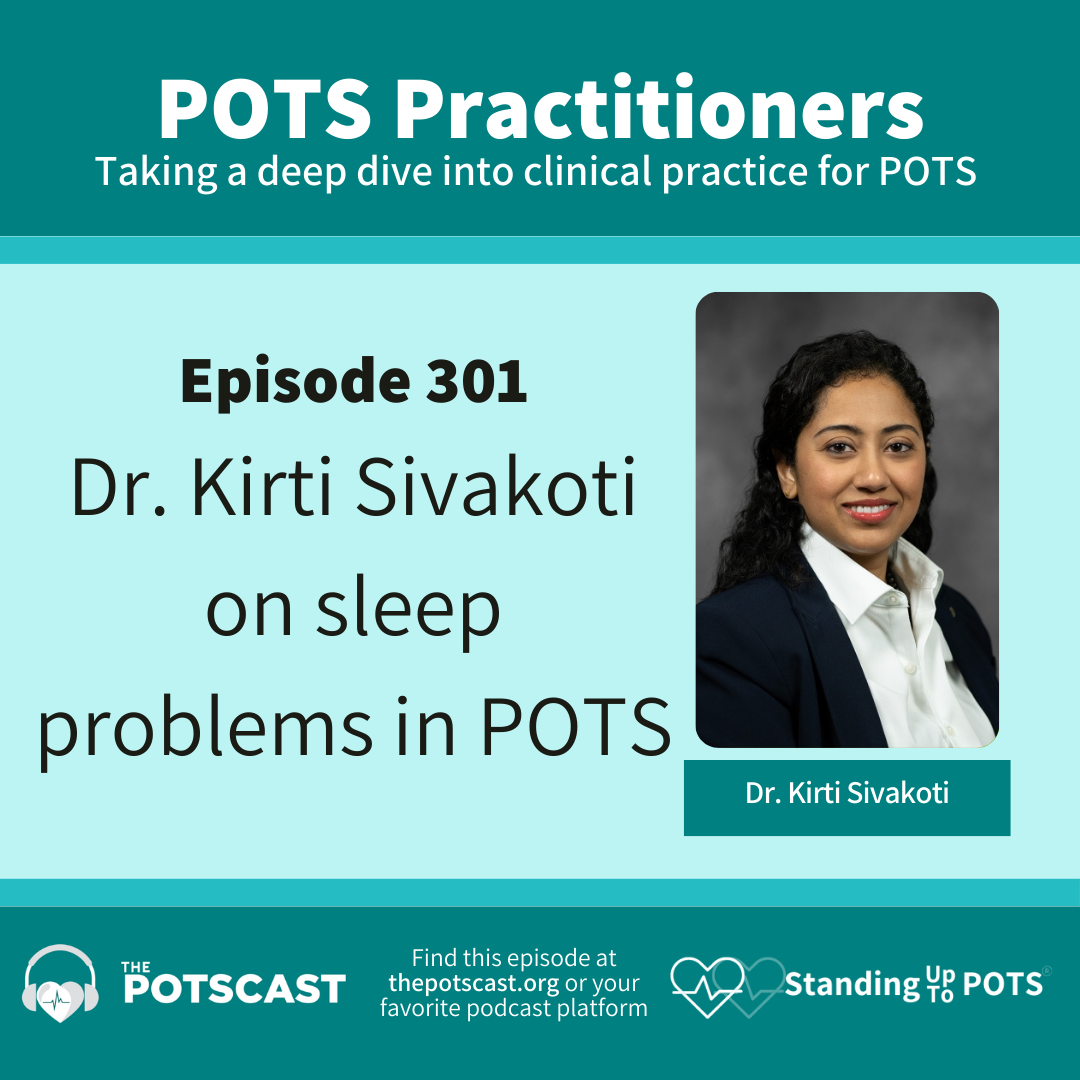
Jill Brook: Hello, fellow POTS patients, and marvelous people who care about POTS patients. I'm Jill Brook, your horizontal host, and today we're lucky to have as our guest for the second time, Dr. Kirti Sivakoti, pediatrician who focuses on medically complex children, POTS expert, assistant professor of pediatrics at the University of Utah, and Associate Medical Director of the Pain and Autonomic Symptoms Evaluation and Support Program at Primary Children's Center.
If you heard our discussion on pediatric complex chronic illness in episode 2 77, you already know that Dr. Sivakoti is so knowledgeable and so compassionate. And after that episode aired, a number of listeners wrote in wanting to hear more about the symptom of excessive sleepiness and excessive sleeping in their children and teenagers.
So Dr. Sivakoti has been kind enough to come back and address that topic today. So Dr. Sivakoti, thank you so much for being here.
Dr. Kirti Sivakoti: [00:01:00] Absolutely. Thank you for having me back. It's such a pleasure, and thank you for the fantastic introduction. It's gonna be hard to beat that.
Jill Brook: Well, so many parents wrote into us after that and they were just so thrilled to hear you speak. And then it was really interesting how, how this one symptom seems like it maybe hasn't been addressed enough. And I guess for starters, just for some of us who maybe aren't as familiar with the symptom, like when is sleep or sleepiness excessive in kids and like what does it look like in your patients with POTS and related conditions?
Dr. Kirti Sivakoti: Yeah, you are right. So sleep is such an important part of the whole symptomatology and also it's the least addressed in terms of not getting the comprehensive history around what's happening with the child. And then in terms of excessive sleepiness, I think there are so many sort of subtypes, so many nuances to it.
[00:02:00] For example, when we talk about excessive sleepiness, right, sleepiness is sort of that feeling off I turn the lights off, the curtains are all drawn, and then if I lay on bed, I think I can sleep very fast. Then the difference between that and something like narcolepsy would be how fast are you falling asleep?
Right? So if, let's say you fall asleep within two minutes, that would sort of fall under that narcolepsy bracket. But if you're taking about eight minutes or so, that would fall under the sleepiness category, the, the hypersomnia. And the normal timeframe for most people to fall asleep is between like 12 minutes to 17 minutes.
And these are all based on sort of when we talk about sleep studies, right, we think about the overnight sleep study, the polysomnogram. But there is another type of sleep study called called MSLT. So these are multiple sleep latency testing. So this type of testing, another term for it is nap testing. So this is [00:03:00] where you take a look at how easy is it for someone to take naps and what is, what is that sleep architecture like? So, so those are sort of some differences. And I think it's also so important to distinguish sleepiness from fatigue. And these two are sort of lumped into this one bracket very frequently, but, but these are distinct symptoms, and if we ask our patients, they usually are able to tell the difference. So fatigue is that feeling of when you think of you ran a marathon and then your muscles are sore, or we have a flu and we just feel so sore. So that's more so the fatigue symptom. And the sleepiness is sort of how fast can I fall asleep? And sometimes they can both happen together. But most POTS patients talk about fatigue a lot more than sleepiness. I think that definitely then there is a subtype of hypersomniac who can sleep easily, sleep a lot. But actually the more common pattern that we see is insomnia.
Almost about, I [00:04:00] wanna say 60% patients fall into that insomnia bracket. And then when we think about sort of that excessive sleeping, think one thing that happens in a lot of these patients are that the fatigue drives the daytime naps and now they're sleeping in the day and that breaks their sort of sleep architecture, right?
So now they're refreshed and it's very hard for them to sleep by 9:00 PM or 10:00 PM. So now they're awake by 2:00 AM, 3:00 AM, and now it seems like they're sleeping till 10:00 AM or so, and now that sort of breaks their whole circadian rhythm. But there are all of these things that are, are going on.
Jill Brook: Yeah, so it can be messed up in a lot of different ways. That's what I'm hearing.
Dr. Kirti Sivakoti: Yeah.
Jill Brook: Okay. And then, so we also hear a term hypersomnolence sometimes. Somebody had asked, what is that? And how do you know if your child has it?
Dr. Kirti Sivakoti: So with hypersomnolence, it sort of falls under that similar [00:05:00] category of sort of hypersomnia or needing, having the need for excessive sleep. In orthostatic intolerance, in OI, in POTS, there are multiple mechanisms that drive that. Like, first of all, I'll just start by saying that sleep is one of those truly autonomic functions, right?
When we think about our autonomic nervous system and how it controls all the automatic functions of the body, sleep is so essentially an autonomic function because it's so unconscious. Blood pressure, heart rate regulation, it happens very unconsciously. So, and unfortunately it's not been very well studied, the autonomic medicine within sleep disorders, right. So it's poorly studied. With that being said, with, with sleep being such an autonomic function, we know that there is a correlation between autonomic dysfunction and sleep on multiple different levels. So when patients have POTS or OI, when there is sort of [00:06:00] that excessive heart rate increase, right, the tachycardia, these patients are constantly in this fight or flight mode. We think about them being in this hyperadrenergic mode. So when they are in that mode, it's very hard for their blood pressures or heart rate specifically to come down. And when they're sleeping, when that doesn't happen, it almost prevents them from getting into a deeper state of sleep, right? So, so there are these true sleep issues, sleep disorders, sleep architecture being altered because of autonomic dysfunction issue. And there's also fatigue contributing to need for excessive sleep, right? So if you think about the second mechanism with the OI, we know that there is reduced cerebral blood flow now thanks to Dr. Peter Rowe and the wonderful work that he did. So he used transcranial Dopplers, and then he looked at how much cerebral blood flow patients with OI, POTS or even [00:07:00] chronic fatigue syndrome, how much blood flow do they get? And there's a huge drop in cerebral blood flow. When there's this drop in cerebral blood flow, they have these release of catecholamines. When there's blood pooling, the way more blood can get back to the heart and to the brain is that norepi, right, the, the catecholamines that can cause constriction. And unfortunately all of these, the catecholamines in a chronic state now prevent patients from going down their nerves to relax and getting into a place of deep sleep.
So that is one mechanism that drives that. So when we are seeing that symptomatically, they're doing worse, I think treating that fatigue portion is so, so important. But also that the true, the hypersomnolence, right, and I think there is a subtype of that, but most patients fall into this category of, they think that they're sleeping less, but they're getting a little bit more than what they think they are getting. So there is this concept of sleep state [00:08:00] misperception. So there was a study that they did and there were about four studies that have been done in sleep in POTS. One study's out of Germany, one from Vanderbilt, one from Stanford, and the other one came from London. So, so in the Vanderbilt cohort and the Stanford cohort, what they did is pretty much they did actigraphy. So actigraphy is where they look at body movements and correlate that with sleep, and then diaries to look at how much do patients perceive that they have actually slept.
What they found is with actigraphy it was 37 minutes falling asleep time, but diaries was about 56 minutes. So they think that they're awake for longer, but they're falling asleep sooner. So they're probably getting a little bit more sleep than what they're thinking. So when you translate that into real life, right, so for naps, they're thinking they're sleeping for maybe a couple hours, maybe they're sleeping for two and a half, three hours, which is now chewing up [00:09:00] eating time into their bedtime sleep at nighttime. So now they're not sleeping well. Now parents are thinking that they're probably asleep at 11:00 PM or so, or 12, but they're sleeping at 2:00 AM in their bed, probably scrolling or something like that.
And then they're waking up late, and now they can't go to school and now they're napping. So I think there is this subjective element to hypersomnolence. But I think there is definitely a subtype where there are patients really need a lot of sleep and that is definitely a subtype we are trying to study and understand.
And there are a few patients that have come in. It's, it's actually not a big number, but these patients will come in and this will be their chief complaint, right. So they'll talk about hypersomnolence as the presenting issue. This is what's disabling me. I have to sleep 15 to 16 hours a day. If not, I cannot function.
But for most patients with POTS, they usually fall under either [00:10:00] the insomnia category or, or within the normal sleep duration category, but probably with more naps and whatnot.
Jill Brook: Wow. Okay. And I think I remember you telling me once before when we had been discussing this, that you had had that occasional patient who like cannot even stay awake in your office? They kind of are just falling asleep as they even try to talk to you. But that's super rare. Is that what you're saying?
Dr. Kirti Sivakoti: Yeah, so, so that is definitely a rare chief complaint, I would say. So most patients with POTS, right, I would say the more pressing concern is fatigue. We think about dizziness and lightheartedness, but I think the most disabling one is fatigue. And that seems to be one of the common thread amongst most patients.
But it's actually rare to have patients who come in and they'll say that I sleep for 15 hours or 16 hours, and that's just what I need to be able to function. And then when we see patients with, with that sleep need, right, we [00:11:00] certainly think about are there mechanisms that are going on that's causing this person to need more sleep in addition to all the things that we understand from the software perspective, right, from the pathophysiology perspective. So when we think about someone who needs, let's say 16, 17 hours of sleep, some things that could be happening that we think about is well, if there is a fatigue component there. If there's a nutritional component, which there almost is because when they're sleeping so long, they're skipping breakfast now. Maybe they're skipping lunch. But when you're sleeping that long, you've almost lost the nutritional intake that you will get from a meal, right? When they're doing this for months, it starts to catch up with them and it can cause or have some hypovolemia as while they're sleeping for so long, so they're not as physically active.
So now there is some secondary deconditioning going on that also reinforces that, right? [00:12:00] So, so it, it's almost like the, the cycle of orthostatic intolerance starts and they start having higher sleep need. But when that sympathetic activation kicks in, because now their heart rate's constantly in 120s or 130s, they don't feel good.
Now they walk a little bit and they don't feel good. Now they wanna lay down, sleep longer. So that sort of keeps happening too. And then the other things also is when they're sleeping, if they're out of school, sort of not having that structure that is so important in some of these illnesses. So I think these are some of the things that we certainly try to work on when we are seeing hypersomnolence. So CBTI is something that we really, really work on. CBTI is cognitive behavioral therapy, but for insomnia. So it has sort of some targets as to cognitive restructuring in terms of what are the patterns and thoughts that, that reinforce the sleeping habits, right? How do we [00:13:00] restructure environments so that way they're not taking as many naps, or if they're taking naps, it's not two hours, it's maybe 20 minutes or 30 minutes. So limiting that amount of time. And when it gets to a place where you know that patients are trying all of these, but it's still disabling, sometimes we go the route of, do we need to start thinking about medication right on top of all the first line things that we are trying to do here in terms of the fluids, the salt, the compression.
Jill Brook: Can I just ask, so I think what I've heard you say, and I've also seen you seen write this before is that sometimes in terms of those first line things, you just try to more aggressively treat the POTS because the POTS might be one driver of the fatigue and the sleepiness. So is that kind of your sort of like first thing you do.
Dr. Kirti Sivakoti: Yes. So, certainly during the history portion I would definitely start by getting a very good understanding of what are the drivers of [00:14:00] hypersomnolence, right? And I think that is where it comes down to your question of it's something that's under recognized, not addressed well. I think a lot of physicians, providers, we are not doing a good job of getting a good history around what is happening with our patients, right? So we think about hypersomnolence, there are lots of assumptions, but are we actually asking the questions? It's so important. So, the first thing that we try to do is ask a bunch of questions to understand, is fatigue driving? Is there sleep disturbance? Is there, are we even asking about restless life syndrome, right? So low ferritin. We know low ferritin levels, which is very common in these patients. And there's also a functional ferritin deficiency. Oh, I can talk about that for so long. But so ferritin, when we think about ion stores, right, so ferritin is a measure of ion store. And when you look at the normal ranges, it could be anywhere from like 20 to a hundred or so. And [00:15:00] usually for, for most patients who are asymptomatic, if they are at 20 or 30 or 40, it doesn't flag. And we are usually not doing anything about it because our hemoglobin's normal and they're asymptomatic.
But what ends up happening in patients with orthostatic intolerance POTS is they have higher amounts of what we call hepcidin. And hepcidin is what artificially suppresses ferritin levels. So it almost induces this functional ferritin deficiency. So, so patients, even with, let's say your ferritin level is about 50, you're probably not seeing all of that.
So if there is a POTS patient with ferritin of 20, even though it's not flagging, that's really low. We wanna aim towards close to 70, 75, over 75 to a hundred for ferritins, for ferritin level for these patients. There's not good evidence in POTS right now, but I think a lot of this evidence is coming from sleep medicine literature.[00:16:00]
Jill Brook: You know what else is so interesting about that is that there are some studies showing a high rate of restless leg syndrome in Mast Cell Activation Syndrome patients, and I'm embarrassed to say that on one of those studies, I did the statistics, but I don't remember how high the prevalence was, but I just remember that it was noteworthy and we actually published a paper, and I wonder if that was the reason why. We never, you know, looked into why we just noted the high prevalence.
Dr. Kirti Sivakoti: That's so interesting, right, and we know there is, there's such a high comorbidity between all of these, the, the MCAS, the mast cell, the hypermobility and POTS. And whether there's an a unifying underlying driver for all of these, whether it's the high catecholamine levels, we don't know, but whatever that driver is, is that what's leading to this functional ferritin deficiency.
But yeah, ferritin deficiency leading to restless leg syndrome, and then, and then usually with this restless leg syndrome, a lot of providers don't even ask the question, right? [00:17:00] We're not even getting the history. It's so important to explore that because if patients are having restless leg syndrome, which actually is more predominant during evening time, during nighttime, that can affect their sleep and now they can't sleep, they're not refreshed, then they continue to have worse symptoms during the day.
And as we know patients with POTS, chronic pain, hypermobility, they tend to have this higher sense of what we call interoception, right, the, the perception of palpitations, high heart rate, pain, the GI symptoms, the, the central sensitization is higher in patients. So at nighttime, when things are quieter and there's nothing distracting, it's so much easier for them to hone in into those sensations and it keeps them awake longer.
So that's why we talk about if there are some of these things, let's say palpitations are keeping my patient awake, we wanna treat the palpitations right, because now it becomes a quality of life issue because it's [00:18:00] impeding their sleep. If there is pain that is affecting their sleep, we wanna treat that pain.
If there is, let's say nausea or GI symptoms, wanna treat that. Headaches or if there's restless leg syndrome, or we wanna optimize that ferritin level. So I think it's so important to get that history of all of these nuances. So restless leg syndrome, finding out about are there things that are keeping you awake?
Asking about sleep architecture, right? So asking about what time do you go to bed? How long are you awake in bed? How many times do you wake up in middle of night? What time are you waking up in the morning? How many naps? And what are the timings of those naps? So there's a lot of pediatric literature that talks about how if patients are sleeping after 2:00 PM every, every, I think it's about every five minutes or so they're sleeping beyond 2:00 PM It just bites into their nighttime sleep, like [00:19:00] 15 to 30 minutes of their nighttime sleep. And we know most of our patients come home after school at maybe like five, six, and they're napping from six to eight, and now they can't sleep till midnight or 1:00 AM or so it, it bites into that. And now they can't wake up till 10:00 AM or 11:00 AM and now that cycle continues and it keeps on, right. So, so I think it's so important to, first of all, I think the first step is teasing out between is there fatigue, and is there fatigue plus normal sleep pattern, right? Asking about what is your sleep duration? Is that normal? Do you take any naps? If they say, no, I'm sleeping about nine to 10 hours, great. Okay, and then fatigue is a major concern. Then that would be the patients that we are heavily focusing on the first line in terms of let's optimize your fluids and your salt. Let's expand that volume, right? Volume expansion. Let's [00:20:00] talk about if there's orthostatic hypotension component, or your symptoms are predominated by syncope, and then compression to get more blood back to your brain. So pretty much like increasing cerebral blood flow and also focusing on that physical therapy because that is what will help condition their heart. And that conditioning will help eventually pull them out of the place of fatigue. But then if they are talking about disturbed sleep architecture, right? And they could have both, so fatigue, and now they're talking about, yes, I'm napping, I wake up multiple times at night, I have palpitations that keep me. Now we wanna go to this algorithm where we are exploring those details. Are there things that can treat to help functioning in our patients and sleep better in our patients? Do we think patients need sleep studies, right? So if they're waking up multiple times at night, and if it's a patient with let's say, hypermobile EDS, hypermobility we don't think about it too much, but [00:21:00] like it would make sense that the connective tissue is not as stronger, so they might have a component of sleep apnea just from like floppy tissues when they're sleeping. So there's actually a study that looked at polysomnogram sleep study pattern in patients with EDS, and it was actually reported out normal. But when you look at it there is this a flat top pattern. So when they look at the nasal reading, right at the nose, there's this flat top pattern, which is there's sort of this blunting, probably reduced airflow that's happening in patients with EDS. And that could have, even though it's reported as normal, that could have increased intrathoracic pressures, right, the same things that we think about in a 400 pound person with sleep apnea issues. So it's, it's certainly not very well addressed. So I, I think that that teasing out the things and the algorithm and treating the things that I've been thinking about, when do we do sleep study, right, [00:22:00] as, as the medical people who are taking care of these patients. Have we done our homework before we send them to sleep specialists in terms of have we fixed the ferritin levels, right? Have we addressed the palpitations or the pain or all the things that could be, that could keep them away, rather than just sending them to a sleep specialist because the sleep specialist is just gonna say, well, there are these other things that need to be taken care of. Why don't you work on that and then come back.
Jill Brook: So it sounds like, like parents and kids and, and actually all of this sounds like it probably might apply to adults too, so maybe we don't even need to limit it to children.
Dr. Kirti Sivakoti: Totally, yeah.
Jill Brook: Is that, is that families and, and patients should really do their homework first and make sure that their sleep hygiene is good.
And, you know, we keep hearing about how screen time at night is bad and how if you wanna have, you know, a good bedtime, you have to start thinking about that in the morning and maybe get some light early in the day and, and [00:23:00] things like that. So like all that basic stuff they should do before they bother a doctor about it and then you will do your stuff and then, and only then would you put it on to the sleep study level. But it sounds like there's so many factors that could play into it.
Dr. Kirti Sivakoti: Absolutely. Yeah. So I think things that could be done at home, right, easily, initially, well, I don't know if it's easy, but initially that could be done are definitely work on that POTS treatment portion, because that's gonna be a major portion of improved cerebral blood flow, reduce the fatigue and, and all of that will help reduce the sleep need per se.
So working on, let's say the beta blockers, the medications, or the, the fluid volume expansion. And with regards to sleep, as much as possible having that structure around sleep, right? No phones, no screens for a couple hours before, which is so hard because these are teenagers we are talking about.
And, and they wanna have friends and they have [00:24:00] activities and all of the things that make their life interesting. So it's, it's, it's hard, but also, it's so important to prioritize. Or taking baby steps towards it, right? If they can't do it every single day, can they start few days a week? And can they keep on improving that?
And then like you mentioned, right, having that light therapy right when they wake up in the morning, just flood with sunlight. So that is super helpful. Having a really nice sleep environments, so no lights or just minimal lights. No sounds so they can sleep deeply. Whatever they need for for them to sleep comfortably.
So that, and then the other thing that I think very frequently we overlook is medication, effects of medication. They have such a huge impact on some of the sleep architecture and symptoms as well. Actually beta blockers, they can inhibit melatonin release. So a lot of our POTS patients are on propranolol or metoprolol, one of those meds.
So talking to those [00:25:00] patients, especially if they're on a BID dosing, doing a three milligram melatonin at bedtime, that really helps them because it sort of blocks their receptors and reduces melatonin secretion. So three milligram melatonin, that helps in some patients. I wouldn't go over three milligrams because now we start talking about side effects and nightmares and whatnot.
And if patients are on antidepressants or if they're on other meds, like let's say clonidine, we think of those as like sleep aids, right? But with that being said, some of those sleep effects, the, the sedation can last well into the day. It's not really helpful for their blood pressure, whatnot. If patients are on medications like stimulants we know that that can increase heart rate and blood pressure, and if patients are taking it later towards the day, or if it's still in their body, not worn off at bedtime, that can, that can prevent their, their blood pressure and heart rate [00:26:00] from getting to a level where, where it gets to when we are sleeping normally. And that sympathetic activation can also keep them awake. And we know that patients with POTS are, are actually what we call more than 50% of them are non dippers. So non dippers are when we, when normal people, when we are sleeping, our heart rate and blood pressure dips normally to over 10 to 20%.
But then for patients with POTS, their heart rate and blood pressure does not dip that much, actually stays elevated. There was a study that looked at salivary cortisol levels and, and they think of salivary cortisol as sort of a measure of sleep fragmentation or increased catecholamines, and, and that was elevated in patients with POTS the first thing in the morning. So I think there is definitely a factor of this continued tired but wired, right, the fight or flight mode that continues in their sleep as well.
Jill Brook: Wow, there's so [00:27:00] many factors. This is fascinating. And I, I did not know about the non dipper thing. Is that just thought to be an autonomic...
Dr. Kirti Sivakoti: Yes. So yes, so, and that's what the, what the thought is in terms of it's most likely the autonomic dysfunction that's driving that. And there are so many ways we can study that, right? The, the most accurate way is what we call microneurography. Microneurography is actually, when you have this tiny needle in an unmyelinated nerve that measures the sympathetic activation or not, which is invasive and it's, it's sort of hard to do when someone's sleeping and measure autonomic function accurately. But things that get close are looking at the sleep studies and in between are how do we look at blood pressure and heart rate, maybe a pulse ox. So a lot of this data is coming from like pulse ox and pulse transit time and looking at their blood pressures as well. Microneurography hasn't been done in POTS, [00:28:00] but there is such a need for, for sort of better research and understanding that.
So this non dipper, it's thought to be because of sort of like baseline elevated heart rates in these patients, or elevated blood pressure. Also patients with POTS, right, and we think about how they have increased micro arousals as well.
When we think of sleep, we think as macro, right, the whole night of sleep and sleep study also sort of measures the macro, the whole night of sleep. But then what we are not looking at really well are the micro arousals. And it's possible that during sleep study they haven't looked at that or you need longitudinal data to look at that micro arousals portion.
So if they're waking up multiple times at night, that can prevent them from their blood pressure and heart rate getting down really, really low. When we think about palpitations or pain or restless leg syndrome, right, those symptoms can also keep their [00:29:00] heart rate blood pressure up and prevent them from going down the interoception, right, the somatic symptoms, the central sensitization, that can also keep some of their, their measures, the vital signs up. So, yeah, there's so many factors to it, but it's, it's thought of as an autonomic function.
Jill Brook: Okay. Another thing that comes to mind is just hearing about in the world of just general health is how important circadian rhythms are and how the more that you can get your, your physical activity and your light exposure and some food in early in the day, that that is better for your circadian rhythm.
But that always makes me think about how POTS patients oftentimes in the morning feel nauseous, and that's when their energy is worse. And I can just hear some thinking right now, but nighttime is when I actually feel good and that's when I actually have an appetite. And so I guess, I guess we just have to kind of suck it up, right?
Like, like to the extent that we could do any of those things earlier, the earlier the better in terms [00:30:00] of circadian rhythm.
Dr. Kirti Sivakoti: Absolutely. And you brought up such a, a, a great point which is, you are right, most patients with POTS, they feel better towards the end of the day, right? Like you said, when they wake up, there's dehydration component and you're nauseous and all of it. But yes, the answer to that is gonna be yes, because the, the better patients feel in the morning and they can get more physically active and do all the things in the morning, then it's easier to sort of tap into that normal circadian rhythm as well, right? So, and it's easier to sort of ease into. It's, it's, it's like you have the, this energy tank, you start it off early, so now you have exhausted your energy tank, so come evening it's easier for you to go to bed. Rather than we are taking early morning or afternoon to build up our energy tank, and now later on in the evening, we feel so good that we have all our spoons in the evening, so now we don't wanna sleep.
So, and I [00:31:00] think being mindful of that every single day, it is hard and my heart goes out to them, but I think it's so important to do so much in the morning, so then that's the reason why we sort of emphasize on the structure, go to school still, wake up, and then, and then chug water, not sip, chug water.
If you can have a liter with a salty snack or a, or a electrolyte drink, something before you get out of bed, throw on those compression garments. Take midodrine, propranolol, whatever it takes. Eat breakfast even if they're not hungry. Whatever it is, even a small portion size, so that way you have this great start to the day.
And then make sure that there are school accommodations in place so they can continue to drink that water and their electrolytes and snacks when they need it. If they have time well, if the school allows, go lay down in this nurse office when they don't feel good, come back to class, right. So that way they have, they are [00:32:00] using a lot of their energy during the day and come nighttime, it'll be easier for them.
It's, it's hard. It's, it's, yeah, but it's gonna be super helpful if, if that shift happened.
Jill Brook: Yeah. Okay. This is great. And is there anything that would be most helpful since there's so many factors, like if, if patients were gonna bring some information into their doctor or bring, I don't know, a sleep log or like what information is helpful for you to have patients either track or whatever, and then bring it in for this conversation?
Dr. Kirti Sivakoti: Yes. So I would definitely say, because one of the things with, with POTS, because it's so many symptoms that happens with it. Knowing that, like, first of all, I think it's so important to know, is that person on your team, right? Is your healthcare provider, are they gonna understand you? Are they gonna make time for it? Are they gonna listen [00:33:00] to you? It's so important. The last thing you want is a pediatrician or a provider who's like, well, you know, just try to sleep earlier and wake up in the morning. And then you're like, but I've been trying to do that and it's not helpful, right? So you want somebody who understands the gravity of the, the, the, the complexity of the situation and who's willing to sit down with you.
So I think it's super important to have that person on your team. And sometimes that might mean doing a little bit of shopping before you figure out that, okay, this is the person, and they don't have to be an expert at POTS, but they have to be that person who is telling you that, okay, I might not be an expert, but I'm willing to listen and understand and see what the challenges are and connect you with the right person.
So, a big part of that equation is time as well. And I think from the patient perspective I would say a good thing would be maybe make the visit about POTS and sleep only. Have this [00:34:00] continuing relationship with that person on your team. And then, 'cause when we take all the symptoms in one 30 or 40 minute visit, could feel so much.
And now we're like, it's, it's so hard to spend that time to go into the details and think about sort of the algorithms and how can I best help the patient. So once you have that relationship, talked to them about POTS, done the diagnosis, then have a visit, a follow-up visit where you only talk about sleep.
If that is, if we know that there's this huge component of sleep architecture disruption. So I think I would say our framework on how we are approaching the provider is as equally important as the preparation we are doing for the visit. In terms of how to or what to tell our providers and how to approach it, after having done the initial things in terms of, you know, tried the sleep hygiene, right, you have, you have tried, you are doing all the things, the volume [00:35:00] expansion, the first line things for fatigue management, talking to them about, I have done those things, but still I wake up multiple times. My sleep architecture is disrupted.
Or thinking about there are these factors that are keeping me awake. Do you think we should be treated for that? And sometimes it's, it's the question that we are trying to get answered too. And if you have the right questions, we'll also get the right answers. So, thinking about how do I bring this issue up that I know that sleep is an issue.
What have I tried? What have I not tried? What can I take to my provider? And then what do I think are my most disabling things, right? So if it's pain, my iron is low, whatever those things are, tying that into sleep, do you think that could be affecting my sleep? I think coming from that framework would be super, super helpful.
And I would say for, for listeners, maybe checking out there's a really good paper on [00:36:00] sleep disorders and POTS. One resource if, if we wanna do more, look more into it, it's by Mitchell Miglis. So he's at Stanford. And there's this really good graph that he talks about on how to separate out patients with fatigue and then patients who have true sleep disruption, sleep disorder. And then we need to look more into the sleep issues.
Jill Brook: Great. We'll put that in the show notes. We had one specific question from one mom who emailed in and was wondering what you think about like Adderall for POTS and energy.
Dr. Kirti Sivakoti: Yeah, that's a great question. So, I have to say, I, I have, I've actually prescribed that once for a patient. So in this patient, what happened is, so has POTS and there are a few other things in terms of autism, ADHD, things that we are getting in the way of managing and, and incorporating all the, all the first [00:37:00] line things, right?
There are lots of GI symptoms as well. When there are comorbid GI symptoms, whether that's celiac or malabsorption, it's just not being able to drink or eat the amount that we tell our patients to. Not everyone can get to 80 to a hundred ounces of fluid or that amount of salt, right?
And when they have a lot of nausea or abdominal pain or whatnot, they, they can't do that. So when that happens, I think there's a lower threshold for medications for sure. So that's where we sort of trialed midodrine because there was this component of redistribution and pooling hypermobility as well in this patient.
So did not improve with midodrine and had side effects at, towards the lower dose, so stopped that, and tried some of the other medications, beta blockers, whatnot. And nothing seems to help it. So that's where we, we went down this path and brain fog was a major, major complaint, right? Naps and brain fog and [00:38:00] sleepiness was a major complaint.
And there was this comorbid ADHD as well. So we did Adderall on the patient to help with the wakefulness, and it was helpful. So usually, and we just go off of the ADHD dose, 10-15 milligram. You can titrate per the weight of the child. But it was helpful because there's this component of helping, it increases the heart rate and blood pressure a little bit, so that blood pressure effect can help the wakefulness and in general that the stimulant has some wakefulness effects too.
There was a study that was published by Dr. Jeff Boris where he looked at sort of his cohort of patients. I think it was close to 700 patients or something like that. And he looked at the efficacy of stimulants for wakefulness in, in the setting of brain fog in POTS. And he found that it's actually effective 70% of the time.
So I think it was like 68.8, so close to [00:39:00] 70% of the time. So, I'm definitely starting to incorporate that more frequently in my practice. I, I think what I, I try to do in my practice generally is I, I wanna make sure that we are trying all the first line things just because if there is somebody who's very hypovolemic or all that needs to happen is there is, there's excessive deconditioning, or their blood pressure's very low, and if the first line medications work, now we don't have to put them through the stimulants, whatnot. 'Cause one of the things that we worry about with the stimulant is that added sympathetic activation, right? Which in some patients they might not respond well to it. They might get like more jittery or their heart rate, their heart rates on the higher side, now I can elevate that a little bit more, and it can affect their sleep as well, when we talk about the non dipper concept too. But I think there's definitely this cohort of patients where it's very helpful, and if we have tried those first [00:40:00] lines, then I think it's totally fine to to trial Adderall as well.
And the other thing that I just wanted to say as an addendum to this last thought is usually in primary care or the pediatrician level, right, the duration between that first visit or the first visit we are talking about the first line interventions to the trialing and getting to Aderall, sometimes that is stretched out, probably because have you tried this or tried that? And there's not an algorithm that tells them that, well, if you have tried these and the patient's not able to optimize on other, the, the volume expansion or because of GI symptoms that maybe have a lower threshold to try these.
I think this is where we're turning into a little bit of, they might have to tap into the dysautonomia experts in their community. But I think shortening that and, and there are so many system level barriers against that, shortening the duration between when you see the [00:41:00] patient to diagnosis to managing them, to managing them in terms of titrating their management, adding medications, to titrating the medication. Such a long journey. I think, I think it definitely needs to get tighter.
Jill Brook: Yeah. Well thank you for acknowledging that 'cause, yeah, we, we definitely get a lot of messages about that being frustrating. But, but we're so grateful for you to kind of spread the word about this so that more patients and practitioners can listen to this and kind of know what the thought leaders are thinking about this. So that's fantastic. Is there anything else that you think people are gonna wanna hear about this?
Dr. Kirti Sivakoti: So I would say as a last thought, it's so important that with, when we think about sleep in POTS, managing the fatigue aspect of it is as equally important as managing the sleep disruption. And, and thinking about, and jumping early on in terms of [00:42:00] cognitive behavioral therapy for insomnia treatments and trying to maximize all of that, thinking about medications, because that is very frequently overlooked. A lot of our patients could be on 4, 5, 6, multiple medications and there are polypharmacy issues, right, we think about medication side effect. Thinking about are there things that could be optimized with medication, right? Can they take medication at a different time during the day? Does it need to be optimized because that could be interfering with their sleep architecture as well.
That's important. And the third most important thing is if you have that person who will advocate for you, a provider that is willing to listen and on your team, bringing sort of that, the, the, the framework of questions to them, to lead them to the right answers would be helpful.
Jill Brook: That's great. Well, we'll put a link to your programs and your practice in the show notes if people want [00:43:00] to learn more about you or find you. But Dr. Sivakoti, this has been so helpful and I so appreciate that you've been so responsive to the questions that came in from the last episode and being so kind to take all this time and and I just love your encyclopedic knowledge and this has been just amazing. Thank you so much.
Dr. Kirti Sivakoti: Absolutely. Thank you for having me. Please let me know if there are any additional questions.
Jill Brook: Oh. You might regret saying that, but thank you. Thank so much. Okay, listeners, that's all for today. We'll be back soon with another episode, but until then, thank you for listening, remember you're not alone, and please join us again soon.