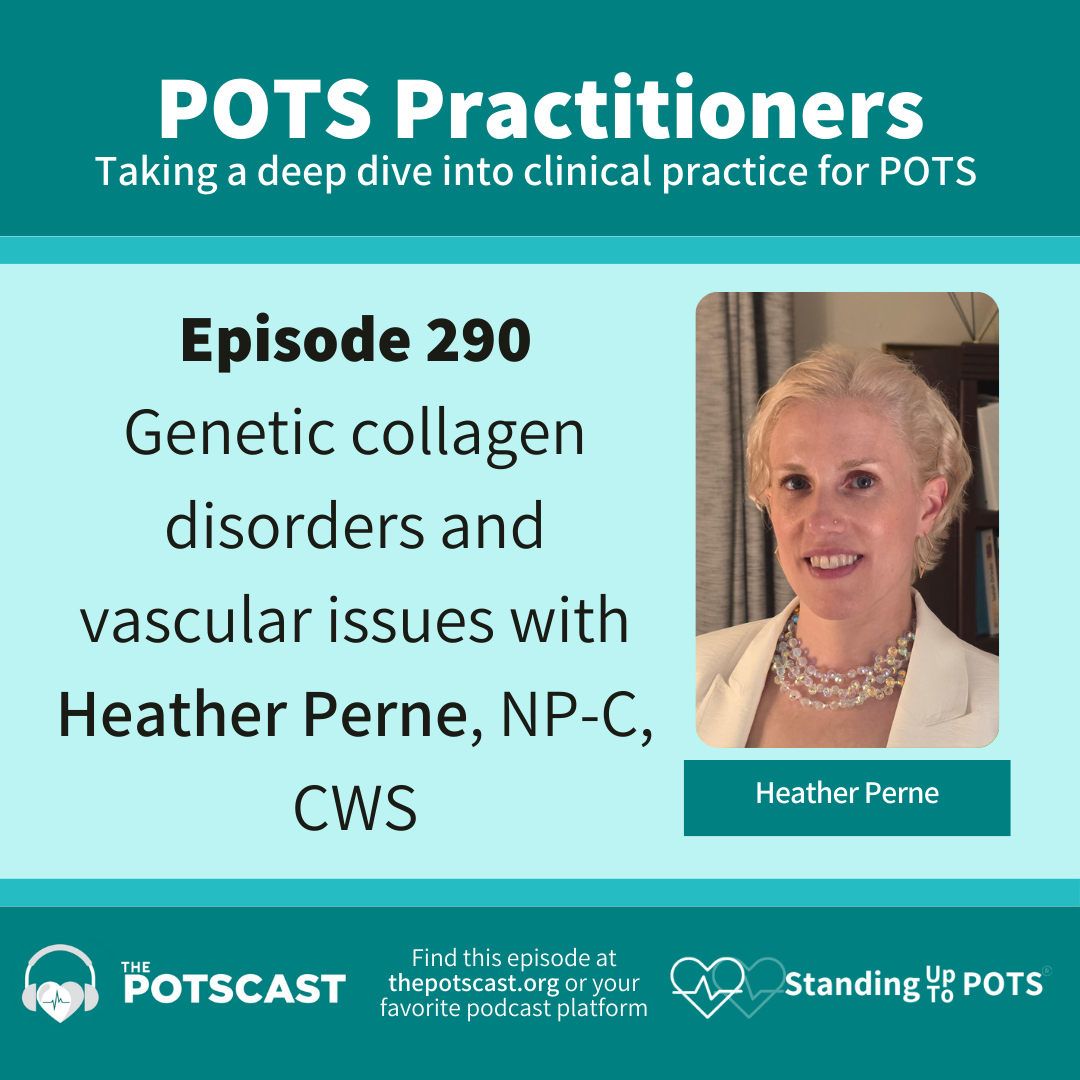
[00:00:00]
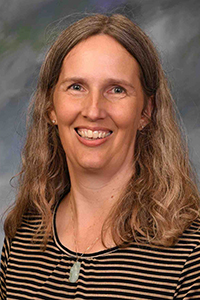
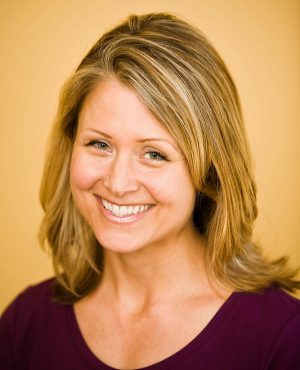
Jill Brook: Hello, fellow POTS patients, and marvelous people who care about POTS patients. I'm Jill Brook, your horizontal host, and today we are interviewing nurse practitioner Heather Perne about genetic conditions that can be associated with POTS and dysautonomia. She has expertise in vascular medicine and as part of the ProMedica Jobst vascular clinic in Toledo, Ohio, which is starting a heritable connective tissue clinic where Heather will focus on the Ehlers-Danlos Syndrome, Marfan Syndrome, Loeys–Dietz Syndrome, and other genetic conditions that can affect the connective tissue.
Of course, we know that there are hypotheses out there that these conditions may be underlying factors for some cases of POTS by making blood vessels extra stretchy or contributing to blood pooling, but Heather is also focusing on the other problems that can be associated with these conditions besides just POTS and dysautonomia.
Her clinic also strives to identify common [00:01:00] comorbidities in its genetic patients, such as dysautonomia, vascular compression syndromes, MCAS, et cetera, and to help coordinate patient care between all disciplines. So this could be a great resource for patients who either have underlying genetic connective tissue issues or who need to be tested for them.
Heather, thank you so much for being here today.
Heather Perne: Thank you so much for having me, and that was the perfect introduction.
Jill Brook: Oh, good. Good. I'm glad I got it right. But can you tell us more about your background? I mean, I don't even know what is vascular medicine. And yeah, what is it you do?
Heather Perne: So it's funny, I actually fell into vascular medicine, vascular surgery because my first real interest was wound care. So I started out doing home health nursing. I did that for four years. I loved it because of all the time I got to spend with patients, just, you know, talking to them, getting to know them, educating them. And a lot of what we do in home care is wound care, like the multilayer compression [00:02:00] wraps for leg wounds, wound VACs, et cetera.
I found that I really liked it. So after I passed my boards, moved back to Toledo from Charlotte, and was looking for a nurse practitioner position, there was an opening at a wound clinic, but it was a wound and vascular surgery combined service. So they basically said, you know, sounds like it's a good fit, you just have to have a little bit of vascular willingness. And I fell into it that way. So with vascular medicine, you are looking at things like lymphedema, venous insufficiency. When people get pulmonary embolism or DVT, you're looking at the anticoagulation management, which medication to choose, and for how long.
Vascular surgery, I mean, also deals with the venous compression syndromes doing the procedures to address, whether it's pelvic venous insufficiency or varicose veins, et cetera. And also dealing with the vascular compression syndromes like median arcuate ligament syndrome, May-Thurner [00:03:00] syndrome, Nutcracker syndrome, and all of the other things like aneurysms, dissections, carotid stenosis, you know, dialysis access. The way I explain it to patients is we deal with all of the arteries and the veins, in the body, except for in the head and except for in the heart. So pretty much neck down.
Jill Brook: Okay. Awesome. Now, you have also mentioned that you sort of have a backstory as both a patient and a healthcare provider. Can you talk about that?
Heather Perne: Yes. So I'll, I'll give the story first on how I became interested in EDS. I specifically remember one day I was sitting at the computer and I just decided to look up Ehlers-Danlos syndrome for some reason. I don't specifically remember why. This was a few years ago. And so I'm looking at all of the different comorbidities that a lot of these patients have, and then I came across vascular EDS, which I did not even know, you know, was a thing. I didn't know it was a diagnosis. And then I [00:04:00] thought I should read more about this because I work for a vascular surgery practice I might someday come across this. So that started my interest in the heritable thoracic aortic conditions. And it just so happened a few weeks after I was reading about EDS, I saw a patient in wounds clinic of all places, a young patient, and I'm looking at all of her diagnoses, all of her comorbidities, and I'm thinking, you know, it sounds like she might have EDS, honestly, just by looking at her diagnosis list. So then I started to talk to her more about it, and I realized, you know, I pulled up the diagnostic criteria, realized that she did have hypermobile EDS and from there the rest is history.
I think what struck me was how long she had had all of these symptoms and was waiting for answers, not only for the particular diagnoses that she had already [00:05:00] received, but the one thing that tied them together. I feel that once you know what to look for, you can look at a chart and honestly, within a minute have a pretty good idea if you at least need to screen somebody for a heritable thoracic aortic disease or hypermobile EDS or one of the genetically triggered Ehlers-Danlos syndromes.
So I thought, you know, I'd really like to learn more because I wanna help this patient population. I think also being a woman and the fact that EDS affects mostly women also kind of drew me to that a little bit. I self-identify as a feminist, so I love to help women generally speaking. So that was another factor.
And I just started to, you know, essentially learn more and more. And then on the personal side of things, I was diagnosed with autonomic dysfunction just about two years ago, [00:06:00] and it took 26 years for me to get a diagnosis from when I first had symptoms.
Jill Brook: Oof.
Heather Perne: So, and the funny thing is, is that this was all just like a huge coincidence.
I fell into vascular surgery, I happened to be looking up EDS and then I got COVID and I had shortness of breath to the point that I thought I should go to the ED because of course when you work in vascular surgery, you think, you know, you're short of breath, you have COVID, you know, it could be a PE. So I went to the hospital just to say, look, can you just do a quick scan or you know, get some blood work just to make sure I don't have a PE because I was so short of breath.
Jill Brook: Pulmonary embolism for people who are...
Heather Perne: Oh yes, I'm sorry, pulmonary embolism, blood clot in the lungs. And it turned out to not be a pulmonary embolism, thank goodness.
And one of the nurses said, oh, it sounds like it could be [00:07:00] POTS. And in my mind I was thinking, I know what POTS is, I don't think it's POTS because I don't have the tachycardia, I don't have that fluttering in my chest. But I did have a long history of kinda being short of breath at baseline. And I think that's one of the reasons she said that.
So then I thought, you know, I should get this checked into. You know, I've just been putting it on the back burner for years. And the minute that I knew something was wrong was when I was 15 years old. And I don't know if they do this, you know, across the whole US, but in high school gym class, you have to run a mile.
And I was very active. I was, you know, dancing three times a week. Had, you know, no risk factors so to speak, that would make me really short of breath. And I was looking around me and I was finishing near dead last, and my chest just felt like it was fire. And I thought, okay, something is, is wrong. I don't know what it is.
Years later, you know, I went to see a physician and they [00:08:00] thought it was asthma. So I got an inhaler. It never really helped and I just chalked it up to, I don't know, maybe it's not severe enough, maybe I'm not using it right, I'm not sure. And then years later I went to an allergist immunologist who then said, you don't have asthma, gave me a Holter monitor for 24-48 hours. And that was not remarkable at all. And because I, I don't have POTS, I didn't have the tachycardia either, so then I just thought, well, I don't know, maybe, maybe my body is just weird. This is just me. And, so fast forward to 26 years later when I ended up in the ER thinking that maybe I had a pulmonary embolism, I decided to finally get this checked out. You know, what is the shortness of breath that has been plaguing me for 26 years? So I went to see a cardiologist and he said, well, sounds like it could be POTS or maybe you have a cardiac valve issue. I had heard how difficult [00:09:00] autonomic dysfunction is to treat, and I kid you not, I was really hoping to have a cardiac valve issue. I had a plan. I even told the cardiologist, I said, okay, just so you know, after I get the echocardiogram, if we see that I have a cardiac valve issue, I don't want a mechanical valve because I don't wanna be on Coumadin for the rest of my life. I'll get a pig valve, we'll replace it every 10 years.
I can, you know, be on a different anti-platelet anticoagulant, but I'm not gonna be on Coumadin. Like, that's our plan. I think he was kinda like, yeah, okay, you're getting a little ahead of yourself. But in my mind, because I knew autonomic dysfunction was hard to treat, it made sense.
So when I had the tilt table and I did have a syncopal episode, I passed out, I felt like total crap for at least the next 24 hours, I remember waking up sobbing because I knew that it meant that I had autonomic dysfunction. And, you know, the nice little medical plan that I had all packaged up [00:10:00] just fell to pieces.
And I just remember thinking, I really didn't want this, I wouldn't wish it on anybody. Simultaneously it actually came with relief because then I knew this is why I can't tolerate the heat. This is why I get that dependent acrocyanosis, like when my hands and feet turn purplish red on a regular basis.
This is why my hands and feet are always like icicles and I literally have to warn patients before I touch them because they might jump off the exam table. This is why I have brain fog and one other thing that made me kind of decide to also go to the cardiologist to see what was going on. I would frequently bend down in clinic to look at, let's say a diabetic foot ulcer.
And I noticed, you know, more and more when I stood up, I would get lightheaded to the point that I had to sit down quickly. So again, there was this kind of grief, but also relief, if that makes sense. Getting very tired after [00:11:00] hot yoga, all of a sudden made sense. I do not recommend hot yoga to anybody with autonomic dysfunction, 'cause again, I don't have POTS, I have more like neurally mediated hypotension and vasovagal syncope. That made sense. I started to think about my flexibility, the fact that I was diagnosed with ADHD, the brain fog, the anxiety, my TMJ issues. And then I started to think, okay, I have this diagnosis of autonomic dysfunction and I have a significant family history of hemorrhagic strokes, like on my maternal side of the family.
Someone had a brain aneurysm that nearly took his life, and unfortunately my cousin passed away in her sleep almost three years ago when she was 45, after having, I mean, a variety of, of symptoms. Chronic headaches. And [00:12:00] they didn't do an autopsy, so we can never know for certain, you know, what took her life.
But she, she had what I'm told was an especially excruciating headache the day that she passed. She went to take a nap essentially, and, and that was it. She, she passed away. So I'm thinking about all of these things and I thought, you know what, let me get an MRI. You know of my brain just to make sure.
Luckily my PCP listened and said, you know, let's just get one to see. Luckily it was negative. There was no brain aneurysm. And then when I met with one of the autonomic dysfunction providers, and it was mostly because of my family history, because I did not have any major vascular events.
Could we get the connective tissue panel? Do you mind ordering that from Invitae, which, which is now Labcorp? And so she ordered it and then it came back that I had a variant of unknown significance on the COL3A1 gene. So [00:13:00] that's the gene for, which if it's pathogenic, it means that you have vascular Ehlers-Danlos syndrome. And I kid you not, I remember clicking open the results and I just turned white. I was like, are you serious? Out of all of the genes on this panel, this is probably the one that I would not want any variant of. And it was kind of ironic too, because I remember a colleague giving me a sticker for my laptop that actually said VEDS because she knew of my interest in heritable thoracic aortic disease, and this was even before I was diagnosed with autonomic dysfunction or any of this. She just happened to see this VED sticker and thought of me.
Jill Brook: Yeah. And just to make sure that everybody understands, so vascular EDS is different than hypermobile EDS, and maybe you can talk about that so that the people out there who know they have EDS are not worrying about strokes. And the other thing is you've used a term a couple times, heritable [00:14:00] aortic something, and I'm wondering, maybe you can define that too.
Heather Perne: Yeah, sorry. So heritable thoracic aortic disease. These are the heritable connective tissue disorders, which predispose one to getting aneurysms and dissections and arterial ruptures.
Jill Brook: A dissection being what?
Heather Perne: So a dissection is when the very inner lining of an artery essentially gets a tear. Then it's kind of just moving around within the artery and then depending on how much it moves away from the wall, it's going to block the blood flow. I might not be very good at explaining it. A picture would do much better justice. But because it can block blood flow to, you know, major organs it can cause a lot of issues.
Jill Brook: Okay. And to be clear, this is not the common thing that's associated with POTS. The common thing that's associated with POTS is the hypermobile [00:15:00] Ehlers-Danlos Syndrome, and these other ones are way less common, right? So people shouldn't be out there worried unless they have other signs that you'll talk about.
Heather Perne: So unless they have a family history of these kinds of vascular events, there's, you know, no cause for concern. I myself was a little bit surprised. And so with vascular Ehlers-Danlos syndrome, someone can be at risk of uterine rupture, basically rupture of hollow organs. They can be at risk of these aneurysms and dissections.
With hypermobile EDS, you know, you're, you're still gonna have that joint hypermobility and it's gonna manifest in ways like GI issues and, you know, a higher risk of autonomic dysfunction, Mast Cell Activation Syndrome, et cetera. But vascular EDS is, is very, very different. It, it is not, it is life-threatening in a way that hypermobile EDS is not.
So again, [00:16:00] unless people have very specific features or a family history or they have had a major vascular event, I do not think that this is something that, you know, everybody with POTS, for example, needs to be worried about.
Jill Brook: Okay. I think that's great. That's great. I just wanted to make sure nobody, we weren't making people nervous unnecessarily.
Heather Perne: Oh, yes. A hundred percent. A hundred percent.
Jill Brook: Okay, so, but, but my goodness, but you learned that you did have this dangerous kind.
Heather Perne: Well, it's a, so it's a variant of unknown significance, meaning that the COL3A1 gene has an anomaly, but the researchers don't know enough about this particular variant to know if it causes disease or not. Interestingly, after I got the results, I was diagnosed with a brain aneurysm 'cause I had a headache that wouldn't go away.
And then I went to the ED and I said, hey look, just because of my family history and this test result, I know it might [00:17:00] not mean much 'cause we don't really know, but can you just do a quick scan just to make sure? And they said, you know, I do have a brain aneurysm, which where I didn't before. So we will monitor it.
I've had a total of five miscarriages. One of them happened after, you know, the COL3A1 variant of unknown significance result. And I thought this was interesting. This kind of also made sense. After getting that result, I decided, oh, I wanna, you know, try to dye my teeth or, or whiten them 'cause I drink a lot of tea and I kid you not, they gave me the lowest strength one. I did three or four treatments at home and I got three chipped teeth. A part of my teeth just literally fell off. So I thought, okay, well this makes sense. It might be reclassified someday as pathogenic, who knows? I will not be the one to do that. I'm not the, you know, geneticist or the researcher. If it is diagnosed as pathogenic, I won't be [00:18:00] shocked. If it's diagnosed as, you know, reclassified as benign, that would be great. And I have low blood pressure. I don't smoke. I don't have diabetes.
So there's nothing else that I can do. And I live my life every day to the fullest. And you know, I don't let it bother me too much. But I do think it's good for people across the board to to know their family history.
Jill Brook: And do you mind saying a little bit more and maybe just repeating like, what is the family history that people should pay attention to?
Heather Perne: Yes. So if people have a family history of thoracic aortic disease, so that is aneurysms or dissections or ruptures of the aorta, or really any other artery, whether it's arteries in their legs, even visceral arteries, the arteries that let's say go to your spleen or go to your kidney or intracranial, aneurysms, [00:19:00] ruptures especially if that person is under 60 years of age when that is diagnosed. Then at the very least, you know, just getting some imaging, like an echocardiogram to check the major artery in the body, the one coming off of the heart, the aorta, or a CT angiogram. A lot of it depends on the family history. I only ask for brain one because that's where my family history kind of guided us. So every case is extremely individual, I would say, but overall, that's what to look for.
Jill Brook: Yeah, and I don't wanna get ahead of us, but this is a question for now, or you can come back to it later, but I guess who is a good candidate for genetic testing for these types of things?
Heather Perne: Sure. So when I'm thinking of testing patients who I think might have the heritable thoracic aortic disease, and those again are the heritable connective tissue disorders that essentially make it more likely, like there's a [00:20:00] 250 times greater risk that somebody would have a dissection or rupture.
What I just went over with the family history of the aneurysms and dissections. If somebody themselves has had a major vascular event, or they've been diagnosed with an aneurysm or dissection or a rupture, that would also be a reason to get testing. Also, if there is a patient who has an aneurysm or a dissection already, even if they're 90 years old and they have no family history, if they have physical features, let's say, of Marfan syndrome or Loeys–Dietz syndrome, then I would also think about testing them to see if they have Marfans, Loeys–Dietz or any of the other genes.
And that's for the HTAD side of things. When we're thinking about doing a broader panel, like the connective tissue panel that they have on formerly Invitae, now Labcorp, I [00:21:00] use the Red Flags list by Clair Francomano, the geneticist in Indiana, very involved in the Ehlers-Danlos Society. So those red flags are much more extensive than what I use for the HTAD screening. Some examples are severe periodontal disease. So I've had two patients, both of whom lost all of their teeth before the age of 30. I think that is significant. And again, it's on a case by case basis. If somebody has, you know, a few cavities here and there, it's not gonna flag in my mind to order the testing for them, but the more severe periodontal disease will. Some other examples are if somebody was born with clubfoot, for example. If they have a history of retinal detachment. If they have had hernias, et [00:22:00] cetera. And again, I'll stress that this is on a very, you know, case by case basis. But generally I go through these red flags and then I, I use the criteria from the AHA/ACC aortic disease guidelines if I'm going to order testing for the heritable thoracic aortic disease.
Sorry, I know that was a lot. But that's all to say that most people do not need genetic testing. Obviously the hypermobile EDS is a clinical diagnosis. And I am, as most people are, very selective on, you know, who, who needs it.
Jill Brook: Right. So it sounds like somebody who has just POTS or dysautonomia or MCAS or hypermobile EDS is not at a higher, higher risk for this stuff. It would have to also include that other, those other things that you mentioned, family history, the stuff with the dental issues or the clubfoot or [00:23:00] whatnot.
Heather Perne: Yes, exactly. So there was somebody I saw once who ended up with a diagnosis of classical EDS and she had atrophic scarring. Some of the other things were, you know, stretch marks and the absence of weight gain in the absence of pregnancy. And a few other things. And again, nothing vascular, but I thought, well, you know, maybe you have classical EDS or one of the other subtypes. And she did. And those subtypes, you know, also don't mean that you have a condition that is going to be deadly. It means that you have a genetically identifiable heritable connective tissue disease.
Jill Brook: Okay. Can you tell us a little bit more about your genetic clinic and what goes on there and the services and how it works? And if somebody is feeling like, oh, you know what, I do have that family history. What do they do and how, how does it work and does insurance cover it? And how long does it take?
Heather Perne: [00:24:00] Sure. I wouldn't say it's like a genetic clinic per se, but you know, I'll, I'll do the screening. And I do offer to send people to an institution who has a cardiovascular genetic counselor. Unfortunately, in Toledo, we don't have any cardiovascular genetic counselors. There are a lot of oncology genetic counselors. But a lot of people either can't because of insurance reasons or it's too far, or they just don't want to for whatever reason. So I do encourage people to, again, go to a cardiovascular genetic counselor, but if they can't or don't want to for whatever reason I'm happy to, to order the testing. People don't need a referral to come to the center unless their insurance mandates that they do.
So what I do during the first visit, essentially I'll screen for hypermobile EDS if that's what I think they have based on their history. And [00:25:00] I'll screen for the heritable thoracic aortic disease if that's why they're presenting to clinic. I'll also look into their, their medical history, and I'll screen for the common comorbidities like we were talking about, the autonomic dysfunction, Mast Cell Activation Syndrome, the vascular compressions.
I really like to look into specifics of what aggravates their headaches and what makes it better and any other symptoms that can go along with that, like weakness, loss of coordination, you know, vision and hearing changes and pulsatile tinnitus to see if maybe they have transverse venous sinus stenosis, for example, which is a newer phenotype for people with heritable connective tissue disorders. I will look at GI issues, vitamin deficiencies, anemia, et cetera. I'll order any labs, any imaging that I think that they need, and then I will make referrals as needed based on those results. If genetic testing [00:26:00] is warranted and they want to pursue it and they don't want to see a cardiovascular geneticist or, or they feel like they can't for whatever reason, then I go forth with ordering the testing.
Jill Brook: And then sort of what they get back is, is results about whether they have the genetic variants of known genes that are associated with these problems, and whether they definitely have 'em, definitely don't, or then you can also have this variant of unknown significance like you had, which is to say the science isn't sure yet?
Heather Perne: Yes. And if people do qualify, you know, for the testing and they want to go forward, I do tell them, look, you could have a genetic test that reveals absolutely nothing, no abnormalities. You could have, like we were talking about, the variant of unknown significance, in which case you might have more questions.
It's not gonna give you a straightforward, clear cut answer. Or you could have a [00:27:00] pathogenic variant. A lot of people of course have the hypermobile EDS. I have seen patients in clinic who I don't think have heritable connective tissue disorders. But maybe they've come in with, you know, chronic fatigue, and, you know, autonomic dysfunction has been missed. I have also seen that. So I see a pretty wide variety of patients, I'd say most of whom do have chronic health conditions. Most of the time there are a few things here and there that just haven't been identified. You know, like the person who, I just saw this today, had a Holter monitor with heart rate variability from 46 to I think 136. Saw the cardiologist and everything was fine. I mean, I'm 99% sure that person has POTS. You know, has all the symptoms. So sometimes, you know, it is just identifying that, and the person doesn't have a heritable connective tissue disorder. Any way that I'm able to help people, you know, is very fulfilling to me.[00:28:00]
Jill Brook: Well, and it's so interesting that you mentioned that you might also be seeing dysautonomia patients because they came in for either a venous compression or median arcuate ligament syndrome, and it has nothing to do with a genetic problem, but it's one of these other vascular problems that can then work into dysautonomia, huh?
Heather Perne: Yes, a hundred percent. And one thing that I'm really interested in is the correlation between pelvic venous insufficiency and POTS. Because Peter Rowe did a study a while ago that showed, at least in his study, about 50% of his POTS patients had pelvic venous insufficiency. And then when that was, you know, fixed with embolization or coiling, most of the patients had symptoms that really improved because you're not having the, the pooling in the splanchnic bed anymore, you're getting more blood to your brain. So there is a lot of crossover, like you said, with the vascular compression syndromes and, and venus insufficiency with POTS and also with connective tissue disorders. I'm [00:29:00] just fascinated on how everything is connected. So I view, you know, my responsibility is basically connecting the dots and helping people in any way that I can.
Jill Brook: Oh, that's so wonderful. And I know that you've also mentioned seeing colleagues like gaslight dysautonomia patients, and I was just wondering, can you tell us like, well, so what have you seen specifically and do you have any advice for people?
Heather Perne: Yeah, so I've heard on, you know, two different occasions just healthcare professionals in general say something like "crazy POTS patients". And I will pop up and I'll say, I don't think I'm crazy. And I just, hey, I might not have POTS, but I have autonomic dysfunction. Basically our, our symptoms are the same. And just let it be known that it's not appreciated and that the symptoms are real. And I'll also say, you know, if your heart was racing, for [00:30:00] example, and you had decreased blood flow to your head on top of being medically gaslit because people like you don't believe our symptoms, you'd probably be a little bit anxious too. But also I just have a big problem with medical professionals calling patients crazy. Let's say somebody did have schizophrenia and you know, all of these other psychological diagnoses, which are real, you still shouldn't be calling the person crazy. I just feel like as a medical professional, you shouldn't be saying that.
There was one time actually when I heard somebody call a patient crazy who I was just talking to and had then left the clinic. I'm sitting there looking at imaging of the brain, which is showing me that transverse venous sinus stenosis, which causes, you know, the worsening headaches when you lay down, idiopathic intracranial hypertension. And I'm thinking, [00:31:00] first of all, even if you think somebody's quote crazy, it doesn't mean that they don't have other health issues. So just on so many levels, it bothers me to my core. That was another example, and I was literally looking at the imaging. The only time that I really felt gaslit myself, and I think it's because I didn't have the tachycardia and I don't have chronic pain like a lot of EDS patients, but I showed my genetic testing results to a healthcare professional who said, and I quote, I don't believe this, everything is written, and then went on to say how one time there was a groom who stood up at his own wedding and was shot dead. Like, I kid you not, that was the reaction. And the only reason I showed this person was because if I happen to have a major, you know, vascular event and I was found down, I just wanted somebody to know, maybe this is why. But for a medical professional to [00:32:00] literally tell me when they're looking at the results, I don't believe it. And then go on to say everything is written. I was shocked to put it mildly.
Jill Brook: Yeah.
Heather Perne: I, I just don't get it. So I try my best to educate where I can.
Jill Brook: Well, we appreciate that and that's also why we like having people like you come on the program so that people know who to go see because, because it is quite hit or miss, right? Two people with very similar credentials. One person might be the one who says, I don't believe it, you know, POTSies are crazy. And the other person to someone like you who really cares so deeply and goes the extra mile to help people. And there's like no way to know other than to just, I think, hear them speak or see what they write and get to know them a bit.
Heather Perne: Definitely. I agree. I'm a big proponent of people getting second opinions. Or if they just don't feel like the vibe is right or they don't feel like they're being listened to, that's a huge [00:33:00] part of things. You want to feel like you're heard when you go to see any provider. You wanna feel like they're listening and you wanna feel like they don't think that they know everything.
Personally, I think that's dangerous because you might not second guess yourself, you might not dig deeper. Nobody knows everything. And I've had multiple people tell me, I would rather have a provider or insert healthcare professional here, tell me that they don't know then just pretend that they do.
Jill Brook: Yeah, absolutely, absolutely. I couldn't agree more and I think it's wild that we even have to observe that often.
Heather Perne: It is, it is wild. A hundred percent. Yes. And also, medicine is such a gray area. So many of the decisions that we make are just so individual to that specific person. Yes, there's a lot of stuff that we [00:34:00] all learned. Yes, there are textbooks. But at the end of the day, you have to look at the imaging or whatever lab test, and then you also have to listen to the patient.
Like for MCAS for example, not my area of expertise. Same with Sjogren's for example. So often even the biomarkers for that, like the, the tryptase and the ANA and other biomarkers for Sjogren's might be within normal limits, but the person might still have MCAS or, or Sjogren's. So I just feel like everything is very nuanced and we have to pay attention to that gray area.
Jill Brook: And yeah, I think you bring up a good point that a lot of times the testing is imperfect, and so that's important to keep in mind too.
Heather Perne: Honestly, that's, that's an indicator for me. If I hear somebody say, yeah, all of my tests and lab work, you know, it's all been normal. I'm like, you either have a heritable connective tissue disorder, or MCAS, [00:35:00] or like autonomic dysfunction. That's like a red flag.
Jill Brook: Right. If they're still looking for answers after this many normal tests...
Heather Perne: Exactly, or somebody will even look at the test, you know, like that Holter monitor, like, yeah, you don't have an arrhythmia, but you do have POTS.
Jill Brook: So is there anything in this space, whether it's research or treatments or awareness or, I dunno, anything you see on the horizon that gives you optimism for this patient group?
Heather Perne: I think there is more awareness now, generally speaking about autonomic dysfunction and a lot more awareness about POTS, which I realize is, you know, under that umbrella of autonomic dysfunction, since COVID. So I think just wider knowledge of that is good. They have conferences, which I think have more and more people attend every year.
There are, you know, I hate to say it like, oh, the celebrities are raising awareness, [00:36:00] but you know, celebrities like Sia and Billie Eilish, she has the trifecta and she's come out and spoken a little bit about that, I guess. I do think that when celebrities come out and speak about these things, that raises awareness and that's good.
I am very interested in newer findings like that transverse venous sinus stenosis, which can cause the idiopathic intracranial hypertension. It's a newer phenotype, so to speak. Today I actually saw it for the third time. That can actually be stented in the right patient if they are refractory to, you know, the medication, to decrease that pressure. So I think that's interesting and exciting that that research has come out. I'm also interested in learning how to treat things like ME/CFS, chronic Lyme disease, et cetera. And I know that there's some pretty exciting research going on in that space. I think Dr. Kaufman, it was either your podcast [00:37:00] or Bendy Bodies or, or maybe both. I listen to your podcast and Bendy Bodies pretty much like every day to educate myself because you know, you have experts come on, which I think is amazing. So that's, that's my hope and the interesting things and what I wanna learn next.
Jill Brook: Yeah, and it is amazing how more and more of these things seem to be relating back to vascular issues. It seems like ever since COVID and long COVID, they're bringing the word vascular into the conversation a lot more with ME/CFS and dysautonomia and all these things.
Heather Perne: That's true. I think you had a guest on a couple weeks ago, and I forget his name, but he had a British accent and he was talking about like basically those micro cloths, like the micro emboli...
Jill Brook: Dr. Asad Khan, yes, and actually it's not gonna be released for a few weeks, but this morning I interviewed someone else talking about ME/CFS, and talking about the vascular angle and the micro clots and [00:38:00] endothelial issues and blood perfusion, and it's all connected, like you say.
Heather Perne: Yes, I cannot wait for that episode by the way. I am excited. I will keep my, my eyes peeled for that.
Jill Brook: Oh gosh. So for other practitioners out there listening right now who don't have the expertise that you do, what do you wish more clinicians knew about these conditions from your lens?
Heather Perne: A couple things. A, they're a lot more common than we think. B, when you do know what to look for these conditions are pretty easy to identify, I think. C, we are not crazy. And I actually heard this quote from Dr. Grubb. It might be, you know, it's maybe not verbatim, but it is, don't let your preconceived notions get in the way of [00:39:00] reality. So just because you don't know something or aren't aware of something, doesn't mean that it doesn't exist. I don't have all of the answers either. Nobody does. But it's definitely my hope that I will do everything that I can to help people find an answer, and if I don't know, I'm gonna refer them to somebody who hopefully does or I'll read up on it.
Jill Brook: Oh, that's such nice, refreshing words to hear from a healthcare practitioner. Thank you so much. So Heather, do you have any final words for people and also where can people find out more about you and your clinic online?
Heather Perne: Sure. I am on the EDS Echo healthcare providers website. So if people just go there and they type in, you know, vascular specialist Ohio, I'll pop right up. They can go to the ProMedica Jobst vascular website. They can also email me at [00:40:00]
[email protected]. The phone number will be on our webpage so people can just call and request an appointment. They don't need a referral again, unless insurance mandates. And because we are a major medical center, we do accept most insurance.
Jill Brook: Oh, fantastic. Okay. And we'll put all those links in the show notes so that they're handy for everyone. And Heather, thank you so much for your dedication and for leading this genetics clinic and for all you do and for educating your peers and for coming on today, we are really excited to have you on Team Dysautonomia.
Heather Perne: Thank you so much. Thank you for your time and I'm happy to have done my first podcast interview without having a total nervous meltdown.
Jill Brook: Oh, we appreciate that you are both patient and practitioner and you are spending your valuable energy to take good care of us all day long, and then also do this in your evening. So, thank you so much. And okay listeners, that's all for [00:41:00] today. We'll be back again next week, but until then, thank you for listening, remember you're not alone and please join us again soon.