Episode Transcript
[00:00:00]
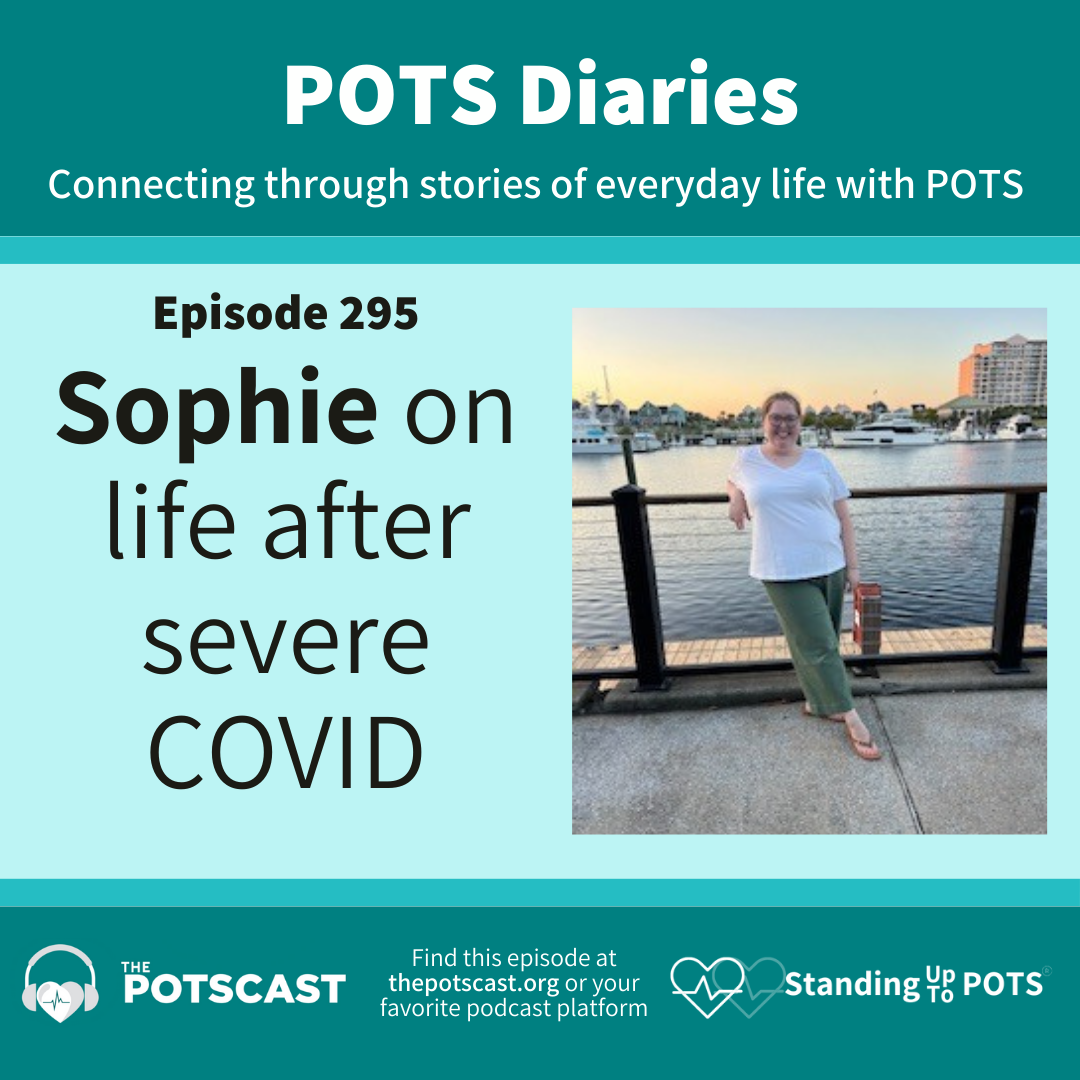
Jill Brook: Hello, fellow POTS patients, and magnificent people who care about POTS patients. I'm Jill Brook, your horizontal host, and today we have an episode of the POTS Diaries with Sophie. Sophie, thank you so much for being here today.
Sophie: Thank you so much for having me.
Jill Brook: So let's just start with the basics of who you are. Tell us a bit about yourself.
Sophie: Yeah, my name's Sophie. I'm 26 years old. I live in Atlanta, Georgia, and I'm a pediatric behavioral and mental health nurse.
Jill Brook: Oh wow. So what kinds of things do you work with or what do your patients have?
Sophie: Yeah, so we work with a lot of kids that have autism, depression, anxiety, ADHD. And I'm kind of on the back end of things and I answer parent questions and phone calls, anything like that.
Jill Brook: Okay. Wow, that sounds intense. Tell us more about you. What, what is your personality like?
Sophie: I would say I'm [00:01:00] pretty like compassionate and considerate. I'm a non-confrontational person. I just kind of like to keep things even and go with the flow, but I also have a type A personality, and I am very organized, like to have a plan, like to know what I'm doing and where I'm going.
Jill Brook: Awesome. And what are you passionate about or what do you like doing?
Sophie: Yeah, I'm really passionate about my job. I love helping kids with mental health issues. I'm very lucky to be able to continue to work, and I absolutely love that. I also love reading. I'm a huge reader. So far this year I've read a hundred books, so I've already hit my Good Reads goal.
Jill Brook: Wow. So do you not sleep or do you just read really fast? Or when, when do you read a hundred books. That's so awesome.
Sophie: I just read on the weekends a [00:02:00] lot because, you know, we don't, the, the fatigue is real and I'm sitting around or laying around a lot, so I wanted to do something productive and I decided to get back into reading.
Jill Brook: That's great. So do you have any books on your mind that you would recommend?
Sophie: The Midnight Library is a book I think everybody should read by Matt Haig. It's, it's very good. Yeah.
Jill Brook: Okay. Thank you. Okay, so did you have a life before POTS, and if so, when did POTS set in and tell us about your pre POTS life. What did that look like?
Sophie: Yeah. So I was a emergency room nurse before POTS. I ended up getting COVID in June of 2022 from work, and I was hospitalized in the ICU step down unit. I [00:03:00] was in respiratory failure. I had severe sepsis, and was in the hospital for about a week. After that is kind of when my POTS symptoms started. So before that I was doing Tae Kwon Do. I was working 12 hour night shifts in the ER. I had a pretty active lifestyle. And after I had COVID and was diagnosed with POTS, that completely went away.
Jill Brook: Wow. Okay, so I mean, that sounds like for a young person you had really severe COVID and it kind of late in the game. Like we always think about how it was that first round of COVID that was so bad, but this was a couple years into it.
Sophie: Yes. Yeah, I was working for about a year in the emergency room before I got it. I had all my shots and boosters [00:04:00] and I was lucky to not get it until then, but that was my first time and it really, it really got me.
Jill Brook: Oh my goodness. I mean, sepsis, people die of sepsis all the time, right? I mean, like, were you at risk to not make it?
Sophie: It was, it was really scary. I am really thankful that my coworkers in the ER convinced me to go to the ER. And they really, they really took care of me, and they made sure that once I was admitted, I was taken care of as well. I didn't realize how scary it was until after I was discharged.
Jill Brook: Wow. And that's probably a blessing, huh?
Sophie: Yeah, I think it's one of those things where like in the moment you, like, you just don't realize it. The adrenaline and probably the hypoxia makes you, you're like, everything's okay.
Jill Brook: So did you have POTS [00:05:00] right away, as soon as you got out of the ER? Or like, I guess, tell us about after that. Like you were probably just glad to be done with COVID and like what happened?
Sophie: Yeah, I was discharged. Immediately, I was told to follow up with cardiology because the medication that they gave me, Remdesivir caused my heart rate to go into the thirties. And so they had to stop giving me Remdesivir and wanted me to follow up with cardiology. So I followed up. I wasn't diagnosed with POTS at that point. I got a 30 day heart monitor, and pretty much right away had POTS symptoms, shortness of breath, palpitations. And then, at my follow-up, I still wasn't diagnosed with POTS by that cardiologist. Despite having the symptoms, it took probably [00:06:00] like another eight months to get diagnosed.
Jill Brook: So I take it you didn't ever like fully bounce back after that COVID. Like, tell us how you were feeling and functioning.
Sophie: I wish I did. I am a shell of what I used to be. It's, it's really sad and it's hard, 'cause I had, you know, just graduated college. I had just started my career, and I was, you know, young in my twenties and I was ready to live life and travel and do all of these things and live on my own. And then this happened and now I am still living with my parents. I need help with a lot of different things, and I pretty much don't have a life outside of work and home. It's, yeah, it's hard.
Jill Brook: Yeah. Can you talk about the [00:07:00] transition of like how you felt when you were like with COVID and then what symptoms went away, but what symptoms either started or stayed?
Sophie: Yeah, so the symptoms that went away, pretty much just my headache. That was the only thing that went away. The shortness of breath stayed, heart palpitations, the fatigue, which is probably the worst symptom that stayed, and I wanna say it's honestly probably gotten worse. Low blood pressure as well. That was something I had in the hospital and that has stayed as well.
Jill Brook: Wow. And so when you finally got the POTS diagnosis, were they able to find anything that helped very much?
Sophie: I found some medications that helped with my blood pressure and my heart rate. I haven't found [00:08:00] anything yet for the fatigue. And I was also diagnosed probably three months after COVID with adrenal insufficiency. They think it attacked my pituitary gland and caused it not to function anymore. And so, I now have adrenal insufficiency and am steroid dependent.
Jill Brook: Can you talk more about what that means? I feel like we hear that a lot, like adrenal insufficiency, but like what, what does that mean to you? What does that mean in terms of symptoms or what you need to do or worry about?
Sophie: Yeah, so adrenal insufficiency, there's two different types. Primary, which means your adrenal glands don't work. Or secondary, which means your pituitary gland isn't producing the hormone to make your adrenal glands work. I have the secondary type. My pituitary gland does not make ACTH, so my adrenal [00:09:00] glands are not triggered to make cortisol. So I'm required, I have to have steroids three times a day. I take hydrocortisone in the morning, in the afternoon, and in the evening. I'm also on fludrocortisone in the morning to help with my blood pressure. If I don't take the steroids, I can go into an adrenal crisis, which is when your blood pressure tanks, your blood sugar tanks, there's nausea, vomiting, you can lose consciousness, and that's a really life and death situation.
Jill Brook: Wow, and this is all because you cannot make the stress hormones that most people are trying to have less of.
Sophie: Yes. Yes. Yeah. And it's ironic. It makes you stressed.
Jill Brook: Yeah. Is this what JFK had?
Sophie: Yes. He had Addison's, so the primary adrenal [00:10:00] insufficiency.
Jill Brook: Okay. But does, does it have any effect, so it's not like you get out of experiencing stress because your cortisol is low?
Sophie: No, not at all. I am a very high strung person and I, I am stressed a lot. So I don't, I wish I could get out of it, but no.
Jill Brook: Yeah. And boy, I have to say that I have not had to take steroids that many times in my life, but I've taken 'em a few times, and when I take them, I turn into a monster. So when I lived in Alaska, I was on steroids a few times and I remember, first of all, I would not sleep at all. I'd stay up all night and just like try to stay busy, like cleaning, 'cause I'd have like this nervous energy. And I would like, actually sometimes like want to encounter a bear. Like I lived in a place in Alaska where, you know, if you went for a walk you could encounter a bear. And if I, you know, got up the energy to go for a walk, I'd want to, 'cause I like, I wanted to beat up a bear. Like [00:11:00] that's how I felt. And I recognized that that was not normal or healthy. And I actually told my doctor that I felt like this was like giving me a mental illness or something. But I can't imagine having to be on steroids all the time. I hope you don't react as badly.
Sophie: I am not angry 100% of the time. I'm not as irritable. I've found ways to kind of help with that. The main thing the steroids have caused is it's increased my hunger and I've gained a lot of weight. I've gained a hundred pounds since I was diagnosed two and a half, three years ago.
Jill Brook: Okay. And that's like a thing that steroids are kind of like famous for, right?
Sophie: Yes.
Jill Brook: Okay. And does it help your energy at all?
Sophie: It is supposed to, but I think I have so many coexisting conditions where chronic fatigue is a symptom that [00:12:00] unfortunately it does not.
Jill Brook: So how do you get through your day, 'cause your day sounds like it's probably pretty demanding. I mean, like parents of kids with these really severe issues, they probably are asking a lot of you.
Sophie: Yeah, I, I like to remind myself that it is not as bad as the emergency room, and it will never be as bad as the emergency room. But I wake up, I commute about an hour to work, and then I am in an office where everybody's really accommodating and nice and helpful, and they're just great. They kind of know what's going on with me, and so they make sure that I take breaks and I'm taking care of myself and they remind me to take my medicine in the afternoon. They're really, really nice. So I do that. Sometimes instead of lunch, I'll take a 30 minute [00:13:00] nap in my car to kind of help and then get back in there, finish the day at four. And then because of Atlanta traffic, my commute's about two hours home, where thankfully my parents, because I live with my parents, they help with dinner. And then I shower and I go right to bed.
Jill Brook: Gosh. So you seem like you're pretty well adjusted to this even though it's like so many lousy things that happened to you.
Sophie: I think I have become well adjusted to it. I used to, when it first started, I used to think it's gonna get better in a few weeks, it's gonna get better in a few months. And now it's been going on for a little over three years, and I think I'm kind of at the point where I'm not sure if it's going to get better, and [00:14:00] so I should probably start accepting and learning to live my life in this new situation.
Jill Brook: Yeah, what, what helps you cope?
Sophie: I know I had mentioned reading. I, I love reading. My pets. I have two dogs, Lenny and Crosby. I love them. I love my family. I have two little sisters. When they come home from college on the weekends, we'll play like board games and hang out and that's really nice.
Jill Brook: So when I was in graduate school, we studied something called downward social comparison as a way that people coped. And at the time they were studying it, I think in the context of people who had like cancer and stuff. And, it was kind of talking about how it helps people feel better to just like think of all the people who have it worse. Do you find yourself ever doing that?
Sophie: Yes, yes. [00:15:00] I, I tell myself a lot, you know, if I could not have a great support system, it could have taken me a lot longer to get diagnosed. So I'm very fortunate in those aspects because I didn't have that.
Jill Brook: Did other people from your same emergency room also catch COVID and also have things like this happen to them? Or do you feel like you're the one unlucky one, or do you feel like this happened to a number of you or...
Sophie: So in the emergency room that I worked in, other people got COVID, but I was the only one that had it as bad as I did. And I know there were a lot of other healthcare workers across the country that had had it as bad as I did, but in my immediate emergency room, it was just me.
Jill Brook: Wow. Wow. Has this changed your outlook on the healthcare system at all now that you've gone from sort of one side to the other?[00:16:00]
Sophie: Yes, it definitely has. I am better at advocating for myself. I used to, at the beginning of this, I really wasn't advocating for myself. I was just kind of like, oh, okay. That's what the doctors said. That's fine. And then eventually I realized, no, this, I knew how to deal with the doctors and kind of say, I don't feel well. This is what's going on, and I need you to help me. And I feel like I am able to get them to take me seriously now, most of the time, and not just say, oh, she's young, it's anxiety, or, oh, she's young, she's making it up. That I know that a lot of people go through that and going through this situation has made me realize [00:17:00] that you need to be your own advocate. It's also given me a new appreciation for parents of children that have chronic illnesses and medically complex conditions, because I feel like managing chronic illness and any medically complex condition is a full-time job, in and of itself. And so when you're having to work another full-time, like an actual job plus raising kids, it's really hard. So I feel like I am, I will do things more for the parents of my patients because I understand how hard it can be, and if I can make it a little easier for them, I will.
Jill Brook: Oh, that's beautiful. I'm sure that makes such a difference to them. And, wow, do you feel like there's anything that you know now about living with chronic illness that you wish you had known [00:18:00] sooner?
Sophie: I wish I had known that it doesn't just have one look. You can't tell that someone is chronically ill. Just from looking at them. I have people tell me almost every day that they couldn't, they wouldn't know that I was sick, that I have such a bubbly attitude and I'm full of energy. And I'm, I'm not. It's just a mask. Because I don't want people to see me not feeling well.
Jill Brook: Yeah, and you know what I was gonna say, I think some of it is even just like habit or muscle memory, right? Like if you get to age 20 and you've always talked in a way that made you sound super bubbly and energetic, I think sometimes, at least for myself, like even when that energy's there, it's not like I talk different.
So I still sound like that same bubbly, energetic person and that, that probably confuses people I've realized. 'Cause [00:19:00] so often people are, they're just like, you sound great. And I'm like, wow, how could I possibly sound great? And I think it's just like old habits of voice inflection or something.
Sophie: I, I think so. I think you don't want people to see you as sick, and you don't want people to feel bad for you and you don't wanna feel like a burden. So you do what you can to not appear sick. And I wish that I knew there were people out there that you don't look sick, but you are.
Jill Brook: Yeah. So it sounds like your social life is pretty quiet these days.
Sophie: Yes.
Jill Brook: Do you have anything that you're able to do, like the online or things, or do you get enough socialization at work?
Sophie: I do get a lot of socialization at work. That is one of the main reasons [00:20:00] I still work and do the commute, is for the socialization and getting out of the house and just seeing and talking to different people. On the weekends though, I really don't have much socialization. I kind of use the weekends to recover from the week, and I sleep a lot. So that is one thing that I feel like POTS and long COVID has taken from me is I don't really have a social life and it's hard to see other people have one.
Jill Brook: Yeah. Yeah. What is the best type of support or help that people could give you these days?
Sophie: Oh, thank you. That's a really, that's a really good question. I wish people would invite me to do things and not just assume that I can't do them because I'm sick. [00:21:00] And I also wish that people would make accommodations for situations. Like, oh, here's, you know, I have to use a mobility aid every now and then, and I wish people would think about that and just, you know, include me in things, but not make me feel like a burden.
Jill Brook: Mm-hmm. Yeah, for sure. Has there been any silver linings at all?
Sophie: I think this has brought me closer to my family. I am having to rely on them a lot, and I think I am a lot more appreciative of what they're doing to help me in everything that they did do before COVID. I can really see how much they care. I think it's also made me a better [00:22:00] nurse. Because I am more, I understand what a lot of these families are going through and the frustration of the healthcare system, and because of that, I have a lot more patience than I did before COVID.
Jill Brook: Yeah. So how do you make it all work? I mean, this sounds really demanding to have that long commute. I don't know, it sounds like kind of your week is a marathon. Do you do things to kind of like prepare and set up for it, or...
Sophie: Yeah, I go to bed really early. At eight o'clock, I know I'm like a grandma. I kind of go up, start my nighttime routine and I hope to be asleep by 9:30 every night. I wake up at 5:30 I'm still tired when I wake up, but I try to get as much sleep as I can, and then when I come home after [00:23:00] work, I don't do a lot of strenuous activity. I'm not cooking, I'm not cleaning, I'm not doing anything except for eating, showering, and occasionally reading.
Jill Brook: Yeah. Yeah, it sounds like you are in a little bit, are you feeling like you're at a steady state right now, or like are you still pursuing other things to try as far as like treatments or are you kind of making peace that this is your new normal?
Sophie: Yeah, I'm still pursuing other things. I had a stent placed in my iliac vein last August, and that helped with some leg pain and cramps, but it unfortunately, I have not seen an improvement in my POTS symptoms. Every [00:24:00] appointment, I'm trying something new and I'm still willing to try anything to feel better and to possibly feel like how I was pre COVID.
Jill Brook: Can you tell us more about the stenting experience, because so many people are thinking about that or wondering about that. Like what did they find? What was the procedure like? How invasive did it feel?
Sophie: I had a little bit of a unique situation because I was originally referred to an interventional radiologist and they contacted me and at our consult, they, they told me there was a really good chance that when they do the venogram, they're gonna put the stent in. And when I got there, that's the plan they told me.
And then when I woke up, they told me my vein was not compressed enough to warrant a stent. [00:25:00] My cardiologist suggested I get a second opinion where they found out that my vein was 90% compressed and the procedure was done wrong. It was done with the wrong size catheter and like the wrong amount of dye. And so I had a year where I thought I wasn't as sick as I was and that this thing that I thought could help me isn't going to.
Jill Brook: Wow. Okay, so, so that's sort of amazing that you got another chance to have it looked at. And so the second time, so the first time they thought it was what, like under 60% or some, there was some lower amount compressed and the second time they said it was over 90.
Sophie: Yes, so I had the stent placed. There was some back pain, I would [00:26:00] say the first couple of days that was like moderate to severe, but it went away, I think within five days. It's minimally invasive and I'm glad I got it done. I haven't had any side effects from it. It just didn't help as much as I thought it would.
Jill Brook: And then, so for people who might not be as familiar, I know I went and watched Without a Scalpel and watched them do one of these procedures on, I forget what streaming service has this, but they basically do, they go in like through your groin and they go into a vein and they like put a little camera in there and they find where it's compressed and then they leave behind a stent?
Sophie: Yep, that's exactly right.
Jill Brook: Okay. Well tell me, tell me the rest of the details.
Sophie: Yeah. So you are under anesthesia. Took maybe 30 minutes to an hour. [00:27:00] It was very, very quick. And afterwards, you're on blood thinners for a while just to make sure the stent doesn't clot up, and then you have ultrasounds periodically afterwards to make sure that everything is flowing correctly.
Jill Brook: Can you feel the stent?
Sophie: No.
Jill Brook: And do you have any activities that you're not allowed to do because of the stent?
Sophie: No.
Jill Brook: Wow. Okay, so, so it helped, but not with everything that you had hoped for. It helped with the leg pain?
Sophie: Yes. I think in my head I was like, oh, this is compressed, when it opens back up, I'm gonna, everything's gonna be fixed. I'm gonna have a normal heart rate. I'm not gonna be short of breath, I'm not gonna have fatigue. And I [00:28:00] think that was a little wishful thinking. But it, it did help. It helped with swelling in my legs. I used to get a lot of like Charlie horses at night, and since I've had that, I've probably only had one or two since the stent, which is a big improvement. And I haven't had any bad side effects, so I'm taking it as a positive.
Jill Brook: Okay. Yeah. And do you know, or have they even looked for very many details about why this happened to you in terms of like the actual mechanism of action? Like we all know that COVID can do a lot of damage, but as far as like details, do you get any answers in that, in that respect?
Sophie: No, I wish I did. In the beginning, like those first couple of months after, it was, it was really crazy. I had an adrenal [00:29:00] crisis, which led me to be diagnosed with adrenal insufficiency. I had kidney stones for the first time in my life. I had to have my gallbladder removed because it just stopped functioning. The ejection fraction was zero. And these were all things that happened after COVID and all of my doctors were wondering, you know, what, what could be causing this? What's going on? And they kind of all chalked it up to COVID.
Jill Brook: Okay. I feel like, I'm sorry to laugh, but like you had so many things happen to you that that didn't even come out in the first 30 minutes. Oh my goodness. So like, what else haven't you told us?
Sophie: It's, it's been a rollercoaster, yeah. So I guess after I was discharged from the hospital with COVID, it took me probably about a month, but I went back to work on like a [00:30:00] light, light duty. So I was just drawing blood, answering the EMS phone. I wasn't really taking care of patients. And then a few weeks after that, in September, I had a really bad flank pain and I went into work and I went to a doctor and I said, hey, like I'm not feeling too hot, you know, do you think like I need to get checked out, and then I passed out.
And so they took me, they took me to a room and I did not work that shift, and that is where I was diagnosed with adrenal insufficiency. And then in October, so the next month, I started having really bad like gallbladder pain, but there were no gallstones. Once they did the HIDA scan, they found out that it had just stopped functioning and they [00:31:00] weren't sure why. They're chalking it up to COVID as well. I never had any issues before that and I didn't really eat like a bad diet for a gallbladder. So, they chalked that up to COVID and the kidney stones, they chalked up to COVID as well. I don't know how, but that was what caused the flank pain that caused the adrenal crisis. And so it's just kind of been one thing after another since COVID, and they're all linking it back to COVID.
Jill Brook: Oh my gosh, you poor thing. So then you must have had like a mindset of like, oh no, what's next?
Sophie: Yes. Yeah, it was because things were happening pretty much on a monthly basis or sometimes a weekly basis. I was kind of, I was nervous. I was nervous. Any [00:32:00] symptom I had, I was second guessing. And you know, as healthcare workers we're sometimes we're not great about going to the doctor. So like when I had my gallbladder pain, it was really bad. My mom who had had her gallbladder taken out before was like, I think it's your gallbladder. You should call your doctor. And I was like, no, it's fine. It's probably just indigestion, like really bad. And it was not. My mom was right. Moms are always right. It was my gallbladder.
Jill Brook: So how long have you gone now without an emergency? Like, like, you know how sometimes a construction site, they'll have a sign that says that, you know, like this workplace has gone X days without an emergency.
Sophie: I think it's, it's, I don't wanna jinx it, but it has been my longest run since COVID without an emergency. I would say October of last year, so October of 2024 was my last [00:33:00] emergency.
Jill Brook: Okay, so you're hoping that you're out of the woods. Oh, you've had it so rough. You've been through so much.
Sophie: It's been a lot. Yes.
Jill Brook: Wow. Okay. Are you up for doing a speed round where we ask you to just say the first thing that comes to your mind?
Sophie: We'll see. Let's find out.
Jill Brook: What's your favorite way to get salt?
Sophie: Potato chips.
Jill Brook: What is the drink that you find the most hydrating?
Sophie: Gatorade, the yellow flavor.
Jill Brook: What is your favorite time of the day and why?
Sophie: Night, because I get to lay in bed.
Jill Brook: Where is your favorite place to spend time?
Sophie: My bed.
Jill Brook: How many doctors did you see for what ended up being POTS?
Sophie: Probably four or five.
Jill Brook: How many other POTS patients have you ever met face to face in the flesh?
Sophie: Probably less than 10, but I feel like there's more that I don't know about.
Jill Brook: What is one word that describes what [00:34:00] it's like living with a chronic illness?
Sophie: Isolating.
Jill Brook: What is some good advice you try to live by?
Sophie: Find the happiness in the little things and take every chance you can to be happy and to have fun because you never know when it's gonna be taken.
Jill Brook: Yeah. What is something small or inexpensive that brings you comfort or joy?
Sophie: Books, or my dogs.
Jill Brook: Who is someone that you admire?
Sophie: Ooh, that's a good question. I admire my parents. They definitely did not sign up to have a 26-year-old still living with them and having to learn all of these different medical protocols and emergency procedures. They've done really well, and they [00:35:00] really do their best to make me not feel like a burden, even though, you know, in my head I'm, I'm feeling like that, but they do their best not to make me.
Jill Brook: So it hasn't been released yet, but a recent podcast that I did with a patient, he said something that I really liked, which is a quote that it's a blessing to be a burden. And he said, it's because if I'm understanding him correctly, he said it's because people thrive when they're doing things for each other and reciprocating care.
And so I've been trying to, I've been trying to focus on that in my head more lately, but...
Sophie: I definitely need to be saying that in my head because when everybody around you has to kind of pick up your slack, and help you with things they didn't need to help you with and take on extra work, it's hard not to feel like [00:36:00] a burden
Jill Brook: What is an activity that you can enjoy even when you're feeling POTSie?
Sophie: Reading. I also enjoy playing like Mario Kart or Mario Party on the Switch.
Jill Brook: What is something that you're proud of?
Sophie: I'm proud at how I've handled all of these like roadblocks or obstacles.
Jill Brook: Do you have any little tricks for helping you fall asleep?
Sophie: I do not. If anybody else has any, it would be great to know.
Jill Brook: Do you have any tips or tricks to share on getting energy when you need it?
Sophie: I also do not, so if anybody has any tips, I'll take those too.
Jill Brook: That's why we ask. What is a gift that you would have sent to every POTS patient on the whole planet if you had infinite funds?
Sophie: Ooh, a cooling pillow or cooling towels.
Jill Brook: Oh yeah, Atlanta
Sophie: Yes. It is not enjoyable. No.[00:37:00]
Jill Brook: How hot does it get there? At the worst.
Sophie: Normally like mid nineties, high nineties and the humidity is not enjoyable.
Jill Brook: What is something you are grateful for?
Sophie: I am grateful to still be able to work.
Jill Brook: Finish this sentence. I love it when...
Sophie: I love it when I make people laugh or smile.
Jill Brook: Aw, people might suspect I'm a POTSie when...
Sophie: I start sweating a lot.
Jill Brook: Have you ever had to sit down or lie down in a weird place because of POTS? And if so, where was the funniest or weirdest?
Sophie: Yes, I had to lie down slash passed out at my job, right in the front door in the lobby during a patient situation.
Jill Brook: Oh.
Sophie: That was embarrassing.
Jill Brook: You just added to the [00:38:00] excitement.
Sophie: Yes. Yeah. Wasn't the plan, but it happened.
Jill Brook: Okay. I just have a couple more questions. What do you wish more people knew about POTS?
Sophie: I wish more people knew that it has a lot of symptoms. It's not just fast heart rate, it's not just fainting. It encompasses a whole lot of things. There's a lot of coexisting conditions with it like Mast Cell Activation Syndrome, hypermobile Ehlers-Danlos, and all of those can make it really hard for someone to function. And if you have POTS, there is a high chance you have those.
Jill Brook: Do you have anything you'd like to say to your fellow POTS patients listening?
Sophie: Yes. Do not give up hope and just try to support each other. Try to find happiness in [00:39:00] the little things. And even though your life is not what you thought it was going to be, or what you hoped it was going to be, there are still good moments and good things will still happen. It just might not look like how you pictured it.
Jill Brook: Yeah. And last question, why did you agree to let us share your story today?
Sophie: I think I wanted people to not feel as alone. And I feel like this has been a pretty isolating experience. I don't have any other family members or friends that have gone through this, and I wanted other people to know that it's, it's happening to others.
Jill Brook: Yeah. Yeah. Well, Sophie, thank you so much for sharing your story and all of your insights and, and tips with us. We appreciate it so much, and I know that everybody [00:40:00] listening is just sending you all the good thoughts in the world for, for only good things going forward.
Sophie: Thank you so much. Thank you for having me. I really appreciate it.
Jill Brook: And one more time, tell us the book you recommend.
Sophie: The Midnight Library by Matt Haig.
Jill Brook: Okay, I'm gonna go check it out right now. Okay, listeners, that's all for today, but we'll be back again next week. Till then, thank you for listening, remember you're not alone, and please join us again soon.