Episode Transcript
[00:00:00]
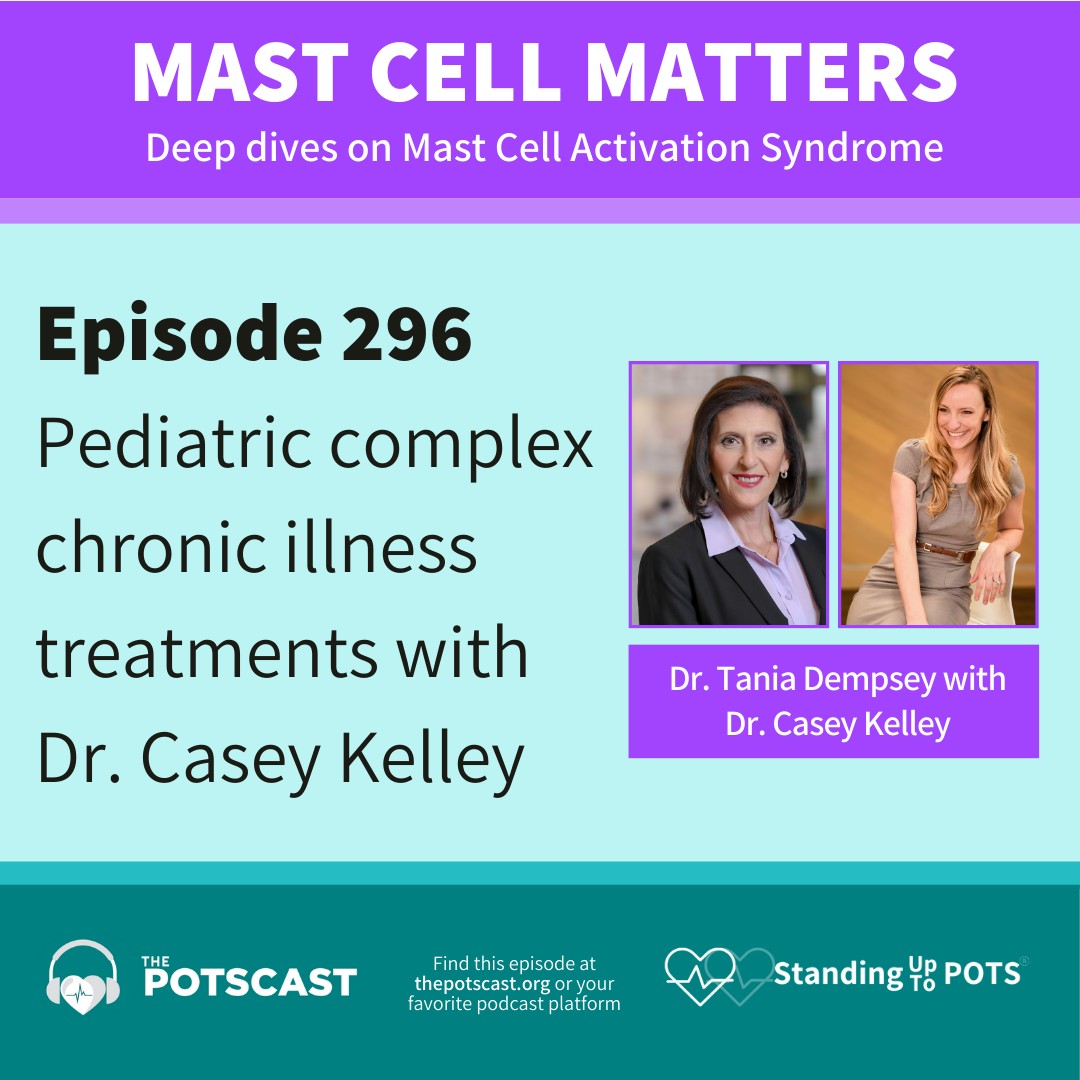
Jill Brook: Hello, fellow mast cell patients and lovely people who care about mast cell patients. I'm Jill Brook, and this is Mast Cell Matters, where we go deep on all things related to Mast Cell Activation Syndrome or MCAS, with the help of our wonderful guest host, Dr. Tania Dempsey, Johns Hopkins Med School graduate, world renowned mast cell expert, physician, researcher, who is so kind to donate her time to be here today. Dr. Dempsey, thank you, and which of your brilliant colleagues did you bring with you today?
Dr. Tania Dempsey: Well, I'm thrilled to have Dr. Casey Kelley here today. Dr. Kelley has devoted her career to helping people reclaim their health by uncovering the why behind chronic illness. As a board certified physician in family medicine and one of the first physicians board certified in integrative medicine, she's passionate about getting to the root cause of disease and empowering patients to achieve lasting wellness.
Dr. Kelley is the founder and medical director of Case Integrative Health in Chicago, where she and her team take a [00:01:00] science-driven, deeply personalized approach to care, combining the best of conventional medicine with the innovation of functional and integrative therapies to restore vitality and longevity. An internationally recognized expert in complex conditions like Lyme disease, Dr. Kelley is also a faculty member at Northwestern University's Feinberg School of Medicine, where she teaches the next generation of physicians how to think differently about health and healing. A graduate of the Ohio State University College of Medicine, Dr. Kelley has been a member of the Institute for Functional Medicine for over 15 years, and previously served as a treasurer of ILADS and is the first class of ILADS fellows.
She's a frequent international speaker known for translating complex science into practical, compassionate care that inspires both clinicians and patients. Welcome, Dr. Kelley.
Dr. Casey Kelley: Thank you. It's so good to be here. Thank you for having me.
Dr. Tania Dempsey: Yeah, no, it's, we always have fun. Of course, know each other from various, various circles, including ILADS. [00:02:00] And yes, I was really excited to have you here to talk about things that you're passionate about, including pediatric Lyme disease.
Dr. Casey Kelley: Absolutely. Yeah.
Dr. Tania Dempsey: So, so, so tell me a little bit about your journey into this realm. Maybe we can start there and hear how you got to this point in your career.
Dr. Casey Kelley: For sure. Yeah. And mine is a pretty personal story, and it's not all that different from most of the patient stories that we hear. I had chronic fatigue and was diagnosed with POTS, Postural Orthostatic Tachycardia Syndrome, when I was in medical school. And in medical school I was really disheartened with, you know, the way we were just kind of taught to diagnose and give a treatment and then not really finding why and then giving another medicine for the side effects of that treatment and just, you know, all of this just kind of felt wrong, right?
It was like, we're missing something here. So I started to really get into integrative medicine and the American Holistic Medical Association as it was back then, back in the [00:03:00] day, and found people who are curious and interested and, and found my people, right? These are doctors who are thinking through this and thinking through problems in a different way.
And throughout that journey I myself got diagnosed with Lyme, Bart, Babesia, the works. And when I was able to actually heal that, heal my adrenals, heal my gut, all of those things, all my POTS went away. But in that process, I then started to look for it in my patients. When you start looking for it, you start finding it.
And then, you know, when you're treating Lyme, I kind of describe Lyme in other vector-borne infections as a masterclass in functional medicine, because you can't, it's not just a simple, here's your antibiotic and you're done. You really have to understand the whole body and how it works and how it works together in the complexities, because it presents so differently in everybody.
And then that leads you to mast cell dysfunction and mold toxicity and autoimmune diseases and all these, you know, other layers that get piled upon these, these vector borne infections. And so I've just really kind [00:04:00] of honed in on my practice and, and caring for these patients and, and trying to help, you know, get to the root cause of all these complex chronic illnesses.
Dr. Tania Dempsey: Yeah. Yeah. That's a, that's a amazing, amazing journey. And one that, you know, I think is, is actually quite common, unfortunately, where, you know, physicians either have issues themselves or their family members. And you'll learn through that process, and then you can't unsee what you, you know, what you see, what you know.
So, yeah. So, but, but you do, you, you're, you're board certified in, is it family medicine? Right. So you do see patients of all ages.
Dr. Casey Kelley: Correct.
Dr. Tania Dempsey: And so, so tell us a little bit about, because I mean, my focus is mostly adults. I do some adolescent medicine but because you're seeing the little ones, tell us a little bit about how they're presenting, what age range, you know, you're starting to see more and more and, and what are [00:05:00] the complex illnesses that are accompanying Lyme and, and some of the other things you're finding in them.
Dr. Casey Kelley: Yeah. You know, Lyme is actually very prevalent in kids. It's kind of scary there. Some of the statistics will say something like 205 kids a day are diagnosed with vector borne infection, which is wild. Wild. That's, you know, more than diabetes, cancer, you know, all these things combined. It's a lot of kids. And they aren't usually gonna present the same kind of textbook way that Lyme disease presents in a, in an, an adult with, you know, a bullseye rash or a swollen knee, although I have seen that. I have seen kids with a swollen knee. I've seen kids with Bell's palsy. I've seen kids with bullseye rashes. But a lot of these kids are actually gonna present more with behavioral changes or fatigue or abdominal pain, something that you don't necessarily immediately think of a tick-borne infection with, with these symptoms that arise.
So you have to definitely be, be thinking, thinking about [00:06:00] it and questioning, and especially if they go through the rigmarole and everything's normal, right, through the normal pediatrician being able to kind of look for, for these different issues that might be causing their symptoms.
Dr. Tania Dempsey: Right, right. But it's harder in kids.
Dr. Casey Kelley: It, it can be. You know, I think that kids are resilient so often. I will see them heal faster if we can get, you know, the right to the right point faster. Just, you know, they have, you know, 20, 40 less years of baggage on, on top of all of this. But they don't have the, the words, you know, they don't have the vocabulary.
They can't explain what's going on. So a lot of it does get filtered through their parents because their parents are seeing a change and their parents are noticing a difference. And the kids, you know, sometimes some of the behavioral changes too, it's, they, they, they can't voice that their head hurts, they can't voice that their stomach hurts or they feel twitchy or, or itchy or something.
You know, they just kind of lash out because they, they don't know how to do that yet. [00:07:00] Right. So it can be very tricky to, to get to that diagnosis, especially 'cause the labs we have are not black and white. And we have to rely on those labs sometimes a lot harder with kids because they don't have that same history that you might find in a, you know, a more vocal adult. So it can be tricky. Absolutely.
Dr. Tania Dempsey: Right, exactly. Can, can we talk a little bit about PANS and PANDAS in this population, because I'm sure you see a lot of it. And we've, we've brought it up, you know, a few times on this podcast, but I think it really deserves a little more attention. So I'm, I'm assuming that in some of these patients, one of the ways they're presenting is with inflammation in their brain.
Dr. Casey Kelley: Exactly. Yeah.
Dr. Tania Dempsey: So tell me a little bit about your approach, what you notice, what the parents notice.
Dr. Casey Kelley: Yes. So PANDAS is traditionally associated with strep infection. So it's a pediatric autoimmune neuro encephalitis that happens after a strep infection and it can [00:08:00] be rather acute and it's, it's generally pretty abrupt. Kid is normal one day, the next day, all of a sudden they have severe anxiety, separation anxiety, OCD tendencies, big behavioral changes that are, are night and day.
You know, the kid was fine and then they weren't, kind of, kind of picture that we see with this. And it's very well documented with, with strep. And, you know, when kids come in with those type of symptoms, we are always looking for strep. We always have to look for strep markers, strep carrier strains, even strep swabs sometimes to see if we can kind of get to that.
But PANS is, you know, able to take that same symptoms and that same symptom cluster, but related to other infections. So it doesn't have to be strep, it could be Lyme or Bartonella, or perhaps even a viral infection that can cause this. And again, it's an acute change. It is more of a night and day type of, of change that will happen in these kids.
And it can be dramatic and it can be severe. These kids can be violent, they can [00:09:00] hurt themselves or other people. They can just refuse to go to school. It's, it's life altering, these changes that happen in these kiddos. So we're always doing a good history. Is there exposure potentially to strep, but also tick-borne infections?
You know, do you have a pet? Does the pet sleep in your bed? You know, do you play outside? It doesn't have to be someone who's, you know, hiking in the woods all day, every day, who gets ticks or tick bites. Most people don't see or remember a tick bite. You know, kids are closer to the ground where the ticks live. They're playing around in that ground. And these ticks don't hurt. They don't itch. You don't notice that you have a tick bite if you're not looking for it. And most people don't get a rash. Or if you do, perhaps it's on your scalp where you would never see it, right? So it's really easy to miss that in a kid.
But we just know that all of a sudden there's a big difference. And so, you know, most people will go to their pediatrician, right? Something's changed. Something's up with my kid. And the pediatrician will do their normal testing and [00:10:00] everything is quote unquote normal. So they get referred to psych and then they get put on psych meds, which can help.
But they don't often and or always, and sometimes they actually make it worse. And they're not actually looking for the root cause. So that's where we come in and look for those root causes and try to find those infections and treat what we find to see if we can affect a, a better, you know, improvement in symptoms and, and get rid of those behavioral changes.
Dr. Tania Dempsey: How, how often do you see an underlying a mast cell or Mast Cell Activation Syndrome process along with the PANS and PANDAS?
Dr. Casey Kelley: It's actually pretty common. I noticed it especially with Babesia infections. I think Bart and Lyme were close behind. You may have, you know, better mental powers around this for me, but it's always kind of like, what's the chicken and what's the egg?
Do these kids already have some mast cell dysfunction? Because some of them are, you know, allergenic kids that kind of come in, but not always. [00:11:00] And you know, these, especially for me clinically, where I will see it as the Babesia, the Babesia just really wrecks those mast cells. And those eosinophils, you know, they're associated with allergies and parasites, you know, they're, they go hand in hand. And so those kids, especially. And sometimes it's motion sickness or abdominal pain or nausea. That's kinda their big symptoms. They're not having the sneezing, the itching, you know, the flushing or anxiety too. Those mood changes that happen with the mast cells.
Dr. Tania Dempsey: Yeah. Yeah. Or even POTS. You know, we have, we have we've seen this in adolescents, but I'm sure you're seeing it in, in younger kids where again, they can't explain it like POTS, but they don't feel well like getting, like moving around. They wanna be lying down more, right? So is is it fatigue or is it an in intolerance to position because of their, their heart rate and circulation?
And, and I do agree that, I think [00:12:00] Babesia is a big driver of that, in my opinion. Although they're all kind of in the, in the mix. But I think the mast cells, I mean, I'll, I'll add my, my 2 cents because I think the vast majority of patients who wind up with chronic infections and chronic conditions like PANS and PANDAS, even though it's an acute process, I see it as a chronic problem. The vast majority of them have some underlying vulnerability, whether it was apparent right from the, from the start of their life or whether it became more apparent when they were infected. Often when you take the history and you go back to the health of the mother during the pregnancy, when you start to understand what other family members feel or have, or you start to see a trend that a lot of these people, there are other family members with symptoms suggestive of MCAS, 'cause I think there is something about [00:13:00] MCAS that is making kids, adults, et cetera, more vulnerable to persistent infection. That's a, that's one key to the, I think there's more, I mean, it's not the only thing, but that's what I wonder about.
Dr. Casey Kelley: Yeah, yeah. And it just kind of puts gasoline on that fire.
Dr. Tania Dempsey: Yeah. Yeah. So, so what's your approach? What do you, how do you, how do you start digging at the root cause on, on, on unraveling things. You know, because again, kids are a little bit, maybe more, more sensitive or you can't use the same doses of things that you, you do with adults. So what do you, what do you, where do you typically start understanding that everyone is different?
Dr. Casey Kelley: Sure. Yeah. And I, I try to be very picky with my blood work and testing on kids too. I mean, I am with adults as well, but I have a little more freedom, I think, to check under different rocks. With the little kiddos I'm not trying to draw 20 tubes of blood. So I try to be very, very, very picky about it.
But, you know, we, we test what we need to [00:14:00] test and, and if we have to do out of pocket tests or, or things to look for these infections. We gotta look for it, we gotta do it. We gotta spend this money to try to figure out what is there. But it always starts with a really good history, really trying to dig in. When it started, what the symptoms are like. You know, and digging into sleep and energy and gut. All of the things, right?
We're kind of looking at that and entire picture of this and the history. Back to, you know, were they a c-section kid, were they breastfed or not? You know, that information is very useful to kinda get us in there and, and try to figure it out. But I use those labs to drive it, but I also use the history in the symptoms.
And so at the end of the day, if I have a really strong suspicion that there's something going on, I'm gonna tell the parents. I think this is what it is, let's work together, let's try these different treatments to, to treat it. And for me it's a juggling act. There's always a bunch of plates spinning.
It's about trying to fight whatever infections we find whether that's an antibiotic or an herb. I do love herbs in kids. [00:15:00] I think tolerate them very well. I think they're easier on the gut. And, you know, I'm trying to be a good steward of antibiotics in that sense too. But we will use antibiotics if we need to.
But then we're also supporting the system. So we have to protect the gut when we're, when we're giving antibiotics or antibiotic herbs, we have to support the mast cells in the immune system and the Herxheimer detox, you know, or toxic reactions that can happen with these kids. And that's a lot of detox support and a lot of anti-inflammatories.
And with kids, you know, we try to do as much with liquids and drops. You know, most of these kids can't take pills, so we're also, you know, have to be mindful of that and trying to combine things or get 'em to taste decent enough so that they'll take 'em, right. So that's a challenge with kids too.
And especially some of these kids are really, really picky. There's texture issues, there's sensitivity issues. They won't take this powder, they'll take that powder, they won't do this liquid, you know, so sometimes it's a little [00:16:00] trial and error to, to get down to the, to the, the treatment plan that works.
But we try a lot of different things with kids and, and it's, it's about building and it's about supporting. So I'm always trying to support, not just attack, so it's not just attack mode. And sometimes we don't even start with attack mode because if the kiddo doesn't feel like there's resilience enough, you know, maybe their gut is just too much of a mess or their mast cells are just out of control.
You know, sometimes we have to spend some time to calm that inflammation and those symptoms down before we can even try to attack an infection. So it's very unique, it's very individualized. We kind of go patient by patient, but we're always trying to find the next rock. What's the next thing we're looking for?
What's the next step in here to help you heal?
Dr. Tania Dempsey: Yeah, exactly. I mean, I think you have to do that with all these patients, right? I mean, whether they're young, older. I mean, you always have to keep moving things along, and, and sometimes you do have to [00:17:00] redirect, right? You, you think you're going down one path and then you realize you have to switch, switch gears, right? Is there anything that you're really excited about right now? Either, either something that you're, like, you're noticing more that you didn't notice before, that people are not talking about, or a treatment or something. Where are you right now with the sort of cutting edge stuff? Let's talk about that.
Dr. Casey Kelley: So I would say there's a couple things. So one is I, I'm really getting more and more excited about SOT, even in kids. We have seen some really good results with SOT, especially when we can't tolerate antibiotics or herbs for one reason or another. It's a really great tool to help kids, in adults for that matter as well. I know you use SOT as well.
Dr. Tania Dempsey: We do a lot. And for the very sensitive patient, I mean, I think it's good for a lot of patients, right? But, but for the sensitive patient where you're really having trouble with herbs, you're having trouble with antibiotics you're having trouble with, especially if they're mast cell [00:18:00] patients. Yeah. I think SOT has been really incredible, so I'm with you.
Dr. Casey Kelley: Yeah, it's been a great tool to have. And I think, you know, we were talking at our clinic, we have rounds every morning, so all of the providers come together and, and we talk on rounds. And one of the things that we're talking about today I keep bringing up, actually, I've just noticed more and more since COVID, the stickiness and the hypercoagulability and the endothelial dysfunction. It's rampant and widespread, and these infections make it worse.
Dr. Tania Dempsey: Yeah.
Dr. Casey Kelley: Babesia is horrible with biofilm and nests. Bartonella, endothelial dysfunction and biofilm. Lyme, you know, the Borrelia, miyamotois of the world. These, these big biofilm producers are just making it worse and I'm seeing a lot of, lot of sticky blood issues, which is causing a lot of symptoms. And kids too, not just adults.
Which affects our ability to oxygenate our tissues. Which means our mitochondria don't work as well. Which means our nervous system and our nerves [00:19:00] aren't functioning properly. And it's just exacerbating everything.
Dr. Tania Dempsey: We, we know that this was a problem for sure with patients who've had these infections. We saw this before COVID. COVID is like the, the magnifier to the nth degree. So it just sort of like, it sets the stage. And even, even in people who had mild illness, even in people who don't even know that they had COVID, a lot of them still have the ramifications of it, and then it just compounds the problem, right?
Dr. Casey Kelley: Yeah. And we notice, I don't know if you notice, but just the amount of heparin we've had to give before and after. We need more.
Dr. Tania Dempsey: More. And you can see, like we do, we do 10 pass ozone as well. And the blood comes up into the bottle, we ozonate it. There's heparin in there of course. And then the heparin goes in with the blood. You could do this up [00:20:00] to 10 times. And you can see the biofilm on the bottle when you do this.
And you can see the people who, whose blood is like darker. It's darker, and it's like this biofilm thing. Those are the patients. It clots all the time. So we have to give 'em more heparin. We have to change tubing. The blood is so hypercoagulable.
Dr. Casey Kelley: Yeah. It's just, it's a step change in the last five years. It's wild. And so we've been doing more and more and more testing and more and more treatment for these.
Dr. Tania Dempsey: So what are you doing?
Dr. Casey Kelley: Yeah. So what we're looking at are a couple markers really trying to figure out if they're sticky because they're not clearing the fibrin clots or they're sticky because they're making too much fibrin. So, if they're making too much fibrin, then, you know, I've even started to kind of dive into low doses of Eliquis, which is a, a medicine to help thin that blood. And then if they're not clearing the fibrin clots, that's where I really love the enzymes, the lumbrokinase, [00:21:00] Neprinol of the world, to eat up those fibrin clots. I call 'em Pac Men. Kind of eat up those clots. So I'm, I really love those to support. Those are great for biofilm too. You know, you have to be a little careful. At least I have noticed sometimes if you do that without having antimicrobials on board, you released the kraken and that will exacerbate it.
Dr. Tania Dempsey: Yeah. You can't start treating biofilms without like being prepared for what's gonna happen.
Dr. Casey Kelley: Exactly. And I mean, I use Arterosil to help boost the glycocalyx inside the arteries, nitric oxide if we need to, to boost that. Even can use things like pentoxifylline which is an old school claudication medication. So, you know, we play, we play around with what makes sense for the patient to help support that.
Dr. Tania Dempsey: Yeah. I know. And there's a really great drug that is only available in Europe and in particular, it's made in Italy. And it's very hard to get. I have had some patients who have been able to source it. [00:22:00] I don't ask questions. But I will tell you that if you read the research on this, it's called Sulodexide. It is very, very exciting research. And I wish we had the ability to use it here and had access to it because I think that, you know, for patients, unfortunately, I don't know what it is about Eliquis, but a lot of my patients can't tolerate it.
Dr. Casey Kelley: Yeah.
Dr. Tania Dempsey: And, and so if they need something, yes, sometimes using enzymes, but it's for these, some of these patients, it's not enough, right? So, so this is a tool that if you, again, if you read the literature, I mean, it's been studied extensively in Europe.
Dr. Casey Kelley: There's some COVID clinics in the States that are using it too. I don't know how they get it.
Dr. Tania Dempsey: I know how they're getting it. They have a patient who goes to Italy and, and brings back cases. I'm telling you, like, I've heard some stories. There's gotta be a better way, right. We have to have access to it. But anyway, I'm excited about that, but I just wish, you know, we had, we could do something.
Dr. Casey Kelley: Yeah, [00:23:00] I do think ozone is a great tool for these too. I mean, you know, minus the, you know, the extra heparin that we have to give. But I use it in in kids too, not too young, maybe like 10 or 11 is kind of the youngest where we've added that. They respond really, really well to it. And you know, we tend to start really low with the kids as far as the doses and go up and, you know, all of that. But yeah, it's another useful tool. It is an adult treatment, but we have great responses to the kids for this too. And I think ozone also helps with blood flow. It helps heal those blood vessels. It helps to heal and repair along with fighting the infection. So it makes sense. But it is, it is a tool that we help, that we have used in kids.
Dr. Tania Dempsey: I mean, listen, what I tell patients is that it's like super oxygen, right? It's like instead of O2 it's O3. So imagine oxygenating your tissues if you're not getting enough, now you're getting extra. So yeah, some patients react, some patients it's too much. You have to really kind of, it's always personalized, right? I always [00:24:00] try to figure out dosing. But I've seen it help definitely in the vector borne infection realm, long COVID and even mold and, and mold and mycotoxin illness where you're trying to like, you know, they're on binders or they're doing stuff and, and they, you're still not moving the needle. Sometimes ozone just does, does the trick.
Dr. Casey Kelley: Yeah.
Dr. Tania Dempsey: And POTS, I've seen POTS, that symptom specifically. Of course it's probably all these other things getting better, but I have a few patients with POTS as their main symptom, and that gets better with ozone.
Dr. Casey Kelley: I know it helped me. Yeah. And I've been playing around too, and so typically it's not unheard of for us to give a Myers cocktail in glutathione after ozone, but for these mast cell patients, I've been playing around with just a more simplified mast cell IV. So it's just vitamin C, magnesium and taurine. Simpler. And that has helped, amazing. That little IV combo is kind of turned around some anaphylactic reactions too in that mast cell cascade. I love that combo.[00:25:00]
Dr. Tania Dempsey: And you give that right after the ozone.
Dr. Casey Kelley: We do.
Dr. Tania Dempsey: And you, and you don't worry about the vitamin C, sort of inactivating the ozone?
Dr. Casey Kelley: Yeah, I haven't seen any of that. And it's not that much. So I'm not using, I'm not using a super dose of vitamin C in this case, so it's not enough to turn it into hydrogen peroxide, which you can do at the high doses. So they're at lower doses. Yeah, and I've not seen any bad reactions. In fact, we'll often see it help. Although, I mean, I mean the Myers cocktail itself can be a lot for patients. Especially the magnesium is just so warming and just kind, especially with POTS and those kind of you know, orthostatic issues. It can make you feel really dizzy or lightheaded and certainly warms your nether fields and you feel like you're peeing your pants when you get Myers cocktail, which can be a thing. So it's not for everybody and we don't always add it, but yeah, those are some of the tools that we have.
Dr. Tania Dempsey: So what else, where else should, should we go? What else are you doing? What, what else is exciting in your practice right now? You have two [00:26:00] offices now I believe, right?
Dr. Casey Kelley: We have two. Yeah, we're hoping to open a third next year just to better serve the Chicagoland area and make sure that everybody has better access to, to the IV therapies, for example. I mean, our practice is growing and is, you know, by leaps and bounds. I have three PAs that work with me on the chronic complex side of things.
But it's really cool because we also have one has soon to be two cardiologists. We also have a longevity and hormone team too, kind of looking more at that aspect. And it's really great 'cause we get to work together really closely to help these patients. And I mean, hormones are a big thing these days and obviously a lot of these Lyme patients need hormones too.
But the Lyme patients are some of the hardest patients to get those hormones under control because when the Lyme in, you know, mast cells and mold and things are not under control, those hormones are really hard to balance as part of that process. So it's, it's always an interesting balancing act to get that all together. But it's, it's really fun 'cause we get to work together as a team.
Dr. Tania Dempsey: So [00:27:00] you use a team actually approach to, to some of what you're doing.
Dr. Casey Kelley: Yeah, yeah, yeah. So we get to use everybody's expertise in that sense. And sometimes it's just asking questions at rounds for that, and sometimes it's actually, we're all seeing the patient to kind of collaborate that way.
Yeah, it's really great. It's a fun, it's a fun group to work with and get to help a lot of people, which is fun.
Dr. Tania Dempsey: Yeah, which is so important. Listen, I think that there are just not enough physicians treating pediatric patients right now.
Dr. Casey Kelley: Mm-hmm.
Dr. Tania Dempsey: And, and the fact that you are, and, and, you know, opening more offices and, and training others, I mean, you're, you know, you're teaching, you're lecturing, and going on podcasts. You know, I think that that's really important because I think for a long time, you know, there, there were like a handful of doctors in the entire country that were willing to treat kids with, with these conditions.
And so what do, what do the rest of the people do? [00:28:00] You know? And, and, and they just suffer. And unfortunately what I'm seeing more and more is that they're just, no matter where in the country, there really is this I don't know if it's fear. I don't know if it's ego. I don't know what it come, where it comes from, from a lot of the other doctors, but, you know, the, they don't wanna go there with their patients, the pediatricians. I don't know if it's a default, that position that they have that kids are well, and so there's no way that kids cannot be well. And so then they blame it on the parents or they blame it on, you know, anxiety or they, you know, and that needs therapy. And that's so sad to me, right? That, that people are not taking this seriously. So, you know, I think we just need more providers treating kids.
Dr. Casey Kelley: Yeah. And we have a large childhood population. We're lucky enough in Chicagoland there are you know, a small group of integrative, if you will, providers. But they're, you know, they're far out in the suburbs. There's not really a cluster of us. There's just a couple and we all kind of know each other and talk and, you know, share [00:29:00] patients and, and support each other in that way as well.
And one of my PAs, Tara, is beginning really well known for her PANS/PANDAS work. And, you know, it's really hard, some of those, some of those treatments require things like IVIG, which is really hard to get covered by insurance.
Dr. Tania Dempsey: Are you doing any of that yourself?
Dr. Casey Kelley: Not so much, like we get it covered at times. We're not really doing it in our office. They usually get done in infusion centers. But the coverage, it's so hard to get covered. It's, it's so hard. We, we do have a law in Illinois called Charlie's Law, which can help a little bit to get it covered. But it's a, it's a tricky population. And these kids and these parents, they go through a lot and the schools don't understand, and the schools don't wanna help. And you know, I had a patient today who's, she misses school a lot. And she gets sick, she has to miss school for a few days. She goes back. She gets sick again, she has to miss school for a few days. And you know, we are, we've got it under good control at this point, but she still misses school.
And so the children's services is still like being notified when she's not at school because they [00:30:00] don't trust her or her mom that she's sick, you know, and that there's a reason she's not at school, she's not just playing hooky. And so, like, there's, that part is, I think one of the hardest things too with, with kids in dealing with these populations is there's, there's not enough understanding, you know, there's not enough acceptance, there's not enough credence and, and space given to these kids to, to heal.
And then they're in these moldy school buildings. And that's another fight, right, which just can, for some of these kids, they're so sensitive to these things and, you know, it's, it's this, you know, snowball effect. And it's, it's, it's tricky. It's hard. I said kids are resilient. I do think that there, like, there's a good chunk of 'em that do get better quick, which is lovely and nice. You know, I mean, I've been working with some patients for seven years before we start to see like, really, you know, good stuff.
So, it's nice when we have someone, okay, three months later we're [00:31:00] like, things are good. Like, we're making improvements. It's not always true, but I, kids I do kind of see that on there, especially when we can get to it, when we can actually figure out what we are treating and treat the right thing, their body responds. And then it starts to heal from that process.
But none of it's easy. You know this, it's not any easier than adults and in often ways it's harder, like we mentioned before. But yeah, there's just not enough, there's not enough resources. I agree with you, and I feel so bad for these parents and these kids that they're not getting the support or the acknowledgement, you know.
Dr. Tania Dempsey: There needs to be reform at the school level, but also about the mold, about, I mean, there's just so many issues that I see and I don't even know where I would start, and I just hope there are people who are starting to look at this because it just is, it's not, it's not a good, it's not a good situation.
Let's say the, the parents bring the kids in, 'cause the kids are, are having more, let's say an acute problem. Sometimes not acute. I'm sure [00:32:00] some of it is chronic too. It just takes 'em a while to figure out where they need to go. But how many of them have either siblings that also then wind up under your care or the parents themselves? How often does that happen?
Dr. Casey Kelley: A lot, a lot. I mean, I had a kiddo today who's a twin, and her twin doesn't have these issues. So there's that. But I also have a family of eight. They all have something to various degrees. You know, and is it mom and dad passed it on, or is it that they're all playing in the same backyard, you know?
But they all will present differently too. Like the, the mom with six kids who all present differently and have different treatment plans. God love her 'cause wow, 'cause everybody's body is so different. So even if they do have the same bugs, they're gonna present different ways. So they're gonna need different treatments and different support along the way, right. But it's really common. It is. It's really common. And I, you know, I'll hear parents say, well, you're gonna see the whole family, 'cause we got, you know, we got the sickest kid in and we started to see improvements. So then the [00:33:00] next one, you know, and then they bring in the rest of, and then mom and dad come in, right. And grandma and grandpa come in. So it starts to kind of bring the whole family. But this is a good thing about family medicine too, is that you do get, that, you get to see that whole family and that dynamic plays a role in all of this too.
Dr. Tania Dempsey: That's my, that's my favorite really, to be able to take care of multiple generations. And I do have that, you know, families like that. But, but I see the point being is that I see that too. I do think that the, so I have, I have families where I take care of actually like three generations. So it's grandmother, mother, and then kids. And the kids are already like in college, but they, you know, I took care of them when they were a little bit younger. And then, you know, what I see is that the grandmother is actually maybe the healthiest in some ways, in some ways. Still has chronic issues and getting older.
I mean, there's lots of things, right? But it's a little bit different. But a little bit more [00:34:00] resiliency actually. Then the parents are not bad, but they have stuff and they definitely have a lot of stuff, and, and you're still unraveling things. And you know, they're older than their kids, so they have more traumas or they have more things they've had to deal with.
This is my theory, but the kids are more severely afflicted on many levels. And it's not that, like you said, kids can be easier to treat in some ways. Absolutely. But I think they have more challenges because they are exposed to more toxins. There's no other explanation. And it's epigenetic. They have more exposure to environmental toxins. Pesticides, plastics petrochemicals. I can go on and on and on. PFAS, whatever, right? But then it's also the, the phones and the EMFs and the, the social media, [00:35:00] right. So I just think that the kids are really in this position where, you know, it just breaks my heart that, that, you know, it, it does seem to be that the, that the kids are even more vulnerable than ever.
Dr. Casey Kelley: Yeah, I see what you're saying. I'm thinking more like little kids when I talk about it. You know, when you start to get into the teenage and 20 years age group. But I hear exactly what you're saying. And I, I agree. And I think that that toxin burden that we pass down, generation to generation, you know, that, that bioaccumulation of it then, plus the fact that we have a more toxic world that we're living in, and then you throw, you know, pandemics and things on top of it. We're in trouble. We're in trouble. This is an issue. I mean, there's 205 kids a day diagnosed with vector-borne infections.
Dr. Tania Dempsey: Yeah. That's a crazy statistic.
Dr. Casey Kelley: And that's just, you know, that's just the tip of the iceberg because like you said, like all of these other issues and it's harder to fight those infections when you have those toxins, when you have that stress, when you have the EMFs, when you have [00:36:00] all that stuff on there piling it up.
Dr. Tania Dempsey: That's right.
Dr. Casey Kelley: Yeah. But that's why it's important too, for parents to be their advocate, for their kids, you know? And say something is different, something is wrong. If we can get this now, it's less of an issue. Like let no, don't take, don't take this is all in their head, it's all psych. Don't take that for an answer. That that might be part of it, but there is a reason. Look for it. Something is going on and maybe it's just detox. Maybe it is just they need to be detoxed. Simple enough, right? I say it's simple, but...
Dr. Tania Dempsey: No, we know. We know it's not. Yeah.
Dr. Casey Kelley: Right. That's why like I listen to parents, I trust parents. When parents say something is different I believe them. Something is different. Let's figure this out. Because the more we wait, the longer we wait, the harder it is.
Dr. Tania Dempsey: That's, that's very good advice. I was gonna ask you, 'cause we're gonna be finishing up you know, what, what's one, one piece of advice that you would give and, I mean, I think that was, that was, that was perfect. Couldn't have been better said. Yeah, I think it's, it's the fact [00:37:00] that they can have a relationship with you and that you know, that you trust what they're telling you and they trust that you understand them.
And you know, that, that, that's not really very common unfortunately in our, in our day and age. So, you know, so that's amazing. You're helping a lot of people. Okay, so how can people find you?
Dr. Casey Kelley: Where are we? We are on the interwebs, so, CaseIntegrativeHealth.com. We also have a social media Instagram, Facebook, that kind of stuff. It's all under Case Integrative Health, but I'm also on there, on Instagram as Dr. Casey Kelley. We also have HealWithCase.com, which is our online teaching tool. So we do have some courses on there. I have a course right now, The Fundamentals of Healing, a groundwork for healing, which is about how to eat well, detox, sleep better, move better, et cetera, to just kind of get some of those good solid foundations for healing. And I will have a Lyme Academy coming out [00:38:00] soon to help give some online teaching and, and good, reliable, ready to use tools to help people kind of work through this. Especially, you know, it takes a long time to get in to see Lyme doctors 'cause we're so far and few between, to help give tools to get the party started and get things moving while you wait. I think it doesn't replace seeing a good provider, but it's, I just wanted to get more tools out there for people to help more people in more ways. So check us out.
Dr. Tania Dempsey: Great, great stuff. Thank you so much for being here.
Dr. Casey Kelley: Thank you. So lovely to see you as always. I wish I could give you a big hug.
Dr. Tania Dempsey: I know, I know.
Jill Brook: Dr. Dempsey and Dr. Kelley, thank you so much. This has been some amazing information. I think a few of us are gonna have nightmares tonight about those biofilms in the blood that you mentioned, but we are so grateful for your time and your expertise. Hey, listeners, that's all for now, so thank you for listening, may your mast cells be good to you and please join us again soon.