Episode Transcript
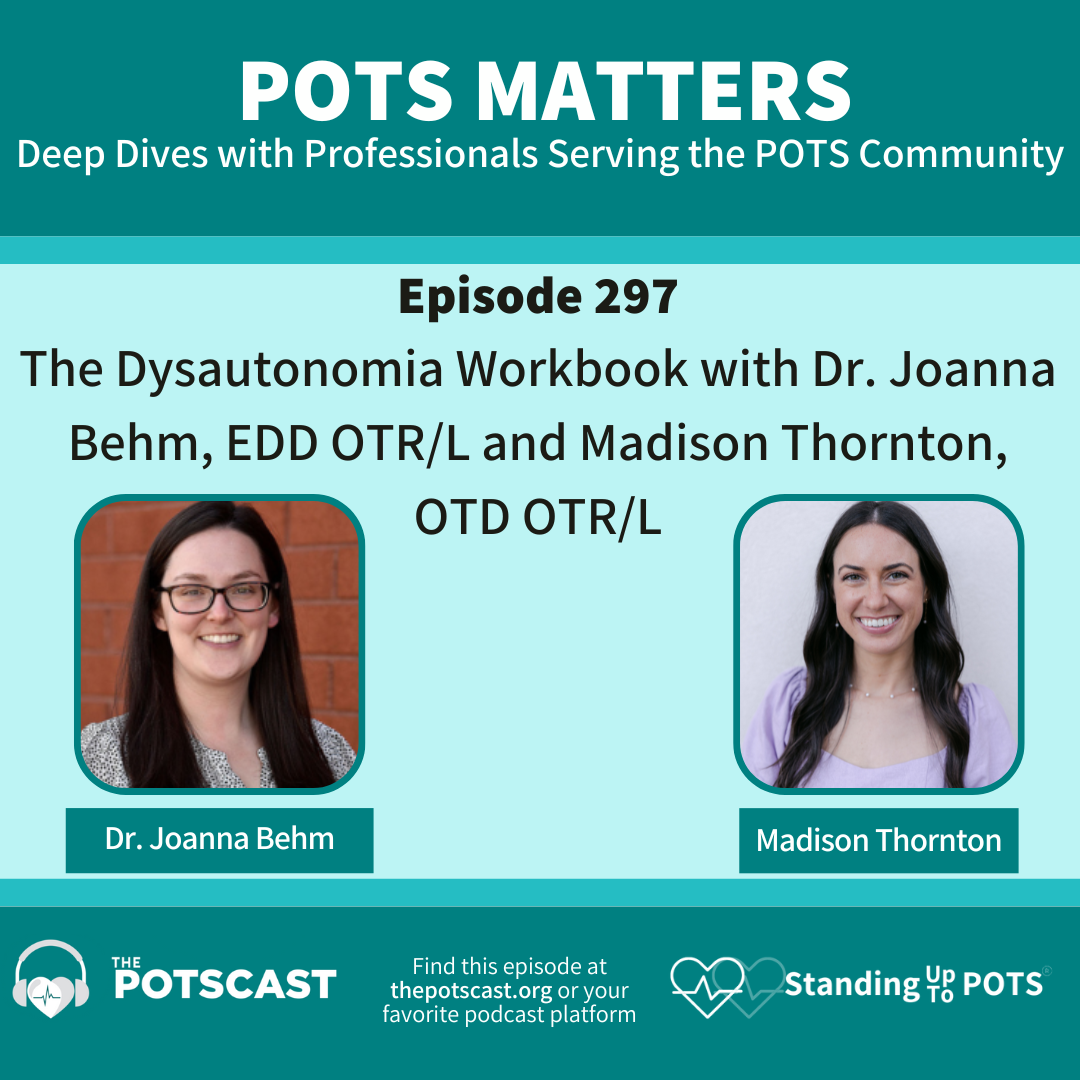
Jill Brook: [00:00:00] Hello, fellow POTS patients, and most appreciated people who care about POTS patients. I'm Jill Brook, your horizontal host, and today we are interviewing two superstar occupational therapists who have written the Dysautonomia Workbook, A Guide to Empowered Living. Dr. Joanna Behm is an occupational therapist and professor of occupational therapy at Messiah University and Vice President of Medical Affairs at Dysautonomia Support Network.
She was our guest on episode three of this podcast, if you remember that far back. And Dr. Madison Thornton is an occupational therapist at Sky High Occupational Therapy in Nashville, Tennessee. Thank you so much for being here today.
Dr. Joanna Behm: Thank you for having us.
Jill Brook: So maybe we can start with Madison, but can you each tell us a bit more about yourself, your professional background, what kind of work you normally do, and how you ended up with expertise and interest in occupational therapy for [00:01:00] dysautonomia?
Madison Thornton: I am a pediatric occupational therapist right now. I have clinical experience in outpatient, in inpatient settings with both adults and with pediatrics. And I kind of, I kind of came to occupational therapy because of having dysautonomia myself. And so, I, I kind of like to say I OT'd myself in a way just by trying to figure out what works best for me to improve, like function and daily life and the things that were important to me. And so, my dream for my doctoral capstone project in school was to somehow combine occupational therapy and dysautonomia, and so then I was connected with Joanna at work and we kind of made the dream come to life.
Jill Brook: Oh, fantastic. And Joanna, I know people might remember you from your awesome episode three, but can you remind us a little more about you?
Dr. Joanna Behm: Yeah. So yeah, so as Jill said, my name's Joanna Behm. And I've been an occupational therapist since [00:02:00] 2014. And I've been with Dysautonomia Support Network since 2013, so I've been with them for a long time. And so, Jill, you and I have worked together for, for a long time and kind of been, you know, collaborating in different ways.
So as you know, like we have been working on some occupational therapy kind of handbooks through Dysautonomia Support Network talking about, you know, how do you do K 12 education with dysautonomia? How do you get through college? What does work look like? What are some assistive technology and tools that one can use?
And so we have done these projects over the years. And then, as Madison reached out to us about being a capstone student with Dysautonomia Support Network, we really had a conversation of, you know, we really just need a patient workbook, or we thought handbook at first, like a patient handbook or workbook that really focused on, okay, I have dysautonomia now what, how do I live life?
Because a lot of our, you know, healthcare is focused on medication, which, you know, for a lot of us is lifesaving, right? But at least in my experience as a patient [00:03:00] with dysautonomia, I was never told, hey, here's some really great lifestyle adaptations you can use besides the typical drink more water, eat more salt, wear compression, exercise even though you feel horrible, right? Like that's really all, at least from my experience, I've been told of what to do with my dysautonomia. And so I knew there had to be more. And occupational therapy really for me opened up this world. I was diagnosed with my form of dysautonomia in college, when I was in OT school.
And so for me it really opened up this world of, gosh, there's so many things we can do to help manage our symptoms beyond the, you know, kind of the salt, the water, the compression, which those are all good things, right? But there's so much more beyond that that no one's talking about. And so Madison and I really wanted to combine our, our personal experience and the occupational therapy experience into one kind of book for people in, in a succinct format that basically says, hey, here's all the tips and tricks we know.
Jill Brook: Awesome. And I guess maybe for anybody who doesn't remember [00:04:00] far back enough for episode three, Madison, could you remind us just what is occupational therapy? How is it different from physical therapy or speech therapy or the other kinds of therapy that people might be familiar with?
Madison Thornton: Occupational therapy is a very holistic and client centered field. And so we really focus on helping people do the things that they need and want to do in daily life. And so, you know, where that might differ, we, I think, you know, we share a lot of great commonalities with the other therapies. You know, physical therapy really focuses on like building strength and endurance and kind of the more structure and function. I think OT also plays a role in that as well as kind of, saying like, what part is hard? What part can we support you in? And are we gonna maybe adapt the environment or adapt the task so that we can support participation and function?
So, I think that where we might differ is like, we try to think about like energy conservation, [00:05:00] pacing, and like also promoting strength and endurance and all of that as well, but also supporting quality of life and like a meaningful engagement in the things that are important to someone.
Jill Brook: Yeah. Joanna, since you're a professor of occupational therapy, do you have anything to add to that?
Dr. Joanna Behm: Yeah, I think I, I always describe it as like physical therapy are, they're really the experts in movement and in movement analysis. Strength, the endurance, the, the flexibility, all those pieces. And they're really the experts in that. And I, I view occupational therapy, you know, physical therapy has their, their main mode is remediation, right? They're trying to help fix the underlying issue. Occupational therapy also can focus on fixing things, but we have other modes of intervention that we look at. So we also look at adaptation. How do we adapt a task? How do we adapt the environment? How do we adapt how the, the person is doing something? We might also be looking at prevention. How do we make something hopefully not get worse. How do we prevent bad things from happening? We look at health promotion. [00:06:00] How do we help people promote their overall health and wellbeing? And so, like Madison said, the thing that I think makes us special is this activity analysis. We look at an activity, let's say making a peanut butter and jelly sandwich. You might say, oh, that's like four steps, right? But occupational therapist would say, oh no, that's like 20 some steps because we're breaking down every single little tiny piece there is, and analyzing every single piece to every single step and saying, what's the problem?
Where are we having trouble? And then that's where we intervene. So I like to say that we're kind of detectives, right? Like we're trying to figure out exactly what the problem is, and then we just have toolboxes of tons and tons of solutions and, and we just, we try, we trial and error and we see what works.
We keep it really independent for every person. Every person gets their own way of, of being treated. Because what works for one POTS patient does not necessarily work for another POTS patient. And so I think that's kind of like what makes us special.
Jill Brook: That's great. That seems like it really is suited well to [00:07:00] POTS since everybody is so different and it's almost like we need that same approach almost, you know, like you'll hear doctors say that that you know, they never know what's gonna work for one person. And it's like only 5% of things work, but you never know, for each person, you know, it's different. And so, so that's great. It seems really well suited. And occupational therapy is something that a physician can refer a patient to, right, because I, I have worked for physicians. I have been a patient in a lot of different contexts where I have not been able to do a lot of normal everyday tasks and never has anyone said to me, hey, why don't you see an occupational therapist?
I've never heard it mentioned. And so it seems like you guys are so helpful and I don't feel like, like you get as much attention as you should.
Dr. Joanna Behm: Well, you're preaching to the choir. We, we agree with you for sure. I think that some of it is that because we do so much, I think it's sometimes hard for folks to like kind of [00:08:00] distill into one short, quick phrase, hey, this is what we do, right. And I think that, you know, people's automatic thoughts are, oh, if you're sick, you go to physical therapy, you have an injury, you go to physical therapy.
And they're so helpful. Absolutely. But also, sometimes it's not just a strength or an endurance or a pain issue. Sometimes it's lots of other issues. And so that's where OT can really come in and be super helpful. And so, we hope through this workbook and just through other advocacy that we're doing, that occupational therapy becomes eventually a household kind of name. Everyone knows what it is and, you know, people are going and getting the care they need. And hopefully doctors will eventually, you know, think off the bat, oh, they have trouble with getting up in the morning doing the things they need to do, you know, so on and so forth, that their first thought will be OT. That's, that's the goal.
Jill Brook: Yeah. Okay, so back to the workbook that you guys have created. Now, Madison, why was this a workbook and not a handbook or a book or, you know, tell us the thinking that went [00:09:00] into your handbook. Why did you make it and why this form factor?
Madison Thornton: Yeah, we kind of started as a handbook as Joanna mentioned, and went a different direction with the workbook because we knew there was, there's a lot of research that we wanted to include in our, in our product. You know, we wanted it to be evidence-based and we wanted it to be like a wealth of knowledge.
But we also thought, you know, the piece that we bring as occupational therapists is like, we really wanna make it practical. We want to like make it kind of easy to implement these strategies and the tools that we're finding are, are really helpful in research. And so, kind of the way we broke down the workbook is in occupational therapy, we have areas of occupation. So these are things we do every day that fill our life. So, the workbook is sectioned out into areas of occupation. So that's things like activities of daily living, which might be like bathing or getting dressed. We have the instrumental activities of daily living that are a little bit more complex than, than the basics. So that might be like grocery shopping or doing laundry or household [00:10:00] chores. It also includes things like social participation and play and leisure, health management. So it kind of just encompasses all the things that we do in a day. And then, so within the workbook we have, you know, we have the research that's there and we also have like activities that are there to support each section.
So, kind of after you read the section, there's like reflection questions, there's activities just to kind of implement what we just read. So, we try to make things like very practical and simple and things that people, people can hopefully use to just make a simple change and hopefully see a difference.
Jill Brook: Yeah. Can you talk a little bit more about that? Like Joanna, so like basically how do you envision a person using this book once it arrives? Like do you want them to read it cover to cover? Do you want them to, like what do you want them to do with it?
Dr. Joanna Behm: Yeah, so I think there's a couple different ways people can use it. I think that if somebody is maybe new to kinda lifestyle management, lifestyle strategies for dysautonomia, maybe starting [00:11:00] at page one and going cover through cover is like a great strategy for them. But for other folks, maybe they wanna jump around. Maybe they wanna, you know, oh, you know what, college is starting in a few weeks, maybe I wanna jump to the college section. Or, you know, hey, I'm looking for a job, maybe I wanna jump to the work section. So it really, in my mind, is meant to kind of be a resource that people can sort of jump around, use different strategies from different sections. And our workbook pages are really kind of about habit tracking. So we say, okay, we just told you a whole bunch of stuff. Pick three things you wanna try. And then after you try them, how successful were they? How effective were they? Did you like it? Was it hard? What was hard about it? What were the barriers? How can we overcome these barriers? So, you know, trying to help people not feel overwhelmed. Because you know, like I, I know this when I'm told, hey, try these 10 new things, it's too much. We can't make change like that, right? We almost need incremental, step by step, add one thing at a time and then eventually you'll, it'll become a new habit for you, right?
And so the [00:12:00] idea is that we're gonna give you tons of options and then you pick one or two or three and you just start there. And then you see, huh, did it work? Did it not work? And then you figure out, how can I implement this into my life? Or if you're like, you know what, I didn't like that idea. It didn't work. Let me go back to the workbook and let me reread that section. Let me find some other things I can try. So we're really trying to kind of help patients build up their own strategies that are individualized to them. Through our book, folks are gonna learn what's their coping style, right? We have a whole section on mental health and coping.
Having a chronic illness is really hard. I've been chronically ill for most of my life, and I, I didn't get my diagnosis until my early twenties. And so that, that's really hard. I still to this day feel emotional effects from that, right? So like, what is my coping style? Am I more emotion focused, avoidant focused, problem focused, right?
So we have a whole section on that. We have a section on relationships. Having relationships with folks as a chronically ill person is hard. It's really hard when your friends wanna [00:13:00] go out and do things and you know, you can't physically do them, right? So we have prompts in there about like, what types of relationships are most beneficial to you?
What types of relationships do you feel are really mutually beneficial to you and the other person, right? Relationships are give and take. How can you be supportive of your relationships? How can your relationships be supportive to you? Here's some talking points. Here's some scripts you can consider.
We also talk about, you know, exercise, the big scary word of exercise. I have a whole lot of trouble exercising. I'm very orthostatic intolerant. And so we really focus on how do you move your body gently. Kind of throw out this idea of this obsession with exercise. We know that we do not have POTS because we're deconditioned, right?
The vast, vast majority of us, that is not the case. So, okay, how can we move our bodies in a way that feels good to our bodies, not in a way that causes more pain or more stress on our joints, or, you know, whatever. And so, we really, we actually have an exercise model that will demonstrate every single step of every single exercise that we [00:14:00] suggest, or really movement, right? And we start the movements all the way from laying on your back to being able to stand up. And so no matter where you're at in your journey, you have a very clear picture of here's exactly where I should start and let's just see how it goes, right? And so those are some of the things that I think are kind of special about the workbook that go very far beyond just like the, you know, the, the basics.
All of us were told when we got diagnosed.
Jill Brook: Wow. Okay. So this is way more far reaching than I, I would've even known to guess, like with the coping and the relationships. I didn't even, I did not realize that was in scope with occupational therapy. That's cool. Madison, do you mind just keep talking about examples? Just, I don't know, give us an idea of things that maybe resonate with you. And I guess what's going through my head is if somebody's listening to this, and it still sounds like a little bit like vague, can you talk about like maybe a couple little concrete parts of it that that would be an example.
Madison Thornton: Yeah, [00:15:00] definitely. Let's see. Like Joanna said, like OT is so far reaching and so it's like, it is very broad. It, it, we, it kind of like just encapsulates the whole person. But let's see. I think that, you know, one section that might be interesting is like, we have a whole section on sleep and rest.
And so like we know that sleep is very important, especially for those of us, us with dysautonomia. And so, you know, our sleep and rest section, it will have, you know, it will have the research it will have the, the things that the, the professionals are saying. And then we also have you know, activities to support and, and like that tracking, that habit tracking of like, what are your needs? How can we set up our sleep in a way to have good sleep hygiene? We go a lot into sleep hygiene. So like what goes into the environment to have good rest? What are our habits before bed that help us have good rest or after? I think like even to a kind of a more detailed [00:16:00] activity of like kind of incorporating the mental health piece too, like reflecting on the day, how can we kind of think about, think about how our day went and, and what can we do to move forward and like, let go of the, like the, the mental burden of the day too. As well as like kind of the more concrete, like how many hours of sleep do we need? Like what is your sleep environment like? It kind of, it kind of, it's pretty broad and, and hopefully kind of breaks down that activity of sleep and rest into a way that we can think, like all of the different things that go into sleep and rest, yeah. Any, anything else, Joanna? Any other sections you think are really important?
Dr. Joanna Behm: Yeah, I think one section that what you, as you were talking about sleep, I was thinking, yeah, like we also have an activity where folks are gonna create their own nighttime routine. And so there's a chart and they're gonna be like, okay, 60 minutes before I wanna be in bed, what am I doing? 45 minutes before I'm in bed, what do I wanna do? Like really starting to prepare our bodies and our minds for sleep. You know, maybe let's not doom scroll [00:17:00] in bed. That might not be helpful. Right. You know, is, is reading a book helpful? Is laying on a, you know, warm heating pad? Helpful is getting into a good position helpful? You know, do you need to take your medicine at a certain time, right, to have that medicine kick in and be helpful, right? Do you need to make sure you're hydrated, you know. So on and so forth. And so we have meditations. We have, you know, deep muscle relaxation type stuff. We have all different activities. I can't do any of like the smell kind of aromatherapy stuff 'cause my mast cell activation disorder, but some folks can, right? So for those folks, is there some aromatherapy stuff that's helpful? And so, you know, we, we have a whole section on sleep journaling, right? What do you, what do you wanna journal before you go to sleep? And so, another section that I think might be interesting to people is we have a leisure in play section, right?
Like our life is not just about survival and work and getting ready and dressed and like there's so much more to our lives, right? And so how do we find active versus passive leisure activities that work well for us? Like, let's break down the leisure [00:18:00] activities that are exciting to you. And let's think about, okay, what is hard about it? What's easy about it? How can I adapt it to make it more possible? Can we explore new hobbies? What would that even be? So, you know, we have a whole chapter just on play and leisure. We have a whole chapter on energy conservation and pacing, and we really go through the four P's of energy conservation. Positioning, the pacing, the prioritizing, the planning, right? And so what tasks are hardest for you? And then how can we make them easier, right? I mean, sure, sometimes just sitting solves a problem, but a lot of times we need more than that. A lot of times that is not enough, right? And so, can we, is a nighttime showering better for you than daytime showering?
Or maybe a 1:00 PM shower is what works great for you, right? But how would you know unless you try? And So the workbook is really created to prompt folks to be really thoughtful and intentional about all aspects of their life, almost to like optimize their life in a way that dysautonomia impacts them the least amount, [00:19:00] I guess, right? So if I were really to like, conceptualize this workbook, I would be like, how to optimize your life so dysautonomia like doesn't slow you down as much as it might be right now, right? I mean, it's not gonna fix any, it's not gonna fix your dysautonomia. You know, I'm an occupational therapist, I still have it, right? I still have symptoms. I had a bad day today, right? But there are things I can do to try to decrease the impact of my symptoms.
Jill Brook: Well, and this sounds so smart. Obviously for people who have chronic illness, but even for anybody else, it sounds smart. And what goes through my head is, is this a one time thing or are you kind of always in a position where you could find some aspect of your life to keep fine tuning? Like do you guys personally always think this way and always feel like, oh, hey, this little area of my life, I'm gonna think about that this week, or this, like, I don't know, is it, is it ever done? Or like, you can always make things better.
Dr. Joanna Behm: I would say for me it's never done. I mean, I was you know, thinking today, I was literally looking on Amazon today for, huh, I [00:20:00] haven't really tried abdominal binders. Maybe I should try those, right. And I mean, I've had dysautonomia for a long time and like I have never tried them and you know, maybe that's something I wanna try. Or I was even looking up lap desks today because I'm really having trouble with blood pooling right now, so I need my feet up. I know I need my feet up while sitting at a desk. Is it a stool that will solve my problem? Do I need to recline my chair? Is it that I need to get sort of like a, a cushion to have my laptop on? And so these are all things that I was thinking about all this morning, right? Because our symptoms wax and wane.
Like, I can have good days and I can have bad days. Today's an extra bad day for me with my symptoms. And so it really got me thinking, okay, I need to really be conscious about my positioning. I'm going into work tomorrow. I have a 12 hour day tomorrow. That is a lot for me. I'm not able to do that well. What can I do? And so I literally thought to myself, okay I need to be able to lay down somewhere at work tomorrow. So like, where can I lay down? What will that look like? What plan do I have? Let me text my boss and say, hey, FYI, I'm gonna need an [00:21:00] hour to lay down, you know? And I'm lucky that I have a job that allows me to do that.
But I, I think the optimization is never over because POTS is not stagnant. It's always changing, at least in my experience and my patient's experience, right? It's always changing. You never kind of know what to expect and what works today may not work tomorrow, right. And so we always need to be sort of, I feel, I feel like it's a condition that keeps me on my toes for sure. So I'm constantly trying to like adapt and do things differently and, you know, try different solutions.
Jill Brook: Plus, once you do find something that helps you, then you become able to do new things. And so it's almost like by definition, now your routine has changed and your world has gotten a little bit bigger and that's a great thing, but now you have those new things to sort of work into your routine. And it's great, I love it, it's just such a wonderful, productive, positive, practical way to just look at lifestyle optimization. But on that note, Madison, I wanted to ask [00:22:00] you if you have any tips or guidelines you give people when they're going through this trial and error process? Because trial and error can be really painful. Like I guess, you know, error and trial are not happy words for many. Like, it sucks. So how long do you recommend people try things? How much error do you take before you give up on something? Or like how do you keep a positive mindset? I don't know. Do you just have any general thoughts on how to go about doing a lot of trial and error and not let it get you down?
Madison Thornton: Yeah. Yeah, I think that part is really hard and I think it can take a long time. Like we understand that completely, as people who have dysautonomia. I think like, you know, I think like a good practical thing is to kind of like track all the things you're doing or you know, as much as you can. I remember like when I was kind of in the depths of, you know, not having a diagnosis and like struggling really, [00:23:00] like, just struggling really hard like, you know, keeping a very detailed log just to try to help me figure out like, what is going on here?
What could be a problem, 'cause there's so many different factors, you know, in, in every day. So it's like, well today, was it my sleep or was it that I didn't drink enough water or something? And so it's just like kind of keeping an eye on like what are my habits and what maybe seems to be helping and what maybe isn't.
And then as far as like pushing through, I think like, you know, it can feel very isolating to be dealing with these things. And like, especially when, you know, a lot of times we might feel misunderstood by, like the medical field or like struggling with finding an answer that is helpful. And I think we hope that you know, through this resource or through Dysautonomia Support Network, that we kind of give people a, a place to land and know that you're not alone, and that, you know, we're right there with you. And you know, I think [00:24:00] there are really good places, you know, to support each other in this and to say like, we're, we're all in it together. And, and you know, I think as best as we can to try to stay positive and be hopeful and think that, you know, there are a lot of tools that are like readily accessible all the time.
You know, like drink more water, get more sleep, those basics. And I think just like, there, there, we hope there are tools here too that are new and that might make a difference in a new way. So I think that would, that would be what I would say about that.
Jill Brook: That's great. What else, what else do you want people to know about the workbook? About this workbook or the other ones that you have put out with Dysautonomia Support Network?
Dr. Joanna Behm: Yeah, so I would say right now in Dysautonomia Support Network, all of our handbooks are available for free. Anyone can download them into a PDF. And so they're there for you for free. This is the first kind of tool that we're, we're putting out, that we are, that we are charging for. So there is, there is a cost to this workbook, but I [00:25:00] will say that this workbook goes way far beyond what our free handbooks have. You know, I think our free handbooks give you a lot of really great information and it's kind of like a great, how do I get started? But I would say if you're ready to go beyond, you know, kind of some of the basics, then this workbook is really helpful.
And I, I really view this workbook as kind of like holding your hand and walking you through it. We even have some templates that it'll literally say in there like, you know, rip this page out, or, or make a copy of this page and put it in a plastic thing so you can write on it and then erase it and then write on it and erase it, you know? So like medication tracking, right? Like, if you feel like you're having side effects, is it the time you're taking your meds? Is it the, is it the med itself? Is it that you're forgetting it? Are you skipping it? Why are you forgetting it? I mean, I know for the longest time I could not get my magnesium into my routine, because I was supposed to take it so long after I ate, but that was not the normal time I took my medication.
And so I had to, you know, I had to really set up a separate routine to add in this [00:26:00] new medication. And so, you know, like how, how do you do that and what does that look like? And so I really think, the hope of this workbook is that folks feel like they can kind of hear our voice and they, they feel like we're kind of sitting right next to them, giving them occupational therapy.
I mean, this is really occupational therapy 1 0 1, you know, and, and maybe even 2 0 1. Like it really goes, goes into depth of all the facets that you would hopefully get with a in-person occupational therapist. But we know that that's not available to a lot of folks. We know that cost is a prohibiting factor, especially, you know, with copays and things like that. And so, we really wanted to put out this workbook that, for the cost of, I mean, at least it's less than my OT copay, if I were to get OT, you know, they, they would be able to get this book and, and apply it for, you know, long periods of time. A lot of our activities too, we say track this for three days. Don't just track it for one or two, track it for three days and see if you can find themes and patterns across these three days, right? Once it could be, you know, an oops, two is a coincidence. By the [00:27:00] time you get to three, you're like, okay, maybe it's a pattern, right? And so, you know, track it for a few days and, and see what you think. And so this is not meant to be devoured and in one sitting. This is meant to, you know, try something, walk away, go live your life and then come back to it.
Jill Brook: Yeah, it almost sounds like it would help you develop a new way of just thinking about your life and, you know, optimizing things. So that's super cool. So we'll put a link in the show notes. Do most occupational therapists know about dysautonomia and MCAS and hypermobility, or how widely known do you think it is in your field?
Dr. Joanna Behm: Madison, what are your thoughts?
Madison Thornton: You know, I, I feel like it is not as known as I wish it was. But I also think, you know, the way that we, in school, you know, we're taught about a lot of principles that easily apply to these conditions. So, you know, like we learn about this, [00:28:00] like, you know, the energy conservation strategies, how to manage like kind of chronic illness in general.
And I think, you know, specifically, you know, POTS, MCAS, it's not like we necessarily learn a lot about those by name, but I think the principles can be, are, are easily transferable to those patients. I wish that there was more of a focus of that in our education. Yeah. Joanna, what's your experience been?
Dr. Joanna Behm: Yeah, I think I agree with you. I think that like all other healthcare disciplines, it's just not as well known as it should be. I think now when I talk to OT colleagues and I mentioned POTS, they at least have heard of it. They know what it is. They know someone who has it. I think specifically after COVID-19, just folks are just a lot more aware now than they used to be.
I mean, unfortunately, because a lot of folks with COVID-19 got long COVID and then ended up getting a form of dysautonomia, so that's super unfortunate. However, I think the awareness has increased some. But I think there's a lot of work to do yet, and I [00:29:00] think that one of the things that we're gonna be planning on working on in the future is creating a, a similar workbook for healthcare providers.
So I think that this workbook will be really helpful for providers. I think it'll give them a lot of good tools that they can then use with their patients. But also, in the future Dysautonomia Support Network would really like to make kind of a, a dysautonomia 1 0 1, you know, for healthcare providers, specifically occupational therapists of course, as, as that's my bias of course. But yeah, I think there's a huge need for more education. And I think that's something that Standing Up to POTS has been so great about. You know, you guys have done an amazing job really educating the public and educating healthcare practitioners. And, you know, even some of the other dysautonomia organizations, I think that all of us are sort of in our own little, you know, in our own ways trying to, to advocate and increase the circle of, of folks who get it and know it. And that's something that just makes me proud and, and excited to be part of an organization that is working toward, you know, more knowledge and awareness about dysautonomia.
Jill Brook: That's great. So if I can [00:30:00] ask just for fun, and this is something that we ask patients but since you guys probably are always thinking about gadgets or items you could own, that would make your life more easy. Can I ask, okay, what is an item that is a hundred dollars or less that you own, that you feel like makes your life easier or more comfortable or more happy?
Does anybody have one to share? And I'll share one while you're thinking about it because I did come across one the other day and they're not paying me to say this, but there's a new company out there making compression tights called SupaCore. And I think they're from Australia. And I have to say that I have never had my torso area and butt and pelvis and abdominal region hugged so tight, but so gently and nicely. And it is actually making a really big difference.
So I feel like as somebody who has spent 20 years wearing super tight pants and always looking for the next better one, [00:31:00] granted, in order to keep the graduated compression, i.e. have it tightest at the bottom and less tight at top, I do have to wear even tighter compression tights underneath it in order for the waist to not be too tight.
But maybe that's just my body shape, but it is really actually made a difference. And so, so that was the one that I feel like has been surprisingly life changing for me. Do you guys have anything?
Dr. Joanna Behm: I will tell you, I just got a rice cooker last week and I eat a lot of rice, because that's something that my belly can tolerate. And I don't have to stand over a hot stove. I can just put it in, walk away. It just magically is there. It's pink. It was from Aldi. I mean, it was adorable, you know? Got it in the fun aisle at Aldi. So, yeah, so I, I have just recently discovered the, the incredible tool called a rice cooker.
Madison Thornton: I love it. I have one of those too.
Dr. Joanna Behm: Never too late.
Madison Thornton: I feel like my, the thing that helps [00:32:00] me when I need it the most, you know, it's like I don't need it often, but when I need it, it is, the only thing that helps is it's like a migraine hat. I don't know exactly what you, what it is, but you put it in the freezer and so it's cold. And so then when you have a headache, it's just like a, it's like a hat that's like a kind of like a compression and cold pack for your head.
And it really helps me because one of my, my worst symptoms is having migraines. And I think one that I think is fun, but I don't have, but I think it is one of, like, one of my favorite adaptive tools is like a, it's like a hairdryer stand. Have y'all seen those?
Dr. Joanna Behm: Yes, I need to get one. I can't believe I still don't have one, but yes.
Madison Thornton: Yeah. So then it, you know, takes away the need to, to hold, hold something over your head, which I know is not always comfortable for us.
Jill Brook: That's so funny. I feel like we could have a whole episode of just naming these things, 'cause I'd never heard of something like that. I had just given up even drawing my hair.
Dr. Joanna Behm: It's like a clip. It'll like clip onto your counter or they have ones [00:33:00] that'll kinda like suction onto your counter and then it's like one of those like, you know, kind of goose arms. You can sort of like bend in whatever way and then you can like sit down and position yourself. I guess you have to move your body right to like get it to like, you know, hit the different areas of your hair.
But as someone who does blow dry their hair, that is always hard for me. Blow drying my hair is miserable, so, I don't know why I don't just go buy one. I should.
Jill Brook: That's great. That's great. Okay. Well, I'm serious, we might have to have another episode where we just go around doing this indefinitely because I feel like there is no end to the little things that the world has devised to make life better or easier.
Dr. Joanna Behm: Absolutely.
Jill Brook: I love how you guys are just thinking systematically about how people can, can improve every aspect of life.
And I had no idea that it was so far encompassing that it even went to relationships. And I feel like the caregivers out there could benefit from this, 'cause I know that they're tired too, and overworked and stressed and I'm sure it sounds like everybody could. So thank [00:34:00] you for putting this work into it.
Thank you for all that you do with your volunteer work at Dysautonomia Support Network. And do you have any final words for people? Any message or stories of positive things? Anything you wanna wanna leave people with?
Madison Thornton: I think, I think we're just so excited for this to be out for our, our community and we hope it is super encouraging and empowering. I think we just we're hopeful that, you know, you know, we can, we can help maybe improve quality of life and participation in the things that this community cares about individually.
Jill Brook: Right on.
Dr. Joanna Behm: And I, I would just say like, just know you're not alone. You know, there's actually a lot of healthcare providers who have chronic illness and so, I wish there was a magic way to like match up the providers with the, the folks you know, who have the chronic illness. If anyone wants to make that a business idea, you know, you could probably make a gajillion dollars. So, [00:35:00] you know, you can give me a small portion for, for the idea. But no, I just, I just want people to know that they're not alone. I know that when I was going through my diagnosis, it just, it feels so lonely and so scary and so just know that you're, you're not alone. There's lots of tools out there, there's lots of strategies to try.
It is never hopeless. There's always something. And just give your, give yourself lots of grace. We all just need lots of grace as chronically ill people, and then I would just say as, as people in general, you know.
Jill Brook: Awesome. Well, Madison, Joanna, thank you so much for being here. Thank you for all your work, all your thoughts and all of everything you do for the community. It's just been awesome. So, hey listeners, that's all for today. We'll be back soon with another episode. But until then, thank you for listening, remember you're not alone, and please join us again soon.